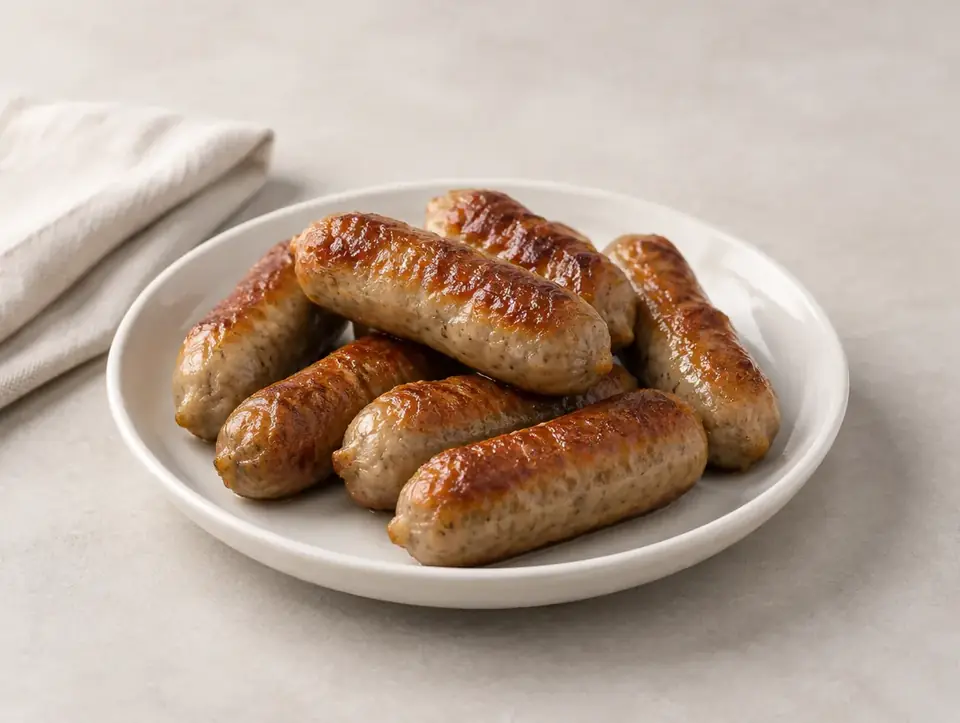
United States · Fresh Cased Sausage · 39.87° N, 98.73° W
Breakfast Sausage Links
Small cased links, steamed briefly, then rolled brown in their own fat.
At a glance.
Breakfast Sausage Links comes from United States · Fresh Cased Sausage and appears in The Breakfast Atlas, in the chapter Bacon, Sausage & Hash. It serves 4, takes about 30 minutes, and uses 4 ingredients and 8 steps.
- Yield
- Serves 4
- Method
- Stovetop
- Time
- 30 minutes
Ingredients
Tap an ingredient to tick it off.
Method
-
Lift the links from the fridge 15 minutes before cooking. Fridge-cold sausage browns on the outside long before the center is safe, which is the root of most split links.
-
Set a heavy skillet or sauté pan wide enough to hold the links in a single layer without touching over medium heat. Add the sausages and the cold water together, before the pan is hot.
-
Cover, bring to a simmer and steam for 5 minutes; the water should come about 5 mm up the sides of the links. The casings turn from pink-translucent to opaque and the links firm noticeably when nudged.
-
Uncover, raise the heat slightly and let the last of the water hiss away — about a minute. What is left in the pan is rendered pork fat.
-
Add the oil and begin rolling the links a quarter turn every 45 seconds or so, using tongs. They should sizzle steadily, not spit violently.
-
Brown for 5–6 minutes in all, turning steadily, until every face is the color of dark toffee and the casings have tightened into a faint, even sheen.
-
Check the temperature: an instant-read thermometer pushed lengthways into the thickest link should read 71°C (160°F) for ground pork. Do not rely on color alone.
-
Rest for 2 minutes on a warm plate before serving, so the juices settle back through the filling instead of running out at the first cut.
Cook’s notes
- The technique
- Never prick them. Pricking is offered as a cure for splitting, but a split is caused by fat and water inside boiling and building pressure faster than the casing can stretch — the fault of high heat, not of an intact skin. The splash of water solves it properly, bringing the interior gently up to temperature so the filling sets before the surface is hot enough to boil it.
- Make ahead
- Raw links keep two days in the fridge and three months frozen, laid flat and separated. Cook from thawed, never frozen. Cooked links refrigerate for three days and reheat in a covered pan with a tablespoon of water over low heat for four minutes.
- Troubleshooting
- Burst casings — the pan was too hot before the middle was warm; steam first. Gray, flabby skins — the lid stayed on through the browning stage, so the sausages stewed. Brown outside, pink inside — thick hog-casing links treated like slim ones; give them 4 more minutes at lower heat.
- Variations
- Vermont maple links carry 2 tsp of maple syrup per 450 g in the mix. Chipolatas are the British equivalent in sheep casing, seasoned with white pepper and often wrapped in bacon. Chicken breakfast links exist but need a fat addition to stay tender. Skinless breakfast sausage, rolled in flour and fried, is the diner shortcut.
- Serve with
- Traditionally alongside pancakes with the syrup allowed to run into the sausage fat, or with fried eggs and hash browns. Orange juice, or coffee cut with cream. Warmed maple syrup in a jug on the table.

Where it comes from
The casing is the technology. Cleaned animal intestine is permeable, elastic and edible, and it lets a sausage hold shape while steam and smoke pass through it — a solution old enough that the Latin salsus, salted, sits behind the word itself. Breakfast links are stuffed into sheep casings of 18–22 mm, roughly half the diameter of the hog casings used for dinner sausage, and that slimness is the whole point: a link cooks through in ten minutes on a busy stove. German and English butchers working in Pennsylvania, Ohio and the upper Midwest in the nineteenth century made the small fresh link a morning food in America, distinct from the smoked and cured sausages they sold for supper. New England added maple. Industrial freezing after the Second World War, and then the arrival of the sausage in a breakfast sandwich on fast-food menus in the early 1970s, fixed the link's size and shape in the popular imagination. Most supermarket links today wear collagen casings extruded from beef hide — uniform, edible, but less elastic and quicker to split.
Breakfast Sausage Links: quick answers
How long does Breakfast Sausage Links take?
About 30 minutes.
How many does this Breakfast Sausage Links recipe make?
This recipe serves 4.
Where does Breakfast Sausage Links come from?
The casing is the technology. Cleaned animal intestine is permeable, elastic and edible, and it lets a sausage hold shape while steam and smoke pass through it — a solution old enough that the Latin salsus, salted, sits behind the word itself. Breakfast links are stuffed into sheep casings of 18–22 mm, roughly half the diameter of the hog casings used for dinner sausage, and that slimness is the whole point: a link cooks through in ten minutes on a busy stove. German and English butchers working in Pennsylvania, Ohio and the upper Midwest in the nineteenth century made the small fresh link a morning food in America, distinct from the smoked and cured sausages they sold for supper. New England added maple. Industrial freezing after the Second World War, and then the arrival of the sausage in a breakfast sandwich on fast-food menus in the early 1970s, fixed the link's size and shape in the popular imagination. Most supermarket links today wear collagen casings extruded from beef hide — uniform, edible, but less elastic and quicker to split.
More from United States


More in Bacon, Sausage & Hash
https://www.atlasserie.com/recipes/breakfast/breakfast-sausage-links/