Britain & Ireland · The Oat Country · 53.17° N, 8.02° W
Oat Quick Bread
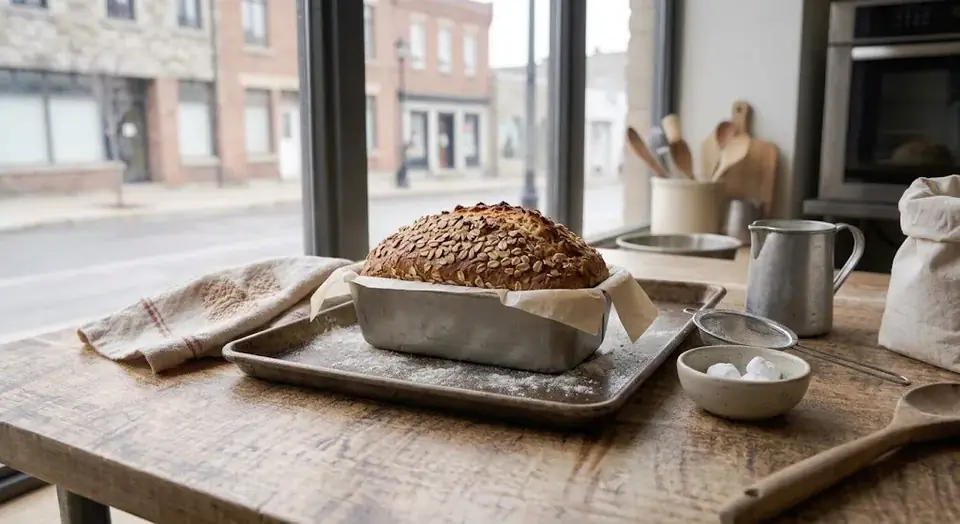
Oats soaked overnight in buttermilk, then baked as a batter loaf.
At a glance.
Oat Quick Bread comes from Britain & Ireland · The Oat Country and appears in The Bread Atlas, in the chapter Quick Breads & Batter Loaves. It makes 1 loaf, takes about 2 hours, and uses 11 ingredients and 11 steps.
- Yield
- Makes 1 loaf
- Method
- Oven 175°C / 350°F
- Time
- 2 hours
Ingredients
Tap an ingredient to tick it off.
- Oat Soaker
- The Batter
- Oat Crown
Method
-
Stir the oats into the buttermilk in a bowl, cover, and leave 30 minutes at room temperature or overnight in the fridge. The oats will swell, soften and thicken the liquid to a loose porridge as their starch and beta-glucan take up water.
-
If you soaked overnight, take the bowl out an hour before baking. Cold soaker chills the melted butter into shards and drags the bake out by ten minutes; room temperature is what the recipe assumes throughout.
-
Set the oven to 175°C / 350°F with the rack low, and butter a 900 g loaf tin before lining the long sides with parchment. Butter the exposed short ends thoroughly; this batter is sticky and clings where the paper does not reach.
-
Whisk the flour, soda, baking powder and salt together and set aside. Keep the soda away from the wet soaker until the last moment — buttermilk is acidic, and the pair will begin working the instant they meet.
-
Warm the honey slightly if it has set, then whisk it into the melted butter, followed by the egg. Honey that goes in cold and stiff stays in ropes through the batter and bakes into dark sticky lines.
-
Fold the honey mixture through the soaked oats until uniform. It will look thin and unpromising and smell strongly of buttermilk. Both are correct.
-
Tip in the dry ingredients and fold with a spatula for about 20 strokes, until no dry flour shows. The batter is thick enough to hold the mark of the spatula and slow enough to pour. Stop there — this is a soft crumb and stirring is the one thing that will ruin it.
-
Scrape into the tin, level the surface, brush with milk and scatter the oats for the crown evenly across the top. Press them very lightly with the flat of your hand so they stay put when the loaf rises and splits.
-
Bake 45–55 minutes. Cover loosely with foil at 35 minutes if the oats on top are already browning — dry oats scorch well before the inside of a wet batter is set.
-
The loaf is baked when it reads 96–98°C in the centre and a skewer comes out with damp crumbs and no batter. A soaked-oat loaf carries more water than a plain flour one, so it will always seem softer at the same temperature.
-
Cool in the tin 15 minutes, then out onto a rack for a full hour before cutting. The oats keep absorbing water as it cools, and a loaf cut warm reads as raw when in fact it is only unsettled.
Cook’s notes
- To serve and keep
- Cut thick, spread with butter and a little heather honey or a sharp marmalade, and eat at breakfast. It is also the loaf to put beside a bowl of soup or a plate of smoked fish. Keep it wrapped in a cloth in a tin, cut face down.

Where it comes from
Oats are the grain of places wheat finds too cold and too wet — the Scottish Highlands, the west of Ireland, the north of England — because they ripen in a short damp summer where wheat rots in the ear. What they cannot do is make a raised loaf: oats hold no gluten-forming proteins, so the historic oat breads of these regions are flat and griddled, the bannock and the oatcake baked on a girdle over the fire, or else they are porridge. This loaf has no long tradition of its own and it is more honest to say so. It belongs to a technique rather than a place: soften the oats in acidified milk until their starch swells, then bind them with enough wheat flour to hold a crumb and lift the whole thing with soda. Irish porridge breads and Scottish oatmeal loaves are its nearest kin, and every one of them works on the same principle.
All 12 recipes from Ireland
All 69 recipes from United Kingdom
Oat Quick Bread: quick answers
How long does Oat Quick Bread take?
About 2 hours.
How many does this Oat Quick Bread recipe make?
This recipe makes 1 loaf.
Where does Oat Quick Bread come from?
Oats are the grain of places wheat finds too cold and too wet — the Scottish Highlands, the west of Ireland, the north of England — because they ripen in a short damp summer where wheat rots in the ear. What they cannot do is make a raised loaf: oats hold no gluten-forming proteins, so the historic oat breads of these regions are flat and griddled, the bannock and the oatcake baked on a girdle over the fire, or else they are porridge. This loaf has no long tradition of its own and it is more honest to say so. It belongs to a technique rather than a place: soften the oats in acidified milk until their starch swells, then bind them with enough wheat flour to hold a crumb and lift the whole thing with soda. Irish porridge breads and Scottish oatmeal loaves are its nearest kin, and every one of them works on the same principle.
More from Ireland

More in Quick Breads & Batter Loaves


https://www.atlasserie.com/recipes/bread/oat-quick-bread/