Portugal · Minho · 39.61° N, 8.06° W
Portuguese Broa
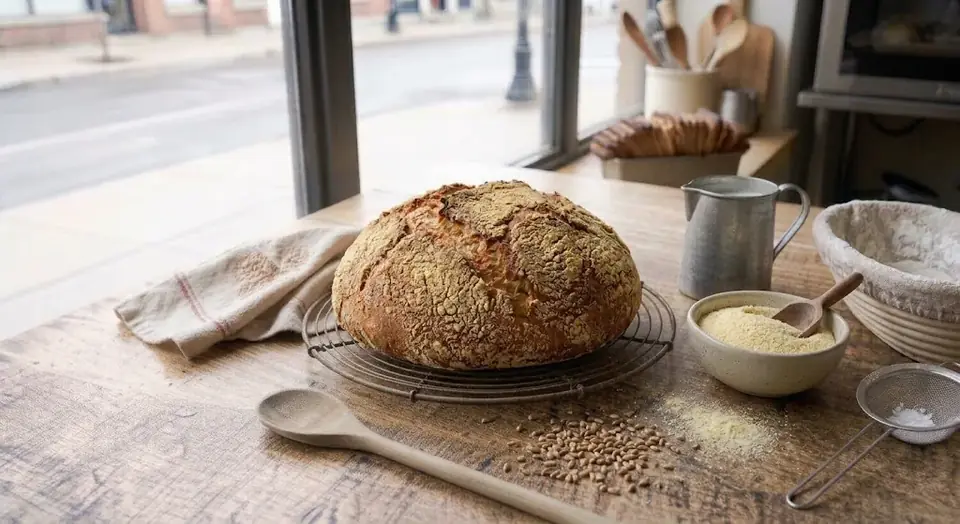
A domed maize and rye loaf, moist inside a thick sanded crust.
At a glance.
Portuguese Broa comes from Portugal · Minho and appears in The Bread Atlas, in the chapter Breads Around the World. It makes 1 loaf, takes about 20 hours, and uses 10 ingredients and 10 steps.
- Yield
- Makes 1 loaf
- Method
- Oven 220°C / 425°F
- Time
- 20 hours
Ingredients
Tap an ingredient to tick it off.
- Rye Levain
- The Scald (Escaldão)
- The Dough
Method
-
Build the levain the evening before: beat the rye flour, water at 28°C and mature starter to a stiff paste, cover, and leave 10–12 hours at 21°C until domed, bubbled through and smelling sharply of yogurt.
-
Next morning, scald the maize. Pour the boiling water over the maize flour all at once and beat hard with a wooden spoon into a thick, smooth, steaming porridge. Cover and leave 45 minutes to cool to 40°C.
-
The scald does something specific. Maize contributes no gluten, so unless its starch is gelatinized it sits in the dough as inert grit that drinks water out of the crumb. Boiling water bursts the granules and they hold that water through the bake and long after.
-
Beat the levain into the cooled scald, then work in the rye flour, white flour, salt and remaining water at 35°C. Mix 5 minutes. This is a heavy, sticky, clay-like paste rather than a kneadable dough, and it will never feel like one. Target 28°C.
-
Cover and bulk ferment 3–4 hours at 26–28°C. Watch for the surface to dome, crack faintly and rise by about a third. Rye and maize both ferment sluggishly, and the crack across the top is the more reliable signal than volume.
-
With wet hands, gather the mass into a high, tight dome on a maize-floured surface, patting rather than shaping. Roll it in coarse maize flour until thickly coated, then settle it seam-side up into a heavily floured basket.
-
Prove 60–90 minutes at 26°C. It is ready when the coating of maize flour has cracked into a visible crazed network across the top — the traditional and still the best indicator that a broa is ready for the oven.
-
Heat the oven to 220°C / 425°F with a stone and a steam tray for 45 minutes. Turn the loaf out onto a maize-floured peel, seam-side down, and leave it unscored. Broa opens along its own fissures, which is where its rustic surface comes from.
-
Load, pour a cup of boiling water into the steam tray, and bake 20 minutes. Vent the oven, drop to 200°C / 400°F, and bake 40–45 minutes more to an internal 98°C — higher than wheat, because gelatinized maize holds a great deal of water.
-
Cool on a rack for a minimum of 8 hours, and preferably overnight, before cutting. The starches are still setting, and slicing a warm broa drags the crumb into paste and wastes the whole day's work.
Cook’s notes
- To serve and keep
- Eaten in thick wedges with caldo verde, with grilled sardines pressed onto the slice so the oil soaks in, and with fresh cheese and olives. Stale broa is the raw material for migas and açorda. Store cut-face down under a cloth for up to five days.

Where it comes from
Broa de milho is not cornbread, and the confusion costs it its reputation abroad. It is a leavened, fermented, oven-baked country loaf that happens to be half maize. The grain arrived from the Americas in the sixteenth century and took hold fastest in the damp, green, smallholding north — the Minho, the Douro valley, Trás-os-Montes — where by the eighteenth century it had largely displaced the millet that Portuguese had until then called milho, and taken its name along with its place. Maize yielded far more per plot than rye on the same land, and the population of the northwest grew with it. Village communal ovens baked broa weekly in high domed rounds, sometimes 2 kg at a time, and it remained the everyday bread of rural northern Portugal into living memory while wheat bread stayed a town luxury. Regional types persist and some are protected: broa de Avintes, from across the river from Porto, is nearly black, faintly sweet and baked for hours in a cooling oven.
Portuguese Broa: quick answers
How long does Portuguese Broa take?
About 20 hours.
How many does this Portuguese Broa recipe make?
This recipe makes 1 loaf.
Where does Portuguese Broa come from?
Broa de milho is not cornbread, and the confusion costs it its reputation abroad. It is a leavened, fermented, oven-baked country loaf that happens to be half maize. The grain arrived from the Americas in the sixteenth century and took hold fastest in the damp, green, smallholding north — the Minho, the Douro valley, Trás-os-Montes — where by the eighteenth century it had largely displaced the millet that Portuguese had until then called milho, and taken its name along with its place. Maize yielded far more per plot than rye on the same land, and the population of the northwest grew with it. Village communal ovens baked broa weekly in high domed rounds, sometimes 2 kg at a time, and it remained the everyday bread of rural northern Portugal into living memory while wheat bread stayed a town luxury. Regional types persist and some are protected: broa de Avintes, from across the river from Porto, is nearly black, faintly sweet and baked for hours in a cooling oven.
More from Portugal




More in Breads Around the World



https://www.atlasserie.com/recipes/bread/portuguese-broa/