Morocco · Maghreb · 29.82° N, 8.69° W
Msemen
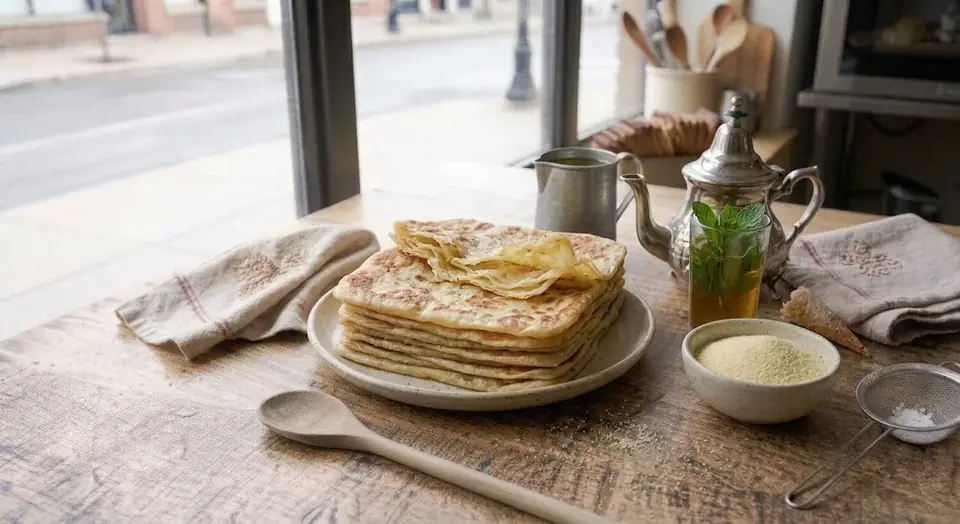
Square laminated griddle bread, torn open beside a glass of mint tea.
At a glance.
Msemen comes from Morocco · Maghreb and appears in The Bread Atlas, in the chapter Breads Around the World. It makes 8 squares, is made on the griddle, and uses 10 ingredients and 10 steps.
- Yield
- Makes 8 squares
- Method
- Griddle, 1¾ hours
Ingredients
Tap an ingredient to tick it off.
- The Dough
- The Lamination Smear
- For the Work Surface
Method
-
Stir the flour, semolina, salt, sugar and yeast together, pour in the water at 30°C, and mix to a soft dough. Knead 10 minutes until smooth, slack and distinctly stretchy — msemen dough must extend without tearing. Target 26°C.
-
Divide into 8 pieces of about 100 g and roll each into a tight ball. Set them apart in an oiled tray, coat their tops with oil, cover, and rest 30–40 minutes. This is relaxation, not proving, and it is what makes the stretching possible.
-
Beat the soft butter and the oil into a loose, pourable cream. If the butter is melted rather than softened it will run off the dough and pool on the griddle, so warm it only to a thick paste.
-
Oil a smooth work surface generously — marble, steel or a clean countertop, never wood, and never flour. Press one ball out with oiled palms, working from the centre, until it is a rough rectangle of about 35 × 30 cm and thin enough to read your hand through.
-
Smear a tablespoon of the butter-and-oil cream across the whole sheet and scatter a pinch of semolina over it. The semolina absorbs fat, keeps adjacent layers from fusing, and gives the finished bread its faint grit.
-
Fold the sheet in three like a letter to give a long band. Smear and scatter that band, then fold it in three the other way to give a square parcel of nine layers. Set it aside, oiled, and repeat with the rest.
-
Rest the squares 20 minutes, then flatten each with oiled palms to about 16 × 16 cm and 5 mm thick. Press outward from the middle so the layers slide; slamming it flat with a rolling pin welds them shut.
-
Heat a heavy flat pan over medium heat — hot enough that a drop of water skitters, not so hot that it vanishes instantly. Msemen wants steady moderate heat over four minutes, not fierce heat over two.
-
Cook 2 minutes a side, turning three or four times and pressing lightly with a folded cloth so the surface takes an even mottled gold. The layers separate visibly at the edges. Add no fat to the pan; the bread carries its own.
-
Stack the cooked squares on a plate under a cloth, where they soften in their own steam. Serve warm; msemen goes leathery once fully cold and is best revived a few seconds a side on a dry pan.
Cook’s notes
- To serve and keep
- Torn by hand with sweet mint tea in the late afternoon, or at breakfast under honey and melted butter, or dipped in amlou, the argan-and-almond paste of the Souss. During Ramadan it appears at every iftar table beside harira. Eat the same day.

Where it comes from
Msemen belongs to a family of Moroccan griddle breads collectively called rghaif, and the relationships are worth getting straight before the folding starts. Rghaif is the umbrella term for oiled, stretched, folded breads cooked on a flat pan; msemen is the version folded into a square, and meloui — mlaoui in Tunisia and parts of Algeria — is the same laminated sheet rolled into a rope and coiled into a spiral, which cooks into a round of concentric layers rather than flat leaves. The technique has no documented inventor and no fixed date, which is normal for a domestic bread. What can be said is that durum semolina and the flat griddle are both very old across Amazigh North Africa, that oil-and-fat lamination appears in a broad band running from Morocco through Egyptian feteer meshaltet to the Levant and on to the Indian paratha, and that no straight line of descent can honestly be drawn between them. In Morocco it is a bread of hospitality: afternoon tea, weekend breakfasts, and every evening of Ramadan beside a bowl of harira.
Msemen: quick answers
How many does this Msemen recipe make?
This recipe makes 8 squares.
Where does Msemen come from?
Msemen belongs to a family of Moroccan griddle breads collectively called rghaif, and the relationships are worth getting straight before the folding starts. Rghaif is the umbrella term for oiled, stretched, folded breads cooked on a flat pan; msemen is the version folded into a square, and meloui — mlaoui in Tunisia and parts of Algeria — is the same laminated sheet rolled into a rope and coiled into a spiral, which cooks into a round of concentric layers rather than flat leaves. The technique has no documented inventor and no fixed date, which is normal for a domestic bread. What can be said is that durum semolina and the flat griddle are both very old across Amazigh North Africa, that oil-and-fat lamination appears in a broad band running from Morocco through Egyptian feteer meshaltet to the Levant and on to the Indian paratha, and that no straight line of descent can honestly be drawn between them. In Morocco it is a bread of hospitality: afternoon tea, weekend breakfasts, and every evening of Ramadan beside a bowl of harira.
More from Morocco


More in Breads Around the World


https://www.atlasserie.com/recipes/bread/msemen/