Sweden · Dalarna · 62.42° N, 16.11° E
Knäckebröd
Rye crispbread with a hole in the middle, dry enough to keep a year.
At a glance.
Knäckebröd comes from Sweden · Dalarna and appears in The Bread Atlas, in the chapter Breads Around the World. It makes 6 rounds, takes about 16 hours, and uses 10 ingredients and 10 steps.
- Yield
- Makes 6 rounds
- Method
- Oven 250°C / 480°F
- Time
- 16 hours
Ingredients
Tap an ingredient to tick it off.
- Rye Levain (Surdeg)
- The Dough
Method
-
Build the levain the night before: mix the rye flour, water at 28°C and mature starter to a thick paste, cover, and leave 10–12 hours at 20–22°C. It is ready when domed, honeycombed and smelling of sour apples rather than acetone.
-
Next morning, combine the levain with the remaining rye flour, the white flour, water at 40°C, salt, seed and optional yeast. Mix 4 minutes only — rye has almost no gluten to build, and long mixing degrades the pentosans holding this dough together. Target 28°C.
-
Cover and ferment 90 minutes at 26–28°C. The dough will not double. Look instead for a surface gone slightly domed and slack, with a few visible bubbles and a clean sour smell.
-
Divide into 6 pieces of about 100 g, round them under a cupped hand on a lightly ryed surface, and rest 15 minutes covered so the paste relaxes and stops fighting the pin.
-
Heat the oven to 250°C / 480°F with a baking stone or heavy steel on the middle shelf. Give it a full 45 minutes: a crispbread bakes in minutes and needs the floor genuinely hot from the first second.
-
Roll each piece on rye flour to a round of 22 cm and 2–3 mm thick, working from the centre outward and turning a quarter each stroke. Thickness matters more than diameter — a millimetre too thick and the middle stays leathery.
-
Run the knobbly kavel over the round, or dock it densely all over with a fork. The dimples pin the sheet down so it bakes flat rather than inflating into a pocket. Cut a 4 cm hole from the centre with a glass.
-
Slide the rounds onto the hot stone, two at a time, and bake 5–7 minutes until blistered and mottled brown at the edges. Do not chase deep color — burnt rye is bitter, and the crispness comes later.
-
Drop the oven to 100°C / 210°F, prop the door ajar with a wooden spoon, and return all the rounds to dry for 45–60 minutes. This second stage is the one that matters. You are no longer baking, you are dehydrating.
-
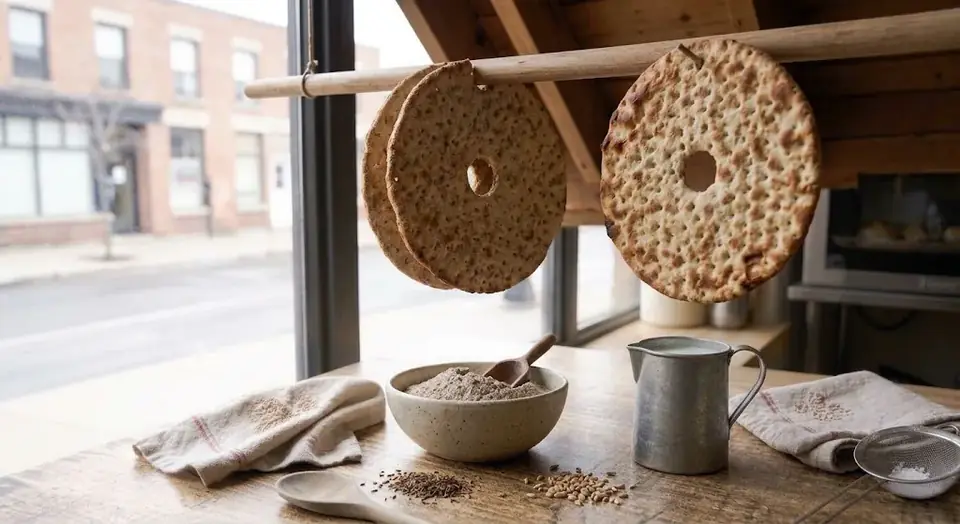
Snap a cooled round in half to test: it should break with a clean report and show no bend at the centre. Cool the rest completely in a dry room, then store on a pole, in a tin or in a paper-lined box, where properly dried knäckebröd is stable for a year.
Cook’s notes
- To serve and keep
- Broken by hand, buttered thickly, and topped with hard cheese and cucumber, or with mashed egg and kaviar from a tube. Served with pea soup on Thursdays and beside pickled herring at the julbord. Store in a paper-lined tin, well away from the kettle.

Where it comes from
The hole in the middle of a Swedish crispbread is a piece of storage engineering. Until well into the twentieth century, farmhouses in Dalarna and further north baked crispbread in two great sessions a year and hung the finished rounds on a long pole slung from the kitchen rafters — the brödstång — where they stayed dry, out of reach of mice, and were pulled down one at a time through the winter. Rye is the reason the bread exists: it ripens in short cool summers and thin soils where wheat sulks, and it was the northern grain by default. Baking to complete dryness solved the other northern problem, that a household could not fire a large masonry oven weekly. Water is what spoils bread, so remove effectively all of it and nothing can grow. Industry caught up in the early twentieth century — Wasa was founded in 1919 and made crispbread a supermarket staple — but the farmhouse method, the knobbly roller and the hole are unchanged.
Knäckebröd: quick answers
How long does Knäckebröd take?
About 16 hours.
How many does this Knäckebröd recipe make?
This recipe makes 6 rounds.
Where does Knäckebröd come from?
The hole in the middle of a Swedish crispbread is a piece of storage engineering. Until well into the twentieth century, farmhouses in Dalarna and further north baked crispbread in two great sessions a year and hung the finished rounds on a long pole slung from the kitchen rafters — the brödstång — where they stayed dry, out of reach of mice, and were pulled down one at a time through the winter. Rye is the reason the bread exists: it ripens in short cool summers and thin soils where wheat sulks, and it was the northern grain by default. Baking to complete dryness solved the other northern problem, that a household could not fire a large masonry oven weekly. Water is what spoils bread, so remove effectively all of it and nothing can grow. Industry caught up in the early twentieth century — Wasa was founded in 1919 and made crispbread a supermarket staple — but the farmhouse method, the knobbly roller and the hole are unchanged.
More from Sweden


More in Breads Around the World






https://www.atlasserie.com/recipes/bread/knackebrod/