Portugal · The Minho · 39.61° N, 8.06° W
Caldo Verde
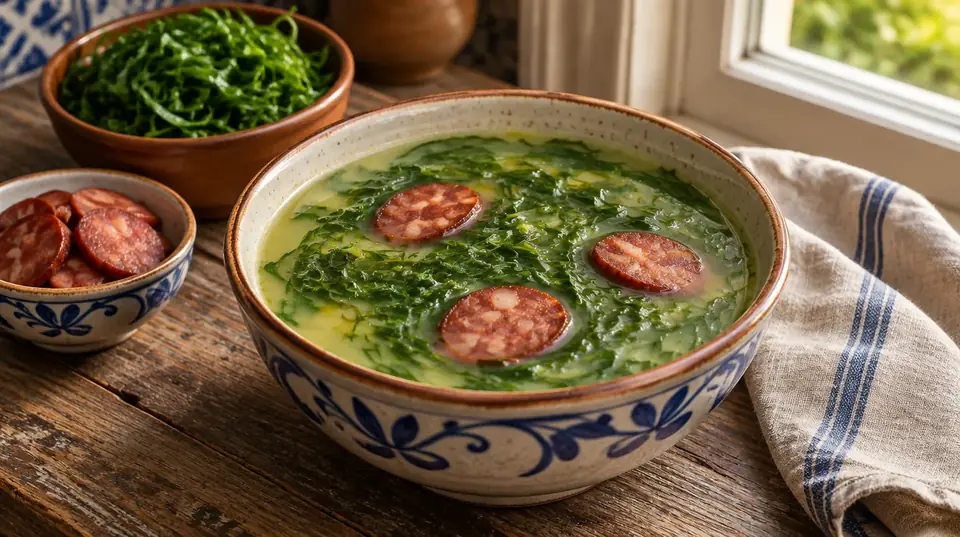
A thin potato broth, hair-fine greens and slices of smoked chouriço.
At a glance.
Caldo Verde comes from Portugal · The Minho and appears in The Soup Atlas, in the chapter Soups Around the World. It serves 6, takes about 45 minutes, and uses 13 ingredients and 10 steps.
- Yield
- Serves 6
- Method
- Stovetop
- Time
- 45 minutes
Ingredients
Tap an ingredient to tick it off.
- For the base
- For the greens
- For the sausage
- To finish
Method
-
Deal with the greens before anything else, because the cutting takes longer than you expect. Strip the tough central rib from each leaf and discard it. Stack six or eight leaves at a time, roll them into a tight cigar, and hold the roll firmly closed with your knuckles.
-
Shave across the roll with a sharp knife, taking off ribbons no more than 1–2 mm wide. Aim for something closer to thread than to ribbon. Shake the shreds loose onto a tray and keep going until all the leaves are done.
-
Put the potatoes, onion and garlic in a pot with the water, the 80 ml of olive oil and the salt. Bring to a boil, then simmer for 20–25 minutes, until the potatoes are falling apart at the edges and a knife meets no resistance at all.
-
Blend the base until entirely smooth. It should pour like thin cream and coat a spoon only faintly — this is a broth carrying potato, not a potato purée thinned with water. If it has gone thick, let it down with hot water until it moves freely.
-
Blend it briefly rather than at length. Potato starch granules rupture under prolonged high-speed blending and release amylopectin, which turns the soup gluey and slightly elastic. Thirty seconds is enough; a food mill or a coarse sieve is safer still.
-
Fry the sausage slices in a dry pan over medium heat, or with a spoonful of oil if it is a lean one. Cook 4–5 minutes, turning once, until the edges have curled and crisped and the pan holds a pool of orange, paprika-stained fat.
-
Pour that fat straight into the soup base and stir it in. The chouriço slices are a garnish; the rendered fat is the only meat seasoning the soup itself gets, and pouring it away leaves the pot tasting of nothing but potato and oil.
-
Bring the base back to a full rolling boil — this is the one moment the pot should be at a hard boil rather than a simmer. The greens need to go into liquid hot enough to cook them in seconds, before the chlorophyll has time to dull.
-
Scatter in the shredded greens, stir once, and cook uncovered for 2–3 minutes only. They are done when they have gone brilliant green and lost their raw stiffness but still show as distinct threads. At five minutes they will be olive-drab and limp.
-
Season with coarse salt and plenty of pepper. Ladle into shallow bowls, lay two or three chouriço slices on the surface, and finish with a hard, unmeasured drizzle of raw olive oil across the top. Serve within minutes; the greens do not wait.
Cook’s notes
- The technique
- The width of the shred decides the soup. Cut to a millimetre or two, the greens cook through in the two minutes before their chlorophyll degrades, and they stay vivid, tender and suspended through the broth. Cut into ordinary 5 mm ribbons, they need five or six minutes to soften, by which point the pigment has broken down to olive-brown and the texture has gone slippery. There is no way around this with heat or timing. Portuguese greengrocers sell couve ready-shredded for exactly this reason.
- Make ahead
- The potato base holds three days refrigerated and freezes for two months, so it is worth making in quantity. The greens go in only when you are ready to eat, into freshly boiling base, and are never reheated. Slice and fry the chouriço fresh; reheated slices go leathery and the rendered fat should be poured in hot.
- Troubleshooting
- Greens drab and slimy — cut too thick or cooked too long. Base gluey and elastic — the potatoes were over-blended; there is no rescue, so use a mill next time. Bland despite salt — the chouriço fat was poured away instead of stirred in. Too thick to pour — it was never a purée; add hot water freely.
- Variations
- New England Portuguese communities use linguiça, which is smokier and coarser than chouriço. Some Minho households add a spoonful of cornmeal for body. A meatless version, made through Lent, drops the sausage and doubles the finishing oil with a little smoked paprika. Northern cooks occasionally serve it with a poached egg dropped into each bowl.
- To serve and keep
- Serve in shallow bowls with broa, the dense Portuguese corn bread, for tearing and dipping. It arrives before or alongside grilled sardines at a festa rather than as a course of its own. Drink young vinho verde, cold and faintly fizzy, which is the wine of the same region. Made in full within this recipe — Potato and Onion Base, Chouriço and Its Rendered Fat, Shredded Couve. Also listed in the Component Index at the back.

Where it comes from
Caldo verde belongs to the Minho, the green, rainy province in Portugal's far north, where couve galega — a tall, loose-leafed Galician kale that grows on a woody stem and is picked leaf by leaf through the year — has long been a kitchen-garden staple. The soup was built around what a smallholding produced: potatoes, an onion, that kale, olive oil, and whatever cured sausage was hanging. It travelled south and became national. In 2011 a public vote installed it among the Sete Maravilhas da Gastronomia Portuguesa, the country's seven gastronomic wonders, though its real status was never in doubt. Its natural setting is the festa. It is what is ladled out at the Festas de São João in Porto on the night of 23 June, alongside grilled sardines and a great deal of wine, and it appears at weddings, village saints' days and funerals with equal fitness. Portuguese emigration carried it to Brazil, Goa, Macau and the diaspora communities of New England, where it is still made with linguiça.
Caldo Verde: quick answers
How long does Caldo Verde take?
About 45 minutes.
How many does this Caldo Verde recipe make?
This recipe serves 6.
Where does Caldo Verde come from?
Caldo verde belongs to the Minho, the green, rainy province in Portugal's far north, where couve galega — a tall, loose-leafed Galician kale that grows on a woody stem and is picked leaf by leaf through the year — has long been a kitchen-garden staple. The soup was built around what a smallholding produced: potatoes, an onion, that kale, olive oil, and whatever cured sausage was hanging. It travelled south and became national. In 2011 a public vote installed it among the Sete Maravilhas da Gastronomia Portuguesa, the country's seven gastronomic wonders, though its real status was never in doubt. Its natural setting is the festa. It is what is ladled out at the Festas de São João in Porto on the night of 23 June, alongside grilled sardines and a great deal of wine, and it appears at weddings, village saints' days and funerals with equal fitness. Portuguese emigration carried it to Brazil, Goa, Macau and the diaspora communities of New England, where it is still made with linguiça.
More from Portugal




More in Soups Around the World




https://www.atlasserie.com/recipes/soup/caldo-verde/