Brazil · Minas Gerais · 10.66° S, 53.17° W
Pão de Queijo
Hollow chewy cheese puffs of cassava starch from the mining hills.
At a glance.
Pão de Queijo comes from Brazil · Minas Gerais and appears in The Bread Atlas, in the chapter Breads Around the World. It makes 24 puffs, is made by oven 200°c / 400°f, and uses 8 ingredients and 10 steps.
- Yield
- Makes 24 puffs
- Method
- Oven 200°C / 400°F, 1¼ hours
Ingredients
Tap an ingredient to tick it off.
- The Scald (Escaldo)
- The Dough
Method
-
Stir both starches together in a stand mixer bowl fitted with the paddle. The azedo is fermented and carries the tang and most of the lift; the doce holds the shell together. Neither can be swapped for wheat or corn starch.
-
Bring the milk, oil and salt to a full rolling boil in a small pan. Watch it — the moment it climbs the sides it is ready, and it must reach the mixer still boiling.
-
Pour the boiling liquid over the starch all at once and paddle on low. It will look wrong: seized, lumpy, like wet gravel. This is the escaldo, and it is the entire structural principle of the bread.
-
Beat 4–5 minutes until the mass cools to about 45°C and gathers into a stiff, faintly shiny paste. It should be warm against your hand but nowhere near hot enough to cook an egg.
-
Add the eggs one at a time on medium speed, letting each vanish before the next goes in. The dough breaks and curdles after the first — keep the paddle running and it comes back glossy.
-
Beat in both cheeses for 2 minutes, until the dough is even, tacky and soft enough to fall slowly from a spoon. Cover and rest 20 minutes while the starch finishes hydrating and firms up.
-
Set the oven to 200°C / 400°F. Oil your palms and roll balls of about 30 g onto lined trays, leaving 4 cm of clear space around each. They spread outward before they climb.
-
Bake 20–25 minutes and do not open the door for the first 15. They pale and dome, hold there several minutes, then take color; pulling them at the pale stage leaves a gluey centre.
-
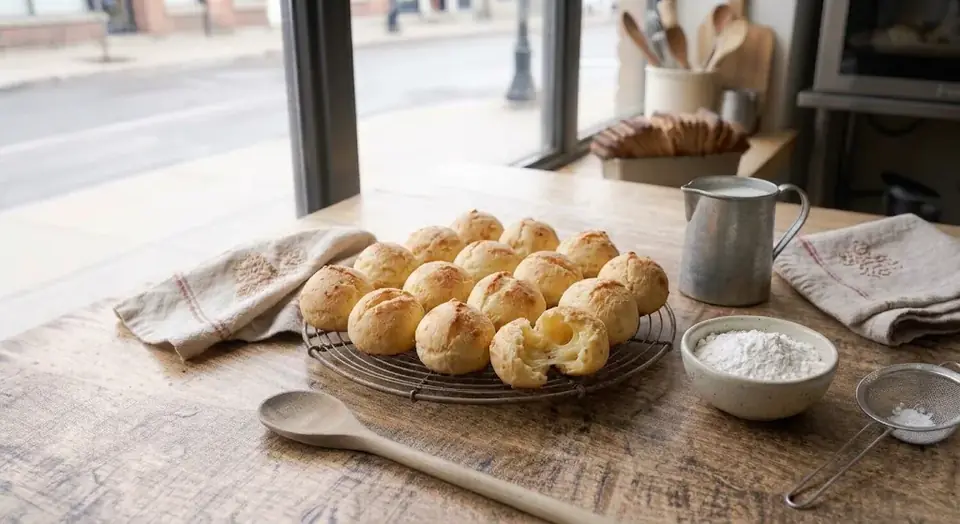
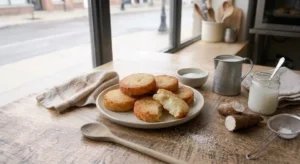
They are ready when deeply golden, split across the crown and light for their size. Tap one and it should sound hollow. With no gluten and no crumb to probe, sound and weight are the tests, not a thermometer.
-
Cool on the tray 5 minutes only. Pão de queijo is best between five and twenty minutes out of the oven, while the shell still crackles and the interior pulls into threads rather than setting solid.
Cook’s notes
- To serve and keep
- Eaten hot, mid-morning and again mid-afternoon, with cafezinho — small, strong and sweet — handed across the padaria counter in a paper napkin. There is no useful way to store the baked bread, so keep raw balls in the freezer and bake six at a time as they are wanted.

Where it comes from
Minas Gerais is cattle country folded into old gold country, and this bread sits at the join. Cassava was the staple carbohydrate of indigenous Brazil long before the Portuguese landed, and the Tupi practice of grating, pressing and settling the root gave the colonial kitchen polvilho — the pure starch washed out of cassava pulp and dried. Around the eighteenth-century mines, and later the dairy fazendas that replaced them, wheat was expensive and erratic in supply. Polvilho was neither. The account usually given is that enslaved and freed African cooks made the first plain polvilho balls, and that cheese and eggs joined them later as the region's herds grew. It is plausible and endlessly repeated, though the documentary trail before the late nineteenth century is thin. The twentieth century is not in doubt: the bread went commercial in the 1950s, spread out of Belo Horizonte through padarias and roadside lanchonetes, and now sells frozen in every supermarket in Brazil.
Pão de Queijo: quick answers
How many does this Pão de Queijo recipe make?
This recipe makes 24 puffs.
Where does Pão de Queijo come from?
Minas Gerais is cattle country folded into old gold country, and this bread sits at the join. Cassava was the staple carbohydrate of indigenous Brazil long before the Portuguese landed, and the Tupi practice of grating, pressing and settling the root gave the colonial kitchen polvilho — the pure starch washed out of cassava pulp and dried. Around the eighteenth-century mines, and later the dairy fazendas that replaced them, wheat was expensive and erratic in supply. Polvilho was neither. The account usually given is that enslaved and freed African cooks made the first plain polvilho balls, and that cheese and eggs joined them later as the region's herds grew. It is plausible and endlessly repeated, though the documentary trail before the late nineteenth century is thin. The twentieth century is not in doubt: the bread went commercial in the 1950s, spread out of Belo Horizonte through padarias and roadside lanchonetes, and now sells frozen in every supermarket in Brazil.
More from Brazil
More in Breads Around the World
https://www.atlasserie.com/recipes/bread/pao-de-queijo/