Iran · The Pebble Oven · 32.47° N, 54.45° E
Persian Sangak
Whole wheat flatbread baked on hot stones, dimpled and sesame-strewn.
At a glance.
Persian Sangak comes from Iran · The Pebble Oven and appears in The Bread Atlas, in the chapter Breads Around the World. It makes 2 breads, takes about 14 hours, and uses 11 ingredients and 11 steps.
- Yield
- Makes 2 breads
- Method
- Oven 260°C / 500°F
- Time
- 14 hours
Ingredients
Tap an ingredient to tick it off.
- Whole Wheat Levain
- The Dough
- The Topping
- The Pebble Bed
Method
-
Build the levain the night before: mix the wholemeal flour, water at 28°C and starter, cover, and leave 10–12 hours at 22°C until domed and bubbling. Wholemeal ferments faster than white, so check at ten hours rather than assuming twelve.
-
Prepare the pebbles before anything else. Wash them in hot water, scrub off grit, and dry them completely. Use only smooth natural river stone — never limestone, painted decorative gravel, or stones picked up from wet ground, all of which can trap water and crack apart in a hot oven.
-
Spread the dry pebbles in a single close layer across a heavy steel tray or baking stone on the middle shelf and heat the oven to its maximum, 260°C / 500°F, for a full hour. The stones must be saturated with heat, not merely hot on top.
-
Mix the levain with the wholemeal flour, water at 30°C and yeast, and rest 40 minutes. Wholemeal drinks slowly, and 88% hydration looks alarming at first and reasonable afterwards. Add the salt and mix 4 minutes. This is a batter-like dough, too slack to knead. Target 27°C.
-
Bulk ferment 3 hours at 26°C, giving four sets of wet-handed coil folds at 30-minute intervals for the first two hours. The dough goes from soupy to glossy and cohesive, holding its shape briefly when lifted before flowing again.
-
Divide into 2 pieces of about 425 g on a well-floured surface and let them relax, covered, 30 minutes. Do not attempt to round them; a dough at this hydration cannot be tightened and does not need to be.
-
Cover a wooden peel, or the back of a flat tray, with a well-floured cloth. Turn one piece onto it and coax it with wet fingers into a long oval or triangle, roughly 40 × 20 cm and no more than 8 mm thick.
-
Dimple the whole surface with wet fingertips, pressing right down to the cloth, then scatter the sesame and nigella and press those in too. The dimples anchor the sheet so it bakes flat rather than ballooning into one enormous pocket.
-
Slide the sheet directly onto the pebbles in one confident motion, jerking the cloth back from under it. Hesitation folds the dough. If this makes you nervous, use parchment on the pebbles for the first attempt — you lose some of the crater pattern and nothing else.
-
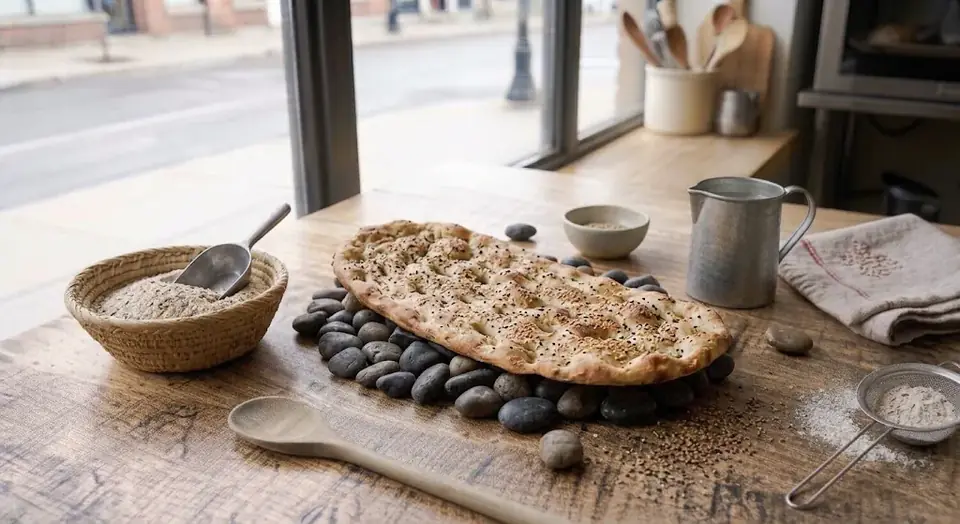
Bake 6–8 minutes. The bread inflates between the stones, blisters and browns across the raised parts, and takes the pebbles' impression as deep craters. It is done when the edges are dry and crisp and the high points properly browned rather than merely set.
-
Lift it out with tongs, shake it hard over the sink and run a hand across the underside — a pebble or two always comes with it, and every Iranian household checks. Serve within the hour, folded over onto itself, while the craters still hold their crunch.
Cook’s notes
- To serve and keep
- Eaten at breakfast with panir, walnuts and a bunch of fresh herbs, or wrapped around kabab koobideh straight off the skewer with grilled tomato and sumac. Torn into abgoosht as the thickener. Fold it in half under a cloth; it hardens quickly once fully cool.

Where it comes from
Sangak takes its name from sang, stone, and the name is a literal description of the oven. A traditional sangak bakery is built around a tanour with a sloping floor covered in small river pebbles heated until they glow; the baker slides a great sheet of very wet dough off a long padded paddle onto the stones, where it takes their imprint as it bakes, and lifts it off two minutes later pocked with craters. Loaves are hung over racks by the door to cool and handed across still warm. Whole wheat is standard, which is unusual — most flatbread cultures reserve wholemeal for the poorest bread, and in Iran sangak is the one people queue for. The story that it began as the bread of the Persian army, each soldier carrying a few pebbles so the corps could build an oven anywhere, is repeated everywhere and sometimes attributed to the Safavid scholar Sheikh Bahai. Treat it as folklore; it is not supported by contemporary evidence, though the technique itself is certainly old.
Persian Sangak: quick answers
How long does Persian Sangak take?
About 14 hours.
How many does this Persian Sangak recipe make?
This recipe makes 2 breads.
Where does Persian Sangak come from?
Sangak takes its name from sang, stone, and the name is a literal description of the oven. A traditional sangak bakery is built around a tanour with a sloping floor covered in small river pebbles heated until they glow; the baker slides a great sheet of very wet dough off a long padded paddle onto the stones, where it takes their imprint as it bakes, and lifts it off two minutes later pocked with craters. Loaves are hung over racks by the door to cool and handed across still warm. Whole wheat is standard, which is unusual — most flatbread cultures reserve wholemeal for the poorest bread, and in Iran sangak is the one people queue for. The story that it began as the bread of the Persian army, each soldier carrying a few pebbles so the corps could build an oven anywhere, is repeated everywhere and sometimes attributed to the Safavid scholar Sheikh Bahai. Treat it as folklore; it is not supported by contemporary evidence, though the technique itself is certainly old.
More from Iran



More in Breads Around the World



https://www.atlasserie.com/recipes/bread/persian-sangak/