Denmark · The Smørrebrød Table · 56.21° N, 9.30° E
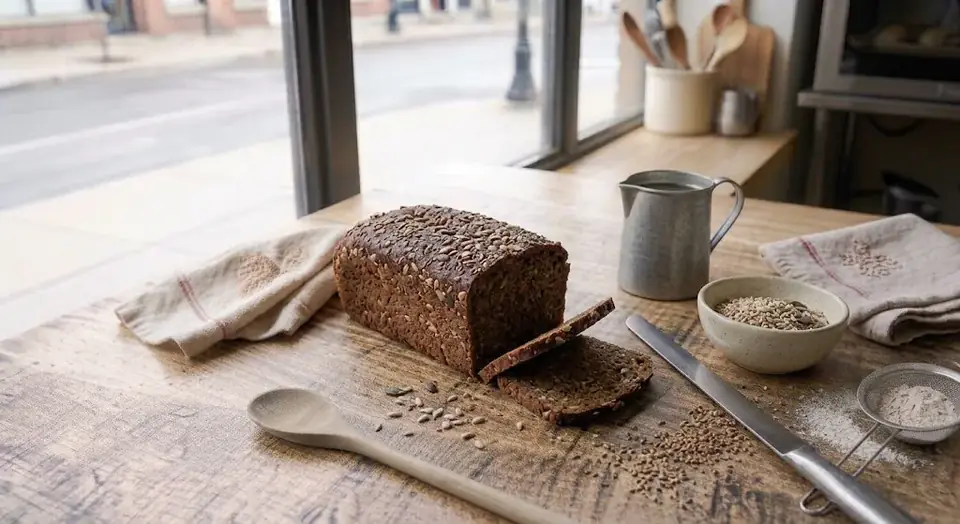
Danish Rugbrød
A black tin loaf of pure rye and whole grain, sliced thin as card.
At a glance.
Danish Rugbrød comes from Denmark · The Smørrebrød Table and appears in The Bread Atlas, in the chapter Breads Around the World. It makes 1 tin loaf, is made by oven 200°c / 400°f, and uses 13 ingredients and 11 steps.
- Yield
- Makes 1 tin loaf
- Method
- Oven 200°C / 400°F
Ingredients
Tap an ingredient to tick it off.
- Rye Sour (Surdej)
- Grain and Seed Soaker
- The Dough
Method
-
Day one, evening. Mix the rye sour — flour, water at 28°C, mature starter — cover, and leave 14–16 hours at 20–22°C. At the same time pour the water or beer over the cracked rye and all three seeds, stir, cover, and leave alongside it.
-
The soaker is not a garnish. Cracked rye and linseed will otherwise steal water out of the crumb during the bake and leave the loaf dry and crumbly, and unsoaked linseed in particular takes up several times its own weight given the chance.
-
Day two, morning. The sour should be domed, bubbled and smelling sharply of yogurt and green apple. Combine it with the soaker, the remaining rye flour, the water at 40°C, the salt and the malt syrup, and beat with a dough hook for 5 minutes.
-
What you have is not a dough by any wheat standard but a heavy grey paste, roughly the consistency of thick concrete, that will not hold a shape and cannot be kneaded. This is correct: rye has almost no functional gluten and relies on pentosans and starch. Target 28°C.
-
Butter a 1.5 litre Pullman or loaf tin thoroughly and dust it with cracked rye. Scrape the paste in with a wet spatula, pressing into the corners, and smooth the top with a wet hand. Fill to no more than three-quarters.
-
Cover and prove 3–4 hours at 26°C. The signal is precise: fine cracks open across the smoothed surface and the paste climbs to within 2 cm of the rim. Rye gives no springy dent to read, so use the cracks. Overproved rugbrød collapses into a wet seam.
-
Heat the oven to 200°C / 400°F. Prick the surface all over with a skewer to release trapped gas, and if you are using a Pullman tin, slide the lid on for a flat top and a fine even crumb.
-
Bake 15 minutes at 200°C / 400°F, then drop to 160°C / 320°F and bake 70–80 minutes more. The long low phase is what fully gelatinizes the starch through a dense loaf; a short hot bake leaves the centre raw and the crust burnt.
-
Bake to an internal 98°C taken at the centre — not 96°C, and not by guesswork. A dense rye holds so much water that anything less leaves a gummy core. Turn out at once, and if the crust is soft, return the bare loaf for 10 minutes.
-
Cool completely, which takes three hours, then wrap the cold loaf in a tea towel and leave it 24 hours before cutting. This is not a refinement, it is the recipe: rye starch keeps setting for a full day, and a loaf cut at twelve hours smears while the same loaf at twenty-four slices clean.
-
Slice with a long sharp knife, 4–5 mm thick. Properly made, the slices are dark, close and damp, and structurally sound enough to carry a pile of herring without folding.
Cook’s notes
- To serve and keep
- Cut thin and built into smørrebrød: butter first, always, then pickled herring with onion and capers, leverpostej with bacon and mushroom, cold roast pork with red cabbage, or shrimp with dill. Eaten with a knife and fork, never picked up. Store wrapped in cloth, cut face down.

Where it comes from
Rye suits Denmark the way maize suits the Minho: it ripens in a short cool summer, tolerates sandy and acid soil, and made the difference between a Danish household eating and not eating through the medieval and early modern centuries. Rugbrød has been the base of the Danish diet for that long, and it remains so in a way that is unusual in western Europe — not a heritage bread people bake at weekends, but the ordinary contents of the ordinary bread bin. The nineteenth century gave it its present social form. Smørrebrød, the open sandwich, developed out of the farmhand's packed lunch into a codified restaurant genre with its own rules of order and combination, and Copenhagen restaurants published smørrebrød menus of extraordinary length, Oskar Davidsen's famously running to several feet of paper. Every item on those lists sits on a slice of rugbrød. The Danish Whole Grain Partnership, founded in 2008 by health authorities and the food industry together, has since pushed consumption up further.
Danish Rugbrød: quick answers
How many does this Danish Rugbrød recipe make?
This recipe makes 1 tin loaf.
Where does Danish Rugbrød come from?
Rye suits Denmark the way maize suits the Minho: it ripens in a short cool summer, tolerates sandy and acid soil, and made the difference between a Danish household eating and not eating through the medieval and early modern centuries. Rugbrød has been the base of the Danish diet for that long, and it remains so in a way that is unusual in western Europe — not a heritage bread people bake at weekends, but the ordinary contents of the ordinary bread bin. The nineteenth century gave it its present social form. Smørrebrød, the open sandwich, developed out of the farmhand's packed lunch into a codified restaurant genre with its own rules of order and combination, and Copenhagen restaurants published smørrebrød menus of extraordinary length, Oskar Davidsen's famously running to several feet of paper. Every item on those lists sits on a slice of rugbrød. The Danish Whole Grain Partnership, founded in 2008 by health authorities and the food industry together, has since pushed consumption up further.
More from Denmark





More in Breads Around the World



https://www.atlasserie.com/recipes/bread/danish-rugbrd/