Persia to Florence · À la Florentine · 32.47° N, 54.45° E
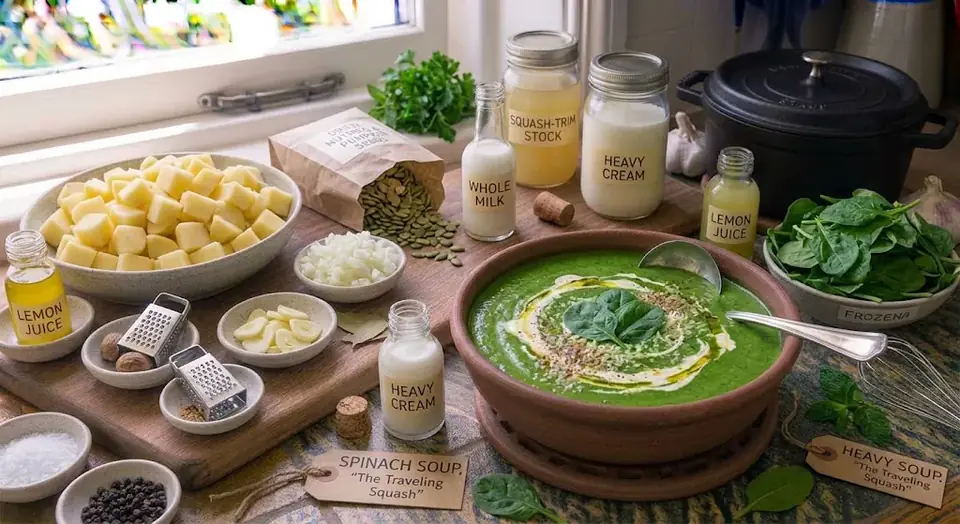
Spinach Soup
A potato base finished with spinach wilted for sixty seconds and blended at once.
At a glance.
Spinach Soup comes from Persia to Florence · À la Florentine and appears in The Soup Atlas, in the chapter Creamy & Pureed Soups. It serves 4, takes about 40 minutes, and uses 14 ingredients and 11 steps.
- Yield
- Serves 4
- Method
- Stovetop
- Time
- 40 minutes
Ingredients
Tap an ingredient to tick it off.
- For the base
- For the spinach
- To finish
Method
-
Wash the spinach in a sink of cold water, lifting it out rather than pouring it out so the grit stays behind, and spin it dry. Pull off any stalk thicker than a matchstick; they are stringy and they will not blend away.
-
Melt the butter in a large pot over low heat, add the onion and garlic with a pinch of salt and sweat for 10 minutes until soft and translucent. Keep them pale — this soup shows every trace of browning as a muddy note in the green.
-
Add the potato and the stock, bring to a simmer and cook uncovered for 15–18 minutes, until the potato falls apart under a spoon. Leave the lid off from here on, so the volatile acids the vegetables release can escape rather than dropping back into the pot.
-
Season the base now, with the 1½ teaspoons of salt. Getting the salt in before the spinach means less stirring and less standing time at the end, and every second at the end costs color.
-
Have the blender on the counter with its lid off, and a large clean pan waiting beside it. From here the recipe runs on a clock and there is no time to go looking for equipment.
-
Bring the base up to a hard boil. Add all the spinach at once and push it under the surface with a spoon. It will look like far too much and will collapse to a quarter of its volume within seconds.
-
Cook it for 60 seconds from the moment the last leaf goes under. Add the parsley for the final 10 seconds. Then take the pot off the heat immediately — not when you have finished the next task, immediately.
-
Blend at once, in batches, filling the jug no more than a third with hot liquid, venting the lid and holding a folded towel over the top. Run each batch 60–90 seconds at full speed until it is uniformly brilliant.
-
Pour each batch into the waiting pan. If you are not serving within ten minutes, sit that pan in a sink of cold water and stir until the steam stops — then reheat gently at the table's convenience rather than holding it hot.
-
Stir in the cream, nutmeg, white pepper and lemon juice off the heat. The lemon goes in last on purpose: acid added earlier, over heat, is exactly what turns a green soup the color of an old army coat.
-
Serve within minutes, in warm bowls, with Parmesan grated over and a thread of olive oil. If you must reheat, do it to steaming only and accept that the second bowl will be a shade duller than the first.
Cook’s notes
- The technique
- The color is a molecule, and it is fragile in one specific way. Chlorophyll holds a magnesium ion at the center of its ring; heat and acid knock that ion out and replace it with hydrogen, and the resulting pheophytin is olive-gray. Nothing reverses it. The reaction is slow at first and then accelerates, which is why sixty seconds of wilting is bright and eight minutes of simmering is drab, and why the vegetable's own acids — released as cells rupture and concentrated under a closed lid — do as much damage as the heat. Cook the base long, cook the leaf briefly, keep the lid off and add the lemon at the very end.
- Make ahead
- Make the potato base up to three days ahead; it holds without loss and freezes well. The spinach stage takes four minutes and should be done at the last moment. A finished pot can be refrigerated for two days and will still taste fine, but it will have gone from emerald to sage and no reheating recovers it. Freezing the green soup is not worth doing.
- Troubleshooting
- Olive-gray — the spinach cooked too long, or the lemon went in over heat. Stringy — the thick stalks stayed on. Thin — not enough potato, so mill in a boiled one. Metallic and drying on the tongue — that is spinach's own oxalic acid, and a little more cream and salt will mask it; young leaves carry less of it than mature bunches.
- Variations
- A Turkish version blends in yogurt off the heat with dried mint and a spoonful of chile butter. Add a bunch of watercress or sorrel with the spinach for a sharper, more peppery bowl. Green minestra Genovese runs chard through the same method with a spoon of pesto stirred in. For a dairy-free pot, use olive oil throughout and blend in a handful of cashews with the base.
- To serve and keep
- Serve it in white or pale bowls, which do the most for the color, and eat it straight away. A poached egg lowered into the middle turns it into supper. Croutons fried in butter alongside. Drink a Vermentino or a young Sauvignon Blanc, both of which handle the mineral edge spinach leaves behind. Made in full within this recipe — Potato Base, Parmesan and Olive Oil Finish. Also listed in the Component Index at the back.

Where it comes from
Spinach travelled west out of Persia, where it was called aspanakh, and its route is unusually well documented. Chinese records credit a gift of spinach seed sent from Nepal to the Tang court in the seventh century. Arab agriculture carried it across North Africa into Sicily and al-Andalus, and Andalusian agronomists of the eleventh and twelfth centuries wrote about it at length and admiringly. Italy adopted it wholesale, and the reason so many European dishes described as à la florentine sit on a bed of spinach is that Florence grew and ate a great deal of it; the popular claim that Catherine de' Medici brought both the vegetable and the name to France on her marriage in 1533 is folklore, repeated far more often than it is evidenced. So is the arithmetic behind Popeye. The story that a misplaced decimal point inflated spinach's iron content tenfold is itself a modern invention, traced and dismantled by researchers in 2010, though the vegetable's oxalates do genuinely bind much of the iron it contains.
Spinach Soup: quick answers
How long does Spinach Soup take?
About 40 minutes.
How many does this Spinach Soup recipe make?
This recipe serves 4.
Where does Spinach Soup come from?
Spinach travelled west out of Persia, where it was called aspanakh, and its route is unusually well documented. Chinese records credit a gift of spinach seed sent from Nepal to the Tang court in the seventh century. Arab agriculture carried it across North Africa into Sicily and al-Andalus, and Andalusian agronomists of the eleventh and twelfth centuries wrote about it at length and admiringly. Italy adopted it wholesale, and the reason so many European dishes described as à la florentine sit on a bed of spinach is that Florence grew and ate a great deal of it; the popular claim that Catherine de' Medici brought both the vegetable and the name to France on her marriage in 1533 is folklore, repeated far more often than it is evidenced. So is the arithmetic behind Popeye. The story that a misplaced decimal point inflated spinach's iron content tenfold is itself a modern invention, traced and dismantled by researchers in 2010, though the vegetable's oxalates do genuinely bind much of the iron it contains.
More from Iran

More in Creamy & Pureed Soups

https://www.atlasserie.com/recipes/soup/spinach-soup/