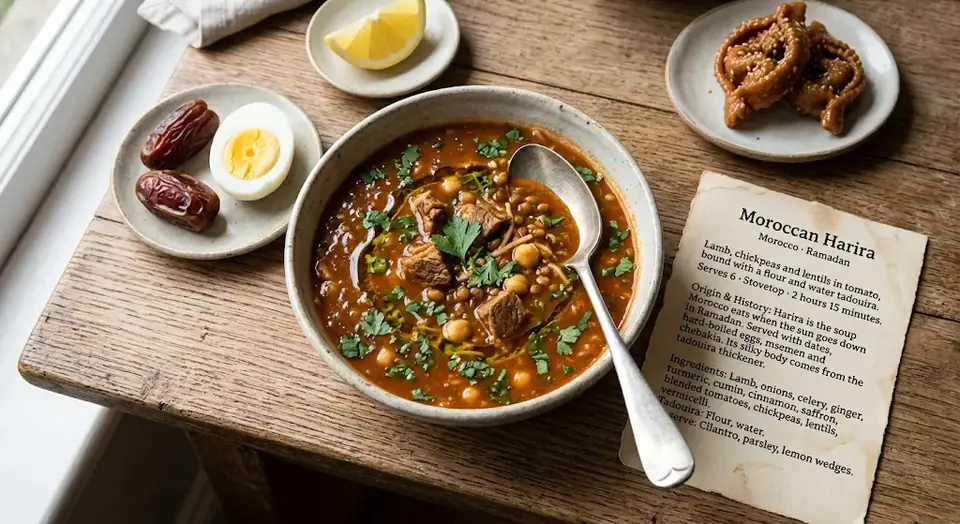
Morocco · Ramadan · 29.82° N, 8.69° W
Moroccan Harira
Lamb, chickpeas and lentils in tomato, bound with a flour and water tadouira.
At a glance.
Moroccan Harira comes from Morocco · Ramadan and appears in The Soup Atlas, in the chapter Beans, Lentils & Grains. It serves 6, takes about 2 hr 15 min, and uses 24 ingredients and 10 steps.
- Yield
- Serves 6
- Method
- Stovetop
- Time
- 2 hr 15 min
Ingredients
Tap an ingredient to tick it off.
- For the base
- For the pot
- For the tadouira
- To finish and to serve
Method
-
Make the tadouira first so it has time to sit. Put the flour in a bowl and whisk in the cold water a little at a time, starting with a paste and thinning it out, until you have a completely smooth liquid the consistency of thin cream. Set it aside at room temperature.
-
Warm the oil and smen in a large heavy pot over medium-high heat and brown the lamb in two batches, 4–5 minutes a batch, until each piece has taken real color on at least two sides. Crowding the pot steams the meat and you lose the fond that flavors everything after.
-
Lower the heat, return all the lamb, and add the onions, garlic and chopped celery. Cook for 10 minutes, scraping the browned fond off the base as the vegetables release their moisture, until the onions are soft and translucent.
-
Add the ginger, turmeric, cumin, cinnamon, pepper and the saffron with its soaking water. Stir for 60 seconds. Ground spices burn quickly in a dry pot, so if it looks parched add a spoonful of the tomato immediately.
-
Add the blended tomatoes and the tomato paste. Cook uncovered over medium heat for 15–20 minutes, stirring occasionally, until the mixture darkens to brick red, loses its raw sharpness and a rim of oil shows at the edge of the pot.
-
Add the lentils and the water. Bring to a gentle simmer, cover partly, and cook for 45 minutes — or 1 hour if the lamb is still firm — until the meat gives under a fork and the lentils are soft but not yet dissolved.
-
Add the chickpeas and the broken vermicelli and cook for 8 minutes more. Season with the salt now and taste, remembering that the flour going in next will mute everything by a noticeable degree.
-
Whisk the tadouira again — flour settles into a hard cake at the bottom within minutes — and bring the soup to a proper simmer. Pour the slurry in a thin, steady stream with one hand while stirring in slow circles with the other. Do not tip it in.
-
Keep the pot at a simmer, stirring, for 8–10 minutes after the last of the slurry goes in. It will thicken visibly, then settle. This time is not optional: wheat starch needs to reach and hold above about 90°C to lose its raw pastiness and give a clean, silky body.
-
Take the pot off the heat and stir in the cilantro and parsley — far more than looks sensible, because harira should taste green as well as spiced. Serve with lemon wedges, and set out dates, chebakia and eggs alongside.
Cook’s notes
- The technique
- The tadouira is a component, not a shortcut, and lumps are entirely a matter of how it goes in. Dry flour meeting hot liquid gelatinizes instantly on the outside of each clump and seals the dry powder inside, where no amount of stirring will reach it; dispersed in cold water first, every granule is already separated and swells alone. Add it in a thin stream against constant motion, then hold the pot at a simmer for a full eight minutes, because a starch that has thickened is not the same as a starch that has cooked. Many Moroccan cooks let the slurry stand for hours until it sours faintly, which adds a real tang.
- Make ahead
- Harira keeps four days refrigerated and thickens considerably as the flour and lentils set. Loosen it with hot water and bring it back to a simmer rather than merely warming it. It freezes for three months, though the vermicelli softens; leave the pasta out if you plan to freeze, and add it on reheating. Stir the herbs in fresh each time.
- Troubleshooting
- Lumpy — the slurry went in too fast or was not whisked before pouring; blend the soup smooth and accept it. Pasty and raw-tasting — the flour was not simmered long enough after going in. Gluey and heavy — too much vermicelli, or it sat in the pot for an hour. Dull under all those spices — it needs salt and then lemon, squeezed in at the bowl.
- Variations
- A meatless harira, common on ordinary weeknights, drops the lamb and leans on more chickpeas and a heavier hand with smen. Some households finish with a beaten egg stirred in threads through the hot soup instead of, or alongside, the tadouira. Rice replaces vermicelli in many families. Algerian chorba frik uses cracked green wheat and no flour at all, and is a different soup wearing a similar coat.
- To serve and keep
- Serve in small bowls or glasses rather than large ones — it is the opening of a long meal, not the whole of it. Dates and chebakia on the same table, hard-boiled eggs dipped in cumin and salt, lemon wedges, and msemen for tearing. Mint tea after, never during. Made in full within this recipe — Tadouira, Lamb and Tomato Base. Also listed in the Component Index at the back.

Where it comes from
Harira is the soup Morocco eats when the sun goes down in Ramadan. The table is laid before the call to maghrib, with dates, hard-boiled eggs, msemen and a plate of chebakia — the sesame and honey pastry made in enormous quantities in the weeks beforehand — and the harira goes out the moment the fast breaks. The pairing is practical as well as ceremonial: dates give fast sugar to a body that has gone since dawn without either food or water, and the soup follows with liquid, salt, protein and starch in a form that is easy to take. It is not exclusively a Ramadan dish. Cafés serve it year-round, it appears at weddings and at funerals, and in the cities you can buy a bowl on the street for very little. Regional hands differ: Fès is associated with a finer, more herb-forward version, while other kitchens lean harder on tomato and lamb. The Algerian chorba frik, thickened with cracked green wheat rather than flour, is a relative but not the same dish. What makes harira itself is the tadouira.
Moroccan Harira: quick answers
How long does Moroccan Harira take?
About 2 hr 15 min.
How many does this Moroccan Harira recipe make?
This recipe serves 6.
Where does Moroccan Harira come from?
Harira is the soup Morocco eats when the sun goes down in Ramadan. The table is laid before the call to maghrib, with dates, hard-boiled eggs, msemen and a plate of chebakia — the sesame and honey pastry made in enormous quantities in the weeks beforehand — and the harira goes out the moment the fast breaks. The pairing is practical as well as ceremonial: dates give fast sugar to a body that has gone since dawn without either food or water, and the soup follows with liquid, salt, protein and starch in a form that is easy to take. It is not exclusively a Ramadan dish. Cafés serve it year-round, it appears at weddings and at funerals, and in the cities you can buy a bowl on the street for very little. Regional hands differ: Fès is associated with a finer, more herb-forward version, while other kitchens lean harder on tomato and lamb. The Algerian chorba frik, thickened with cracked green wheat rather than flour, is a relative but not the same dish. What makes harira itself is the tadouira.
More from Morocco
More in Beans, Lentils & Grains

https://www.atlasserie.com/recipes/soup/moroccan-harira/