Mexico · The French Intervention · 23.91° N, 102.22° W
Mexican Bolillo
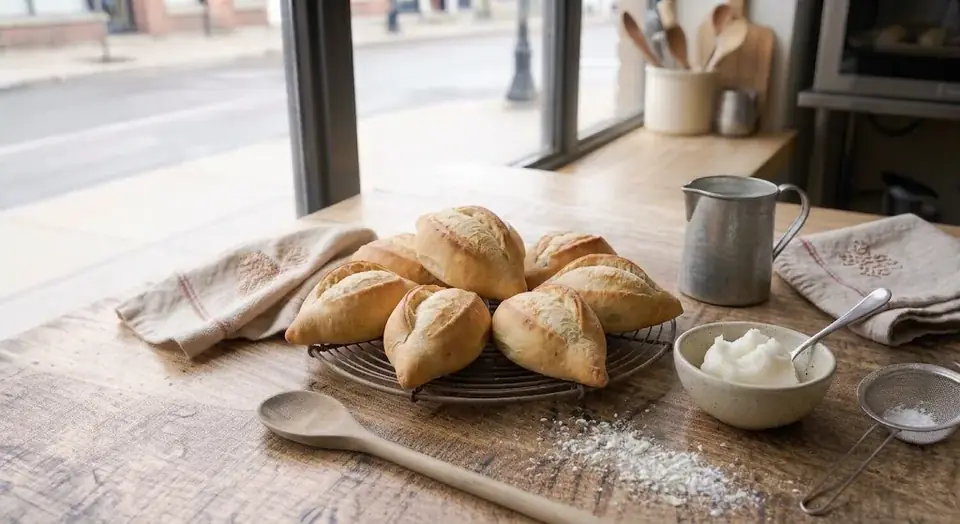
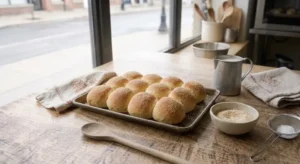
A pointed white roll split by one deep cut, built for the torta.
At a glance.
Mexican Bolillo comes from Mexico · The French Intervention and appears in The Bread Atlas, in the chapter Breads Around the World. It makes 8 rolls, takes about 5 hours, and uses 9 ingredients and 10 steps.
- Yield
- Makes 8 rolls
- Method
- Oven 220°C / 425°F
- Time
- 5 hours
Ingredients
Tap an ingredient to tick it off.
- Poolish
- The Dough
Method
-
Make the poolish 12–14 hours ahead: whisk the flour, water at 20°C and the pinch of yeast to a loose batter, cover, and leave at 20°C. It is ready when domed, foaming and beginning to fall in the centre, smelling of cream and cider.
-
Mix the poolish with the remaining flour, water at 20°C, sugar and yeast, holding back the salt and lard, and rest 25 minutes. Then add both and knead 8 minutes to a firm, smooth, elastic dough. Target a final dough temperature of 24°C.
-
Bulk ferment 90 minutes at 24°C with one fold at the halfway mark. The dough should rise by about three-quarters and feel springy and strong rather than slack; too much extensibility gives the open holes of a baguette instead of a fine close crumb.
-
Divide into 8 pieces of about 95 g, preshape each into a loose cylinder, cover, and rest 20 minutes until the dough no longer springs back when pressed at the edge.
-
Shape each piece into a torpedo: flatten, fold and seal in thirds, then roll under the palms to 14 cm, pressing harder at the ends so they taper into definite points. The points bake crisp and are the first part eaten.
-
Set the rolls seam-side down on a floured couche or a lined tray, cover, and prove 50–60 minutes at 24°C. They are ready when a floured fingertip leaves a dent that fills back roughly two-thirds of the way.
-
Preheat to 220°C / 425°F with a stone and a filled steam tray in place, allowing 45 minutes. A bolillo bakes cooler than a baguette and for longer, which is part of why its crust ends up thin and brittle rather than thick and chewy.
-
Score immediately before loading, and score it properly: one single cut down the whole length of the spine, 1 cm deep, with the blade held almost flat at about 20°. That shallow angle lifts a flap of dough which peels back in the oven into the raised crest a bolillo is known by.
-
Load, pour a cup of boiling water into the steam tray, and bake 10 minutes with steam. Then vent the oven fully and bake 10–12 minutes more, until the rolls are an even pale gold with a darker crest and an internal 96°C.
-
Cool on a rack for 30 minutes. The crust will crackle audibly as it contracts, then soften slightly, which is correct — a bolillo is meant to yield when pressed into a torta rather than to shatter.
Cook’s notes
- To serve and keep
- Split and packed as a torta with milanesa, ham and cheese, or beans and avocado. Hollowed and filled as a pambazo, or torn into pozole. Day-old bolillo becomes molletes under grilled beans and cheese, or capirotada in Lent. Keep in paper for a day.

Where it comes from
Wheat came to Mexico with the Spanish in the sixteenth century and Puebla was baking European loaves within a generation, but the bolillo as it now stands is generally traced to the French presence of the 1860s — the Second Intervention and the brief empire of Maximilian, which brought French bakers, French equipment and a French shape to Mexico City. The line is broadly accepted and the shape is hard to explain otherwise, though nobody has produced a bakery ledger that documents the handover directly, and it should be held loosely. What followed is not in doubt. Mexico built one of the great bread cultures on top of the borrowing: the panadería with its steel trays and tongs, hundreds of named pan dulce shapes, and the bolillo as the plain daily roll underneath all of it. Guadalajara went its own way. The birote salado of Jalisco is fermented with a sour culture, giving a tangy, tough-crusted roll that is the only thing that survives being drowned in the chile sauce of a torta ahogada.
Mexican Bolillo: quick answers
How long does Mexican Bolillo take?
About 5 hours.
How many does this Mexican Bolillo recipe make?
This recipe makes 8 rolls.
Where does Mexican Bolillo come from?
Wheat came to Mexico with the Spanish in the sixteenth century and Puebla was baking European loaves within a generation, but the bolillo as it now stands is generally traced to the French presence of the 1860s — the Second Intervention and the brief empire of Maximilian, which brought French bakers, French equipment and a French shape to Mexico City. The line is broadly accepted and the shape is hard to explain otherwise, though nobody has produced a bakery ledger that documents the handover directly, and it should be held loosely. What followed is not in doubt. Mexico built one of the great bread cultures on top of the borrowing: the panadería with its steel trays and tongs, hundreds of named pan dulce shapes, and the bolillo as the plain daily roll underneath all of it. Guadalajara went its own way. The birote salado of Jalisco is fermented with a sour culture, giving a tangy, tough-crusted roll that is the only thing that survives being drowned in the chile sauce of a torta ahogada.
More from Mexico
 ChorizoMexico · Fresh Chile Sausage
 Breakfast BurritoNew Mexico · Southwestern Border Cooking
 Chia PuddingMesoamerica · Vanilla Base
 Tropical Fruit BowlMexico & Southeast Asia · Street Fruit
 Chia Berry BowlMexico · Chia, Hibiscus and the Modern Bowl
 Chocolate SmoothieMesoamerica & the American Soda Fountain
More in Breads Around the World
https://www.atlasserie.com/recipes/bread/mexican-bolillo/