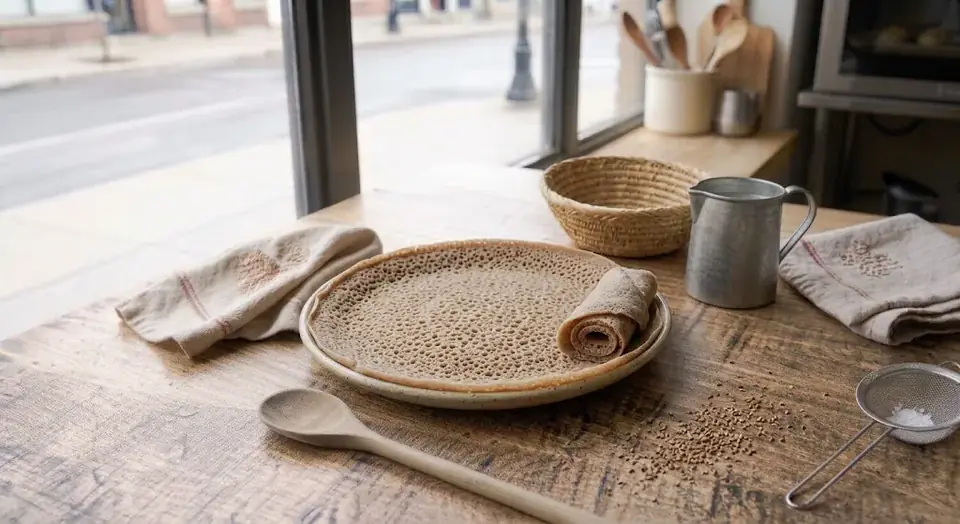
Ethiopia · The Highlands · 8.65° N, 39.56° E
Ethiopian Injera
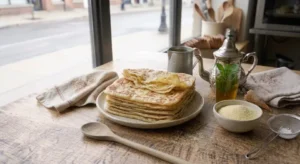
A vast sour teff pancake that serves as plate, spoon and bread at once.
At a glance.
Ethiopian Injera comes from Ethiopia · The Highlands and appears in The Bread Atlas, in the chapter Breads Around the World. It makes 8 injera, is made on the griddle, and uses 10 ingredients and 11 steps.
- Yield
- Makes 8 injera
- Method
- Griddle
Ingredients
Tap an ingredient to tick it off.
- The Ferment — Day 1, 100% Teff
- Alternative — Teff and Barley
- Absit — Day 3 or 4
- To Finish
Method
-
Day one. Whisk the teff flour with 700 g of the water at 30°C into a smooth, thin batter with no lumps, then stir in the ersho if you have it. Cover loosely — it must breathe — and leave at 22–26°C.
-
Day two. The batter separates into clear-to-yellow liquid above a dense sediment. Do not stir it back in. Leave it. It will smell of yeast, then of sour milk, then of something sharper and cleaner.
-
Day three. Pour off and reserve the surface liquid — this is ersho, and the next batch's starter. Add the remaining 450 g of water, stir the sediment smooth, cover, and leave one more day, or two in a cool kitchen.
-
Judge the ferment by smell and behavior, not by the calendar. Three days at 26°C and five at 20°C give the same result: a batter actively bubbling, distinctly sour but not acrid, and thin enough to pour in a ribbon. Pure teff takes longer than a blend.
-
Make the absit. Draw 250 g of batter into a saucepan, whisk in 250 g of water, and cook over medium heat, stirring constantly, until it thickens into a glossy paste like thin porridge — about 4 minutes. Take it off before it stiffens.
-
Cool the absit below 40°C, then whisk it thoroughly back into the main batter with the salt. This is the step most home recipes leave out: it softens the acidity, thickens the batter and pre-gelatinizes part of the starch so the injera stays supple.
-
Rest the batter 2–3 hours at room temperature, covered. It will lighten, froth and rise a little, and should end at the consistency of single cream, dropping from a ladle in an unbroken stream. Slacken with water if it does not.
-
Heat the mitad, or the widest flat non-stick pan you own, until a droplet of water dances and vanishes in two seconds. Wipe it with an oiled cloth and wipe it again — you want a trace, not a film. Too much oil and the eyes will not open.
-
Pour in a spiral from the outer rim inward, quickly and steadily, then tilt to fill any gaps. Do not spread it with anything. A standard injera is 3 mm thick and covers the whole pan; the pour takes about eight seconds and cannot be corrected.
-
Within 30 seconds the surface fills with small craters as gas escapes — the eyes. When they have opened right across and the surface has gone matt, cover for 60–90 seconds to set the top by steam. Injera is cooked on one side only and never turned.
-
Lift it off when the edges curl and it releases cleanly, and lay it flat on a cloth-lined tray. Stack only when each is fully cold. Cover and leave an hour before serving; taken straight from the pan it is stiff, and after an hour it is soft enough to roll.
Cook’s notes
- To serve and keep
- Spread one injera across the mesob as the plate, ladle doro wat, misir wat and gomen directly onto it, and serve more rolled alongside for tearing. Eat with the right hand only, pinching up the stew. The saturated base layer is the final course.

Where it comes from
Teff is a domesticated Ethiopian grain and grows nowhere else in quantity — the seed is minuscule, the yield low, and the plant tolerates both waterlogging and drought on the highland plateau where it was first cultivated thousands of years ago. Because the grain is so small it is always milled whole, bran and germ together, which makes injera one of the more nutritionally complete staple breads anywhere. The fermentation is wild and carried forward: a household keeps ersho, the sharp yellow liquid that separates on top of a fermenting batter, and pours it into the next batch as a starter, so a kitchen's culture can be decades old. Injera is served on a shared mesob, the woven table basket, with wat and vegetable dishes ladled directly onto it; it is plate, utensil and food at once, and the sodden underlayer is eaten last. Gursha, feeding a rolled mouthful to someone else by hand, is the gesture of hospitality built around it.
Ethiopian Injera: quick answers
How many does this Ethiopian Injera recipe make?
This recipe makes 8 injera.
Where does Ethiopian Injera come from?
Teff is a domesticated Ethiopian grain and grows nowhere else in quantity — the seed is minuscule, the yield low, and the plant tolerates both waterlogging and drought on the highland plateau where it was first cultivated thousands of years ago. Because the grain is so small it is always milled whole, bran and germ together, which makes injera one of the more nutritionally complete staple breads anywhere. The fermentation is wild and carried forward: a household keeps ersho, the sharp yellow liquid that separates on top of a fermenting batter, and pours it into the next batch as a starter, so a kitchen's culture can be decades old. Injera is served on a shared mesob, the woven table basket, with wat and vegetable dishes ladled directly onto it; it is plate, utensil and food at once, and the sodden underlayer is eaten last. Gursha, feeding a rolled mouthful to someone else by hand, is the gesture of hospitality built around it.
More in Breads Around the World
https://www.atlasserie.com/recipes/bread/ethiopian-injera/