The Bread Atlas
Grand Country Sourdough
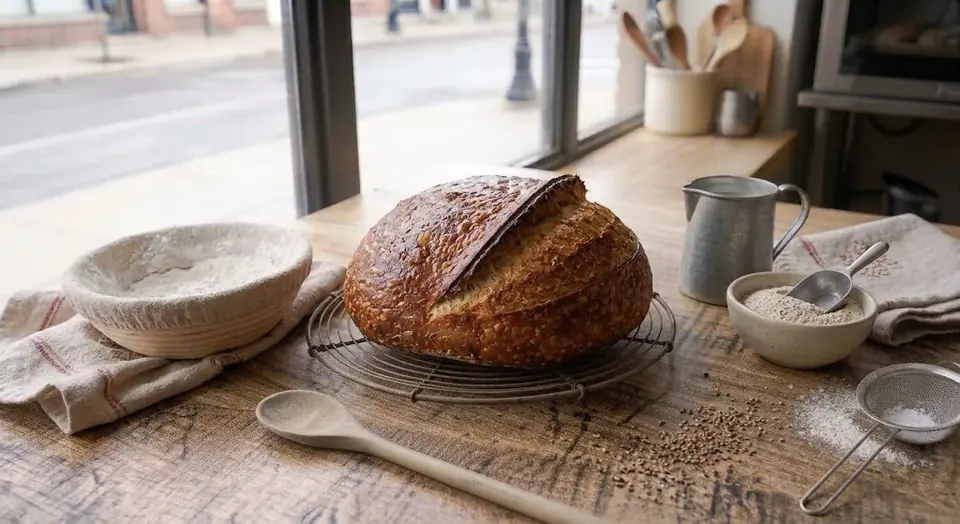
A two-kilo whole-grain miche: the last loaf, and the hardest.
At a glance.
Grand Country Sourdough is a recipe from The Bread Atlas, in the chapter Breads Around the World. It makes 1 large miche, takes about 30 hours, and uses 12 ingredients and 11 steps.
- Yield
- Makes 1 large miche
- Method
- Oven 250°C / 480°F
- Time
- 30 hours
Ingredients
Tap an ingredient to tick it off.
- Stiff Levain — built 12 hours ahead
- The Final Dough
- Basket Dusting Mix
Method
-
Build the stiff levain 12 hours ahead: knead the two flours, the water at 26°C and the starter into a firm ball, and hold at 21°C. At 60% hydration it will not bubble dramatically; it is ready when roughly doubled, doming under a finger and smelling of hazelnut rather than vinegar.
-
Autolyse first. Mix all three flours with the 640 g of water at 28°C until no dry flour remains, and leave 90 minutes covered. Wholemeal needs this more than white does — bran that goes in dry acts like broken glass, cutting the gluten strands as they form.
-
Add the levain and squeeze it through with wet hands until evenly distributed. Rest 20 minutes, then add the salt with the reserved 60 g of water, the bassinage, working it in gradually. Adding that last water late builds gluten at a lower hydration, then slackens the finished dough. Target 25–26°C.
-
Bulk ferment 4½–5 hours at 25°C, with four sets of stretch and folds at 30-minute intervals over the first two hours, then leave it alone. It is ready at a 60–70% rise, doming where it meets the tub, with a smooth jiggle and a scattering of surface bubbles.
-
Tip onto an unfloured surface, preshape into a loose round by dragging it against the bench with a bench knife, and rest 30 minutes uncovered until it skins slightly. Then shape a tight boule — fold the sides in, flip it seam-down, and drag it in tightening circles until the skin is taut.
-
Dust a large banneton heavily with the rice flour mix and settle the boule in seam-side up. At two kilos, a slack skin will not survive what comes next. Rest 45 minutes at room temperature to restart fermentation, then refrigerate at 4°C for 14–16 hours.
-
The cold retard is where the flavor is made: yeast activity nearly stops while acid-producing bacteria work on slowly. Meanwhile heat the oven to 250°C / 480°F with a large cast-iron combo cooker, or a heavy roasting tin over a stone, for a full hour.
-
Now the scoring. Turn the loaf out cold and firm onto parchment, hold the blade at 20–30° to the surface, and cut a single curve two-thirds of the way around the loaf, 1 cm deep, in one continuous stroke. That shallow angle undercuts a flap of skin which lifts into an ear.
-
Understand what the score is for before improvising. A sealed loaf bursts wherever the crust is weakest, usually at the base; the score gives the gas one deliberate exit. One deep cut plus shallow 3 mm decoration at 90° works; six deep cuts release the pressure everywhere and the loaf spreads flat.
-
Load and cover immediately. Steam condenses on the cold crust and keeps it extensible through the first ten minutes, delaying the moment the surface sets so the loaf can expand fully, and it gelatinizes the surface starch into the film that later crisps to a gloss. Bake covered 25 minutes.
-
Uncover — the score should have opened and lifted a clear ear — drop to 220°C / 425°F and bake 35–40 minutes more, to a deep russet and an internal 98°C. Cool four hours at minimum, overnight if you can; cut warm, the crumb only pastes onto the knife.
Cook’s notes
- To serve and keep
- Cut in half through the equator, then into thin half-moons, as a large miche always is. Eaten with cultured butter and salt, with a hard mountain cheese, or under olive oil and a rubbed tomato. It carries strong company — anchovy, aged sheep's cheese, a soft-boiled egg. Keep it cut face down on a board.
Where it comes from
The miche is the old shape of French country bread, from before the loaf shrank to fit a daily shopping trip: a single large round, two kilos or more, baked once and eaten across a week, its size a direct consequence of communal ovens fired for a whole village. Regional versions survived in the Auvergne, the Cantal and the Berry longer than elsewhere. In Paris the tradition was carried into the twentieth century most visibly by the Poilâne bakery, opened by Pierre Poilâne on the rue du Cherche-Midi in 1932 and continued by his son Lionel, which built an international business on a single grey-crusted sourdough miche baked in a wood-fired basement oven. The American revival — Berkeley from the 1980s, then a generation of bakeries, then Tartine Bread in 2010 — put the large naturally leavened loaf back into home kitchens and made the long cold retard and the covered pot standard practice. It closes this book because it asks for every skill in it at once. Bake the boule of 16 and the pain au levain of 28 first; this is the graduation piece, not the primer.
Grand Country Sourdough: quick answers
How long does Grand Country Sourdough take?
About 30 hours.
How many does this Grand Country Sourdough recipe make?
This recipe makes 1 large miche.
Where does Grand Country Sourdough come from?
The miche is the old shape of French country bread, from before the loaf shrank to fit a daily shopping trip: a single large round, two kilos or more, baked once and eaten across a week, its size a direct consequence of communal ovens fired for a whole village. Regional versions survived in the Auvergne, the Cantal and the Berry longer than elsewhere. In Paris the tradition was carried into the twentieth century most visibly by the Poilâne bakery, opened by Pierre Poilâne on the rue du Cherche-Midi in 1932 and continued by his son Lionel, which built an international business on a single grey-crusted sourdough miche baked in a wood-fired basement oven. The American revival — Berkeley from the 1980s, then a generation of bakeries, then Tartine Bread in 2010 — put the large naturally leavened loaf back into home kitchens and made the long cold retard and the covered pot standard practice. It closes this book because it asks for every skill in it at once. Bake the boule of 16 and the pain au levain of 28 first; this is the graduation piece, not the primer.
More in Breads Around the World
https://www.atlasserie.com/recipes/bread/grand-country-sourdough/