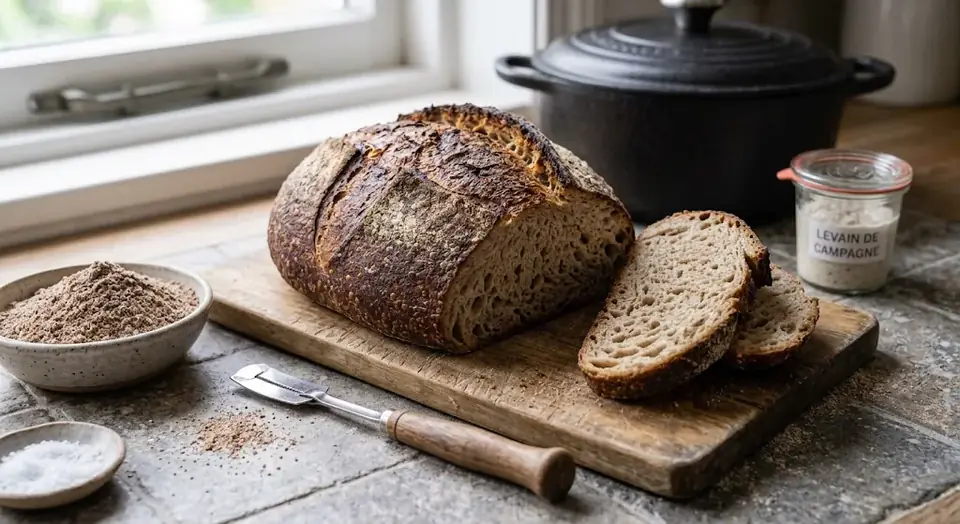
France · The Bâtard and the Blade · 46.56° N, 2.35° E
Rustic Batard
The oval loaf, and the single cut that decides how it opens.
At a glance.
Rustic Batard comes from France · The Bâtard and the Blade and appears in The Bread Atlas, in the chapter Artisan & Sourdough. It makes 1 batard, takes about 22 hours, and uses 9 ingredients and 11 steps.
- Yield
- Makes 1 batard
- Method
- Oven 240°C / 460°F
- Time
- 22 hours
Ingredients
Tap an ingredient to tick it off.
- Levain Build
- The Dough
- For Shaping and Baking
Method
-
Build the levain 10 hours ahead at 26°C and use it when domed and just beginning to fall. Mix both flours with the water at 30°C and autolyse 40 minutes, then add the levain and the salt and work the dough 4 minutes to 25°C.
-
Bulk ferment 4–4½ hours at 25°C with folds at 30, 60, 105 and 150 minutes. End it at a rise of about 60%, with a domed edge and a smooth, gassy surface. Surface tension matters more here than in a boule, so keep the last fold tidy.
-
Preshape into a loose rectangle rather than a round — the shape you preshape is the shape you will find easy to make — and rest 25 minutes seam down.
-
Shape the batard. Flip the rectangle, fold the near third up and press it down, fold the left and right corners in to make a blunt point, then roll the dough away from you in two turns, sealing each turn with your thumbs and finishing on a taut seam. Taper the ends by rocking them gently under your palms.
-
Set it seam side up in a floured oval banneton, cover, and retard 14 hours at 4°C. Score cold. A chilled skin cuts like paper; a warm one drags on the blade and pulls the surface out of shape as you go.
-
Heat the oven to 240°C / 460°F for 45 minutes with a stone on the middle shelf and a tray on the floor. Turn the loaf onto parchment, seam down, and dust it lightly with flour so you can see what you are doing.
-
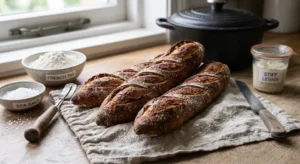
Now the score. Hold the blade at 20–30° to the surface, not upright. A shallow angle undercuts a flap of skin which the expanding dough lifts and folds back on itself, and that lifted flap — the ear — is the visible proof that the loaf grew after its crust began to set. Held vertically, the same cut only gapes.
-
Make one cut, 1 cm deep, running almost the full length of the loaf but curved slightly, so it follows the shoulder of the oval rather than its spine. Cut in one confident movement. Hesitation drags, and a dragged score seals itself shut in the first minute of the bake.
-
Understand what you have chosen. One long slash concentrates the expansion in a single line, giving maximum lift and one dramatic ear. Short overlapping chevrons, laid down the loaf like the cuts on a baguette, spread that expansion into several small ears and give a lower, wider loaf with more crust.
-
Load, pour 250 ml boiling water into the tray, and bake 20 minutes with steam. Vent the oven, drop to 220°C / 430°F, and bake 20 minutes more to a deep amber crust and 98°C inside. The score should have opened to a ridge standing several millimeters proud.
-
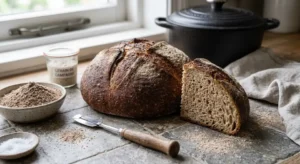
Cool on a rack at least 2 hours. Look at the cut face when you slice: the crumb directly under the ear should be as open as the middle. If it is compressed there, the shaping was tighter along the spine than the sides, and that is a shaping fault the blade cannot fix.
Cook’s notes
- To serve and keep
- The batard is the shape for the table: cut in even slices for cheese, soup and charcuterie, with more crumb per slice than a baguette and a neater section than a boule. Keep it on a board under a cloth and slice from the middle outward if you want both ends to keep.

Where it comes from
French bakeries name their loaves by shape before anything else, and the bâtard sits in the middle of that vocabulary: shorter and fatter than a baguette, longer and lower than a boule, the same dough given a form that suits a table rather than a hand. The name says as much — a bastard shape, belonging cleanly to neither parent — and the practical logic is that an oval gives more crumb per crust than a baguette and cuts into more usable slices than a round. The cut on its back is the part worth studying. Bakers have long said that the pattern was once a signature, the mark by which a household or a baker recognized a loaf coming out of a shared oven, and while the claim is plausible and often repeated, the documentary evidence is slight and it should be treated as trade lore. What is documented is the technical literature: Raymond Calvel, in Le Goût du Pain of 1990, set out the depth, angle and spacing of the score as a matter of craft rather than decoration, which is how it is taught today.
Rustic Batard: quick answers
How long does Rustic Batard take?
About 22 hours.
How many does this Rustic Batard recipe make?
This recipe makes 1 batard.
Where does Rustic Batard come from?
French bakeries name their loaves by shape before anything else, and the bâtard sits in the middle of that vocabulary: shorter and fatter than a baguette, longer and lower than a boule, the same dough given a form that suits a table rather than a hand. The name says as much — a bastard shape, belonging cleanly to neither parent — and the practical logic is that an oval gives more crumb per crust than a baguette and cuts into more usable slices than a round. The cut on its back is the part worth studying. Bakers have long said that the pattern was once a signature, the mark by which a household or a baker recognized a loaf coming out of a shared oven, and while the claim is plausible and often repeated, the documentary evidence is slight and it should be treated as trade lore. What is documented is the technical literature: Raymond Calvel, in Le Goût du Pain of 1990, set out the depth, angle and spacing of the score as a matter of craft rather than decoration, which is how it is taught today.
More from France


More in Artisan & Sourdough

https://www.atlasserie.com/recipes/bread/rustic-batard/