Mesoamerica, Spain & France · Drinking Chocolate · 40.32° N, 3.62° W
Hot Chocolate
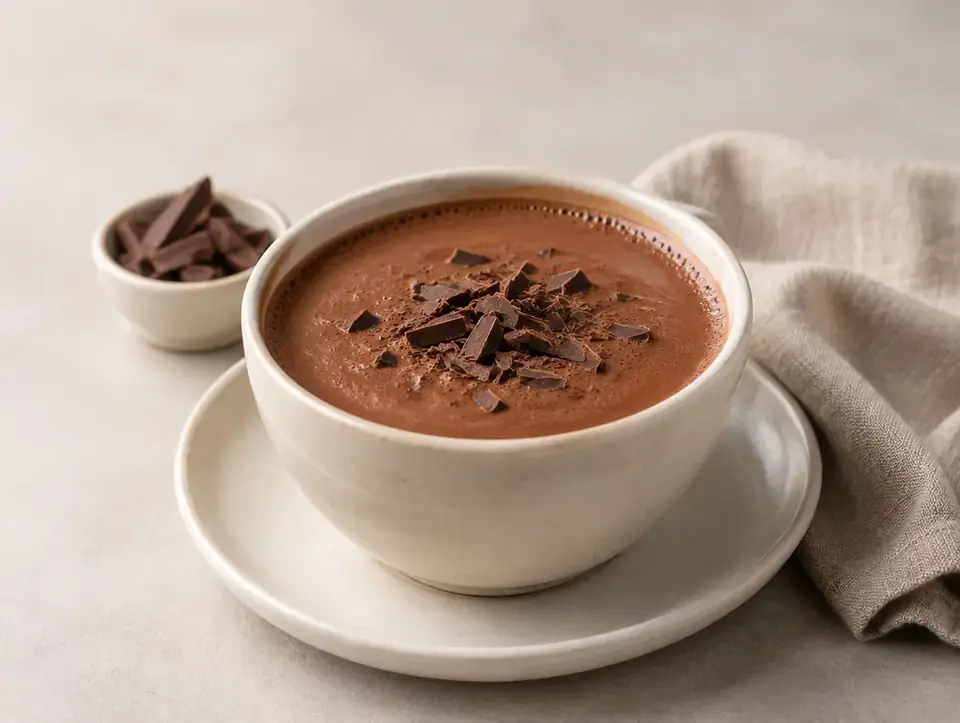
Chopped chocolate emulsified into hot milk and cream, French-style, never boiled.
At a glance.
Hot Chocolate comes from Mesoamerica, Spain & France · Drinking Chocolate and appears in The Breakfast Atlas, in the chapter Smoothies & Breakfast Drinks. It serves 2, takes about 15 minutes, and uses 14 ingredients and 11 steps.
- Yield
- Serves 2
- Method
- Stovetop
- Time
- 15 minutes
Ingredients
Tap an ingredient to tick it off.
- For the French chocolat chaud
- For the Spanish variation, chocolate a la taza
Method
-
Chop the chocolate finely and evenly with a serrated knife, to roughly the size of grains of rice. Uneven chunks melt at different rates, so the last pieces sit stubbornly whole while everything around them overheats.
-
Warm the milk, cream, cocoa powder, sugar and salt together in a heavy pan over medium-low heat, whisking to disperse the cocoa. Take it to about 80°C — steaming hard, small bubbles at the rim, no rolling boil.
-
Take the pan off the heat and pour a third of the hot liquid over the chopped chocolate in a bowl. Leave it 30 seconds without touching it, so the heat has time to travel through.
-
Stir from the very center in tight, small circles. A thick, glossy, almost elastic core will form in the middle of the bowl. That core is the emulsion, and everything after this is only a matter of enlarging it.
-
Add the second third and stir outward from that center until it is absorbed, then the last third. Cocoa butter and water resist each other, and starting small forces them into a stable suspension in the same way a ganache is built.
-
Return everything to the pan and warm gently to 65–70°C, whisking. Do not let it boil. Chocolate scorches readily against a hot pan base, and boiling splits the emulsion into oily specks that no whisking recovers.
-
Off the heat, blitz for 10 seconds with a stick blender, or churn with a molinillo spun between your palms, until the surface is high-gloss and lightly foamed.
-
Rest the pan 5 minutes. The drink thickens noticeably as the cocoa butter begins to set, and this is intended — French chocolat chaud should coat the back of a spoon and cling to the sides of the cup.
-
Reheat gently, pour into small warmed cups, and spoon the lightly whipped cream on top. Two hundred milliliters each is a generous serving of something this rich.
-
For the Spanish version, slake the cornflour in 50 ml of the cold milk. Heat the remaining milk with the cinnamon stick, sugar and salt, take it off the heat and stir in the chocolate until smooth.
-
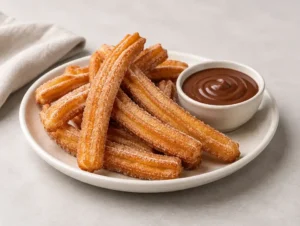
Return the Spanish version to a low heat, whisk in the slaked cornflour, and cook 4–5 minutes, whisking constantly, until it coats a spoon thickly and holds the line when you draw a finger across the back of it. Fish out the cinnamon and serve at once with churros.
Cook’s notes
- The technique
- Hot chocolate made properly is an emulsion, not a solution, and it is built the way a ganache is built. Adding all the liquid at once floods the cocoa butter and leaves it in droplets that later pool as grease on the surface. Adding a third, waiting, and stirring from the center forces the fat into suspension in a small volume of water, where it stays once the rest is worked in. Keep the pan below 70°C throughout and the emulsion holds.
- Make ahead
- Both versions keep three days covered in the fridge. The French one sets to something near a pot de crème and comes back with gentle heat and a whisk. The Spanish one sets solid as the starch retrogrades and needs a splash of milk and hard whisking over low heat. Neither should be boiled to reheat.
- Troubleshooting
- Grainy, with oily beads on the surface — it boiled, or was heated too fast; a stick blender sometimes rescues it. Thin and milky — the chocolate percentage was too low. A skin forming in the cup — normal with the French version; whisk it in or serve under whipped cream. Chalky and gluey Spanish chocolate — the cornflour was not cooked out for the full four minutes.
- Variations
- Italian cioccolata calda works like the Spanish version, thickened with cornflour and served in tiny cups. Mexican champurrado is thickened with masa harina and sweetened with piloncillo, spiced with canela and traditionally churned with a molinillo. Viennese hot chocolate takes the French base and doubles the whipped cream. For a dairy-free version, use oat milk and coconut cream, which handles the emulsion better than nut milks.
- Serve with
- Small cups only, warmed first. Churros or porras for the Spanish version, which is a Madrid breakfast eaten as often at six in the morning after a long night as at eight. The French version wants a plain buttery biscuit or nothing, and a glass of cold water alongside. Made in full within this recipe — Chocolate a la Taza. Also listed in the Component Index at the back.

Where it comes from
The Mexica drank xocolatl cold and unsweetened, often ground with chilli, and raised its prized foam by pouring the liquid from one vessel into another held high. The molinillo — the turned wooden whisk spun between the palms that now stands as the symbol of the drink — is a Spanish colonial invention of the sixteenth or seventeenth century rather than an indigenous tool. In Spain the drink was sweetened with cane sugar, served hot and scented with cinnamon, and it remained a court and convent preoccupation for the better part of a century before it spread. It reached France with the Spanish royal marriages of the seventeenth century — Anne of Austria is usually credited, though the evidence is thin — and England as a luxury sold in chocolate houses from the 1650s. Two national styles came out of that and both survive. Spanish chocolate a la taza is thick enough to hold a churro upright, its body owed as much to cornflour as to cacao. French chocolat chaud is looser but far richer, built from chopped couverture, milk and cream with no starch at all.
All 18 recipes from Spain
All 105 recipes from France
All 30 recipes from Mexico
Hot Chocolate: quick answers
How long does Hot Chocolate take?
About 15 minutes.
How many does this Hot Chocolate recipe make?
This recipe serves 2.
Where does Hot Chocolate come from?
The Mexica drank xocolatl cold and unsweetened, often ground with chilli, and raised its prized foam by pouring the liquid from one vessel into another held high. The molinillo — the turned wooden whisk spun between the palms that now stands as the symbol of the drink — is a Spanish colonial invention of the sixteenth or seventeenth century rather than an indigenous tool. In Spain the drink was sweetened with cane sugar, served hot and scented with cinnamon, and it remained a court and convent preoccupation for the better part of a century before it spread. It reached France with the Spanish royal marriages of the seventeenth century — Anne of Austria is usually credited, though the evidence is thin — and England as a luxury sold in chocolate houses from the 1650s. Two national styles came out of that and both survive. Spanish chocolate a la taza is thick enough to hold a churro upright, its body owed as much to cornflour as to cacao. French chocolat chaud is looser but far richer, built from chopped couverture, milk and cream with no starch at all.
More from Spain

More in Smoothies & Breakfast Drinks

https://www.atlasserie.com/recipes/breakfast/hot-chocolate/