Assam & the Railway Platform · Masala Chai · 22.82° N, 79.54° E
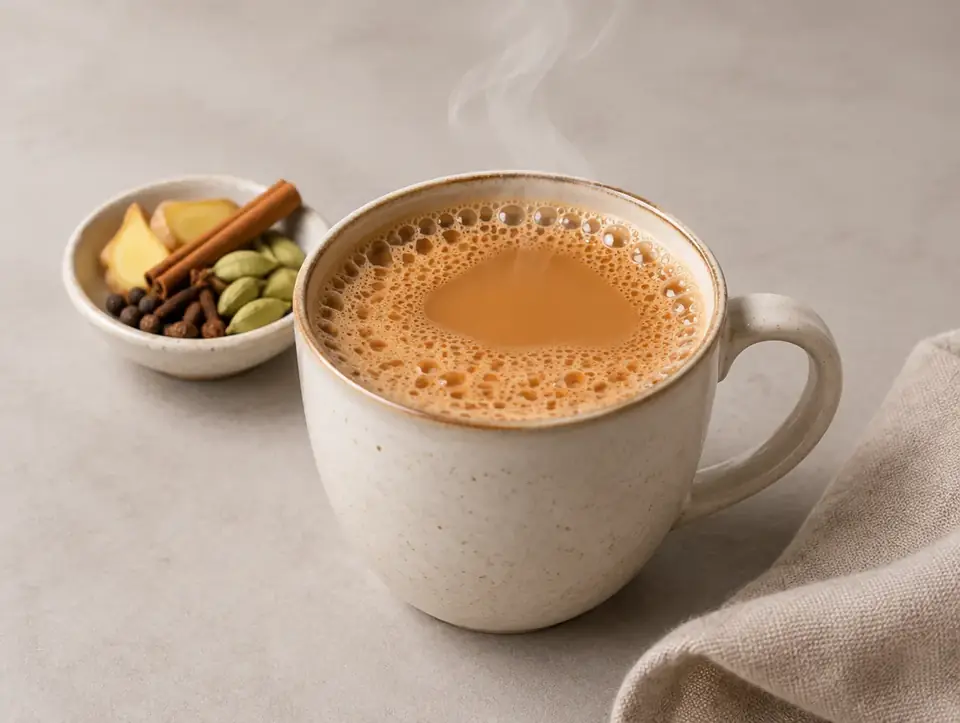
Chai Latte
A proper decoction — spice, then tea, then milk, then sugar — boiled hard.
At a glance.
Chai Latte comes from Assam & the Railway Platform · Masala Chai and appears in The Breakfast Atlas, in the chapter Smoothies & Breakfast Drinks. It serves 2, takes about 20 minutes, and uses 14 ingredients and 10 steps.
- Yield
- Serves 2
- Method
- Stovetop
- Time
- 20 minutes
Ingredients
Tap an ingredient to tick it off.
- For the chai masala (makes about 60 g, enough for 20 cups)
- For two cups of chai
Method
-
Warm the whole spices for the masala — cardamom, cassia, dried ginger, cloves, peppercorns, fennel and star anise — in a dry pan over low heat for 2 minutes, shaking often. You want them warm and fragrant, not colored.
-
Cool them completely before grinding. Warm spice grinds to a sticky paste as its oils release; cold spice shatters to powder. Grind in a spice mill, grate the nutmeg in afterwards, and stir it through.
-
Sieve the ground masala, return the coarse fragments to the mill and grind again. Store in a small sealed jar away from light and use within eight weeks, after which the cardamom has faded to almost nothing.
-
Now the chai. Bring the 300 ml of water to the boil with 3 g of masala and the bruised fresh ginger, and hold it at a steady boil for 3 minutes.
-
Understand what that boil is doing. This is a decoction, not an infusion: cassia bark, cloves and dried ginger are woody, and their aromatic oils will not come out at steeping temperature. Tea leaves would be ruined by the same treatment, which is why they go in second.
-
Add the tea and boil 2 minutes more. CTC tea — crush, tear, curl — is machine-processed into hard pellets that give color and strength quickly and withstand boiling; a whole-leaf Darjeeling would be destroyed and wasted here.
-
Pour in the milk and bring the pan back to a rolling boil. Keep a hand on the pan; milk with tea in it climbs fast and boils over without warning.
-
Let it rise up the sides, lift the pan clear as it reaches the rim, let it fall, then set it back on the heat. Repeat three times. Each rise concentrates the milk a little and builds the foam that a good glass of chai should carry.
-
Add the sugar and boil for a final 30 seconds. Sugar belongs in the pan rather than the cup — boiled with the milk it caramelizes slightly and the drink tastes rounder and fuller.
-
Strain through a fine sieve into warmed cups, pouring from a height so it aerates and foams. Judge the strength: kadak chai should be the color of caramel and leave a coating on the cup.
Cook’s notes
- The technique
- The order is the recipe. Spices first, in water alone and at a hard boil, because their flavor lives in oils bound up in woody tissue. Tea second, for a short boil, long enough for color and tannin and no longer. Milk third, brought up in stages rather than simmered flat. Sugar last, where it can caramelize against hot milk. Change that order and you get spiced milky tea, which is not the same drink.
- Make ahead
- Grind the masala in 60 g batches and it holds eight weeks. The spice-and-ginger decoction alone can be made in quantity and kept refrigerated three days, ready to be brought back to the boil with tea and milk. Finished chai does not keep; reboiled, it turns stewed and bitter within minutes.
- Troubleshooting
- Bitter and stewed — the tea boiled too long, or was reheated. Pale and thin — not enough CTC, or the milk went in before the tea had brewed. A scorched, catching smell — the milk stuck to a thin pan; use a heavy one and keep it moving. Grit in the cup — the masala was coarsely ground and the sieve too open.
- Variations
- Kashmiri noon chai is pink and salted, whisked with baking soda and served with bread; kahwa from the same region is green tea with saffron and almond, no milk at all. Irani chai in Hyderabad is thickened with reduced milk and drunk with Osmania biscuits. Mumbai cutting chai comes in a half glass, strong and very sweet. Gujarati blends lean hard on fresh ginger and lemongrass.
- Serve with
- Serve very hot in small glasses or unglazed kulhad cups, which lend an earthy note as they wet. Rusks, khari puff biscuits, or a plain Marie biscuit for dunking. Chai is drunk all day in India, not only in the morning, and rarely with food beyond a biscuit. Made in full within this recipe — Chai Masala. Also listed in the Component Index at the back.

Where it comes from
Tea in India began as an export crop rather than a drink. The British planted Assam from the 1830s after Robert Bruce reported indigenous tea plants growing there, the Assam Company was formed in 1839, and almost the entire crop went to Britain. Indians drank very little of it. The Indian Tea Association set out to change that in the early twentieth century, subsidizing tea stalls on railway platforms and pushing mills and factories to institute a tea break. The Association wanted its product served the English way, a strong brew with a little milk; vendors ignored that and boiled the leaf hard with milk, sugar and whatever spices were to hand — partly for flavor, partly because it made an expensive ingredient go a great deal further. Masala chai as it is now drunk is therefore largely a twentieth-century development and, in part, a marketing campaign's unintended consequence. A note on language: chai is the word for tea, carried from Chinese chá through Persian chāy, so chai tea says the same thing twice. Chai latte is a café coinage of the 1990s.
Chai Latte: quick answers
How long does Chai Latte take?
About 20 minutes.
How many does this Chai Latte recipe make?
This recipe serves 2.
Where does Chai Latte come from?
Tea in India began as an export crop rather than a drink. The British planted Assam from the 1830s after Robert Bruce reported indigenous tea plants growing there, the Assam Company was formed in 1839, and almost the entire crop went to Britain. Indians drank very little of it. The Indian Tea Association set out to change that in the early twentieth century, subsidizing tea stalls on railway platforms and pushing mills and factories to institute a tea break. The Association wanted its product served the English way, a strong brew with a little milk; vendors ignored that and boiled the leaf hard with milk, sugar and whatever spices were to hand — partly for flavor, partly because it made an expensive ingredient go a great deal further. Masala chai as it is now drunk is therefore largely a twentieth-century development and, in part, a marketing campaign's unintended consequence. A note on language: chai is the word for tea, carried from Chinese chá through Persian chāy, so chai tea says the same thing twice. Chai latte is a café coinage of the 1990s.
More from India

More in Smoothies & Breakfast Drinks

https://www.atlasserie.com/recipes/breakfast/chai-latte/