Kyoto & the Modern Café · Two Ways Cold · 36.01° N, 136.71° E
Iced Coffee
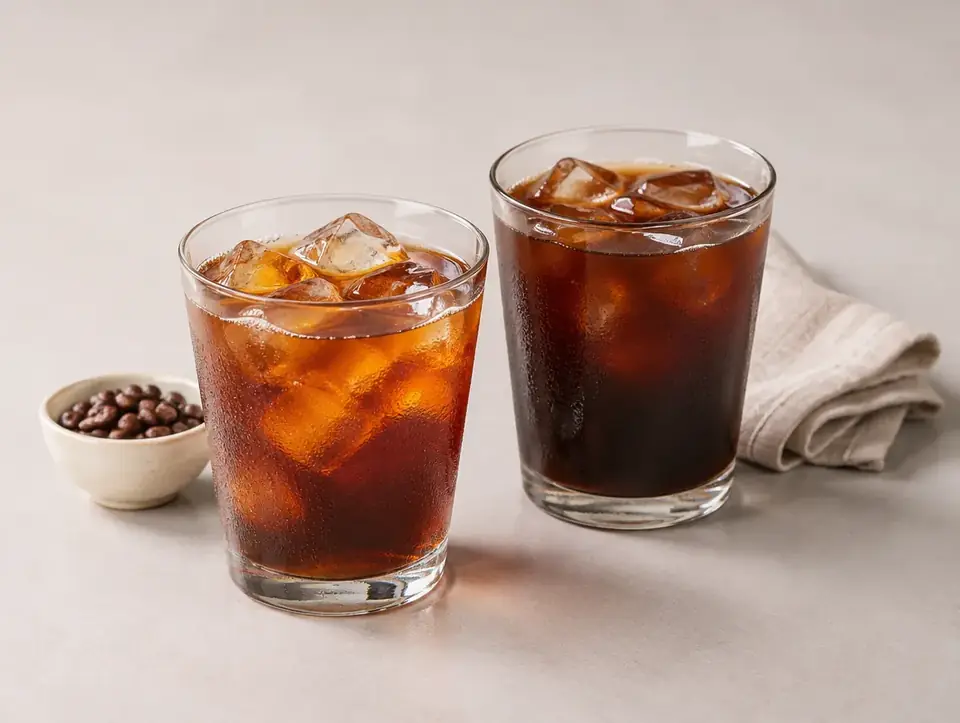
Two cold methods that taste nothing alike: flash-chilled, and slowly steeped.
At a glance.
Iced Coffee comes from Kyoto & the Modern Café · Two Ways Cold and appears in The Breakfast Atlas, in the chapter Smoothies & Breakfast Drinks. It serves 1, takes about 18 hr 10 min, and uses 9 ingredients and 10 steps.
- Yield
- Serves 1
- Method
- Stovetop
- Time
- 18 hr 10 min
Ingredients
Tap an ingredient to tick it off.
- For the Japanese flash-chill (one glass)
- For the cold brew concentrate (makes about 800 ml)
Method
-
Choose the method by the cup you want rather than by the clock. Flash-chill gives brightness, aroma and acidity; cold brew gives weight, sweetness and almost no aroma at all. Neither is the better drink in the abstract.
-
For the flash-chill, work out the water split first. Total water is 370 g for 22 g of coffee, a ratio of 1:16.8 — the same as a hot brew. You put 150 g of it in the server as ice and pour the other 220 g through hot.
-
Weigh the ice into the carafe, set the brewer on top and rinse the paper with hot water, discarding what runs through. Grind a step finer than usual, since the contact time is shorter than a hot brew's.
-
Bloom with 45 g of water at 93°C and wait 30 seconds, then pour to 220 g in two even additions. The whole brew should finish in about two and a half minutes.
-
Swirl the carafe until the last of the ice has melted, usually 15 to 20 seconds, then pour over fresh ice in a tall glass and add the milk if you want it.
-
For the cold brew, tip 125 g of coarse grounds into the jar and pour on the liter of cold water. Stir once, slowly, until every particle is wet — dry pockets float and contribute nothing.
-
Cover and steep 12 to 18 hours at room temperature, or 18 to 24 in the fridge. Past a day you gain a woody, papery bitterness rather than more strength.
-
Strain first through a sieve to take out the bulk of the grounds, then through a paper filter or double muslin for the fines. Let it drip; pressing the bed forces silt through and clouds the result.
-
You now have a 1:8 concentrate. Dilute one part concentrate to one part cold water or milk over ice for drinking strength, and taste before you commit — beans vary more than the ratio does.
-
Keep the concentrate in a sealed bottle in the fridge for up to ten days. Pour it over coffee ice cubes if you want the last mouthful to taste like the first.
Cook’s notes
- The technique
- The two methods taste different because temperature decides what dissolves. Hot water extracts the acids and the volatile aromatics that make coffee smell of anything; flash-chilling traps those aromatics by condensing them into the liquid instead of letting them steam off a cooling cup, so the glass tastes like the hot brew — floral, juicy, high-toned. Cold water leaves most of that behind and pulls slowly at the heavier, sweeter compounds, giving a low-acid, thick-bodied drink that reads as chocolate and nuts and is aromatically flat. Smooth is not the same as good.
- Make ahead
- Cold brew is the make-ahead method: a liter of concentrate is ten days of iced coffee. Flash-chilled coffee is at its best within half an hour, though it will hold overnight in a bottle filled to the brim and refrigerated. Freeze leftover coffee as ice cubes rather than pouring it away.
- Troubleshooting
- Flash-chill weak and watery — the brewing water was not reduced to account for the ice. Flash-chill thin and sour — grind finer. Cold brew thin despite the long steep — grind too coarse, or the ratio drifted. Cold brew silty and muddy — you pressed the filter bed. Cold brew woody and hollow — steeped beyond 24 hours.
- Variations
- Kyoto slow drip runs cold water through the bed at roughly one drop a second for six to eight hours, and sits between the two methods in character. Vietnamese cà phê sữa đá drips a dark roast through a phin onto condensed milk, then goes over ice. Greek frappé is instant coffee shaken hard with a little water into a stiff foam, said to have been improvised at the Thessaloniki trade fair in 1957.
- Serve with
- Serve in a tall glass with plenty of ice and a wide straw. Flash-chill takes milk badly and is better black or with a splash of water. Cold brew takes milk, oat milk and even a little salt very well, which is why it dominates café menus. Made in full within this recipe — Cold Brew Concentrate. Also listed in the Component Index at the back.

Where it comes from
Cold coffee has several separate lineages, and running them together causes most of the confusion. Mazagran — coffee served long and cold with water, sometimes with lemon — comes out of French Algeria in the 1840s and survives in Portuguese cafés. Kyoto-style slow drip, in which cold water falls one drop at a time through a bed of grounds inside a tall glass tower for six or eight hours, is a fixture of Japanese kissaten; it is often sold across Japan and Korea as Dutch coffee, on the strength of a story about Dutch traders in the Indies that is repeated far more often than it is evidenced. Japanese cafés were also brewing iced coffee the fast way, hot straight onto ice, long before Western specialty shops adopted the method and gave it the name flash chill in the 2000s. The American cold-brew boom is newer and squarely commercial: bottled cold brew arrived on shelves in the early 2010s and reached the national chains by 2015. The two methods below are not variations on one another. They make different drinks.
Iced Coffee: quick answers
How long does Iced Coffee take?
About 18 hr 10 min.
How many does this Iced Coffee recipe make?
This recipe serves 1.
Where does Iced Coffee come from?
Cold coffee has several separate lineages, and running them together causes most of the confusion. Mazagran — coffee served long and cold with water, sometimes with lemon — comes out of French Algeria in the 1840s and survives in Portuguese cafés. Kyoto-style slow drip, in which cold water falls one drop at a time through a bed of grounds inside a tall glass tower for six or eight hours, is a fixture of Japanese kissaten; it is often sold across Japan and Korea as Dutch coffee, on the strength of a story about Dutch traders in the Indies that is repeated far more often than it is evidenced. Japanese cafés were also brewing iced coffee the fast way, hot straight onto ice, long before Western specialty shops adopted the method and gave it the name flash chill in the 2000s. The American cold-brew boom is newer and squarely commercial: bottled cold brew arrived on shelves in the early 2010s and reached the national chains by 2015. The two methods below are not variations on one another. They make different drinks.
More from Japan



More in Smoothies & Breakfast Drinks





https://www.atlasserie.com/recipes/breakfast/iced-coffee/