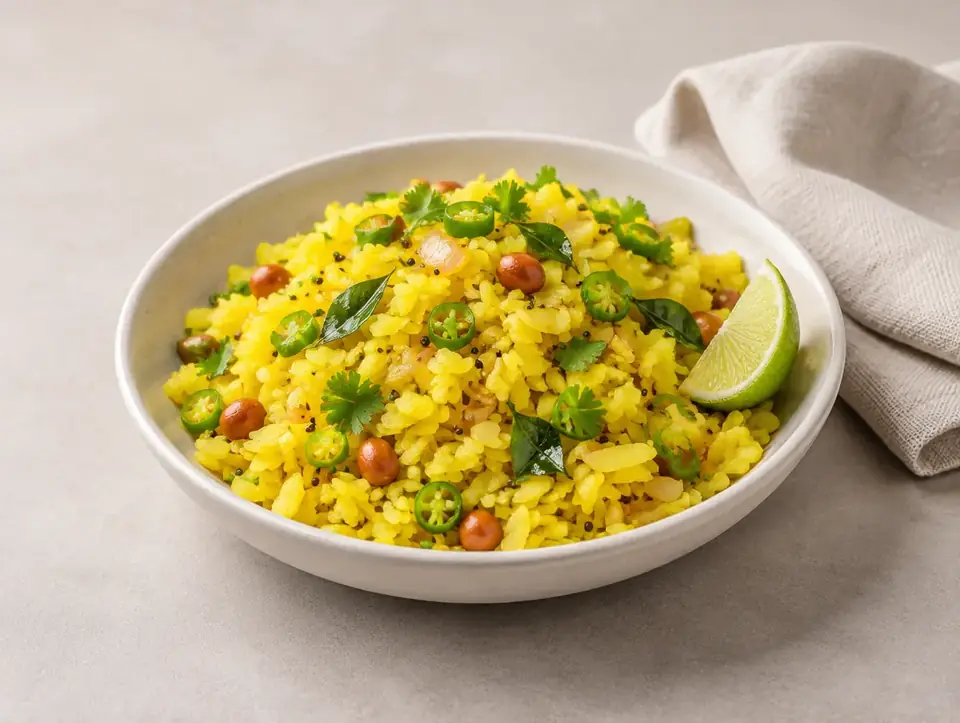
Maharashtra & Madhya Pradesh · Flattened Rice · 22.82° N, 79.54° E
Poha
Flattened rice softened in its own damp, sharp with lime and green chile.
At a glance.
Poha comes from Maharashtra & Madhya Pradesh · Flattened Rice and appears in The Breakfast Atlas, in the chapter Breakfast Around the World. It serves 4, takes about 25 minutes, and uses 20 ingredients and 10 steps.
- Yield
- Serves 4
- Method
- Stovetop
- Time
- 25 minutes
Ingredients
Tap an ingredient to tick it off.
- For the poha
- For the tadka
- For the jeeravan masala and finish
Method
-
Grind the toasted cumin, fennel, coriander, peppercorns and cloves to a powder, then stir through the amchur, black salt and chile powder. That is jeeravan masala, and it keeps two months in a sealed jar.
-
Tip the poha into a colander and rinse it under a cold running tap for 30–40 seconds, turning it with your hand so every flake is wetted. Shake it hard and leave it in the colander to drain.
-
Sprinkle the salt, sugar and turmeric over the drained flakes, mix with your fingers, and leave 10 minutes. The poha swells on the moisture already clinging to it — this rest is the entire technique.
-
Test one flake between finger and thumb: it should crush to a soft, springy pulp with no hard white core. If it is still brittle, flick over a tablespoon of water and wait 5 minutes more.
-
Grade matters more than anything else here. Thick poha absorbs water slowly and survives rinsing; the thin nylon grade sold for chivda collapses into wallpaper paste the moment it meets a tap.
-
Heat the oil in a wide pan over medium heat and add the mustard seeds. Wait until they crackle and jump, about 30 seconds, before anything else goes in — the order of a tadka is not decorative.
-
Add the cumin, then the asafoetida, then the curry leaves and green chiles, standing back as the leaves spit. Each ingredient goes in as the previous one releases its aroma, over about 45 seconds.
-
Add the peanuts and fry 2 minutes until they darken, then the onion, and cook 5–6 minutes until soft and translucent. If using potato, add it with the onion and cover the pan for 6 minutes until tender.
-
Stir in the peas and cook 2 minutes. Now fold in the rested poha with a light hand, lifting from the base rather than stirring, and warm it through for 3 minutes with the lid on.
-
Off the heat, fold through the lime juice, coriander and coconut. Serve at once, and for the Indori version, blanket each plate with sev and raw onion and dust generously with the jeeravan masala.
Cook’s notes
- The technique
- Poha is rehydrated, not cooked, and the difference decides everything. Flattened rice is pre-gelatinized starch that has been dried, so it needs only enough water to soften its structure — a brief rinse leaves roughly its own weight in surface moisture, and ten minutes of resting lets that migrate inward evenly. Soak it in a bowl instead and the outside dissolves before the middle softens, giving lumps of paste around dry flakes.
- Make ahead
- Jeeravan masala keeps two months in the dark. Onions, chiles and potatoes can be prepped the night before, and peanuts fried in advance and stored airtight. The poha itself should be rinsed no more than 30 minutes before cooking; rested longer, it goes claggy. Reheat leftovers with a sprinkle of water, covered.
- Troubleshooting
- Mushy and clumped — thin poha, or too much water at the rinse; spread it out and let it dry. Dry, hard flakes — under-rinsed, so sprinkle water and rest again. Bitter, acrid tadka — the mustard seeds burned before the rest went in. Flat and dull — lime was added while the pan was hot, which drives off its aroma.
- Variations
- Indori poha is looser and slightly sweet, laden with sev, raw onion and jeeravan, and traditionally eaten with a jalebi. Kanda poha in Pune and Nashik holds to onion, turmeric, coconut and lime. Batata poha leads on potato and drops the onion, which makes it acceptable during fasts. Dadpe pohe, from the Konkan, is uncooked — flakes tossed raw with coconut, onion and a hot tadka poured over.
- Serve with
- Cutting chai, strong and sweet with ginger, is the fixed partner. In Indore, a jalebi on the side; in Maharashtra, a wedge of lime and a spoonful of fresh coconut. Serve on a metal plate, and eat it within ten minutes while the sev is still crisp. Made in full within this recipe — Jeeravan Masala. Also listed in the Component Index at the back.

Where it comes from
Flattened rice is old technology: parboiled paddy is pounded or rolled flat and dried, producing a grain that needs no cooking, only moisture. Sanskrit sources refer to prithuka, and the association with hospitality runs deep — the story of Sudama arriving at Krishna's door with nothing but a bundle of beaten rice is told across northern and western India, and poha still appears among the simple offerings cooked for household festivals, sweetened or mixed with curd as gopalkala at Janmashtami. As a breakfast it belongs to two states with distinct habits. Maharashtra makes kanda poha — kanda meaning onion — soft, pale yellow with turmeric, finished with lime, coriander and grated coconut. Indore, in Madhya Pradesh, makes it looser and sweeter, buries it under crisp sev and raw onion, dusts it with the city's own jeeravan masala and sells it from morning carts, often with a jalebi balanced on top. Elsewhere it is the standard weekday tiffin: twenty minutes, one pan, no fuss.
Poha: quick answers
How long does Poha take?
About 25 minutes.
How many does this Poha recipe make?
This recipe serves 4.
Where does Poha come from?
Flattened rice is old technology: parboiled paddy is pounded or rolled flat and dried, producing a grain that needs no cooking, only moisture. Sanskrit sources refer to prithuka, and the association with hospitality runs deep — the story of Sudama arriving at Krishna's door with nothing but a bundle of beaten rice is told across northern and western India, and poha still appears among the simple offerings cooked for household festivals, sweetened or mixed with curd as gopalkala at Janmashtami. As a breakfast it belongs to two states with distinct habits. Maharashtra makes kanda poha — kanda meaning onion — soft, pale yellow with turmeric, finished with lime, coriander and grated coconut. Indore, in Madhya Pradesh, makes it looser and sweeter, buries it under crisp sev and raw onion, dusts it with the city's own jeeravan masala and sells it from morning carts, often with a jalebi balanced on top. Elsewhere it is the standard weekday tiffin: twenty minutes, one pan, no fuss.
More from India





More in Breakfast Around the World




https://www.atlasserie.com/recipes/breakfast/poha/