Poland and Hungary · Makowiec and Bejgli · 52.13° N, 19.34° E
Poppy Seed Roll
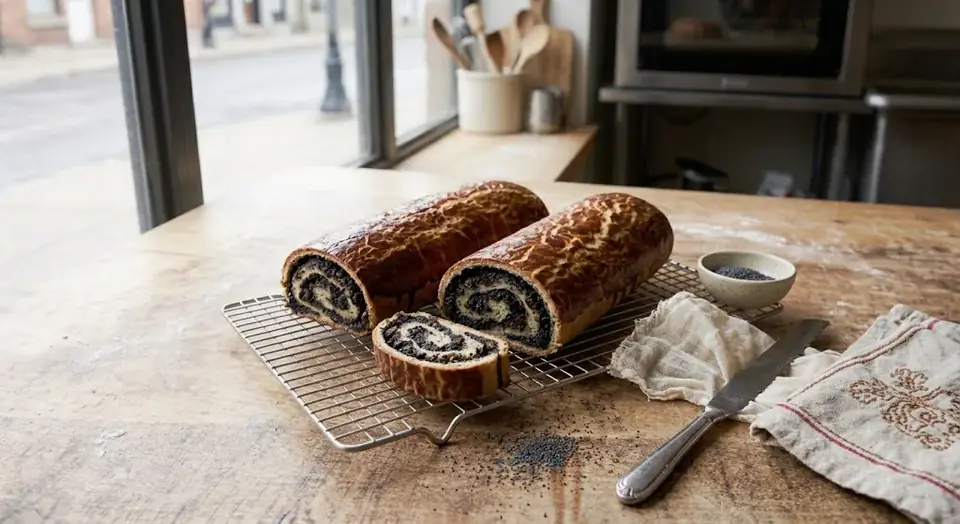
A close-coiled log, black with sweetened poppy, for the feast table.
At a glance.
Poppy Seed Roll comes from Poland and Hungary · Makowiec and Bejgli and appears in The Bread Atlas, in the chapter Sweet & Enriched Breads. It makes 2 rolls, takes about 5 hours, and uses 18 ingredients and 11 steps.
- Yield
- Makes 2 rolls
- Method
- Oven 180°C / 350°F
- Time
- 5 hours
Ingredients
Tap an ingredient to tick it off.
- Poppy Seed Filling
- The Dough
- Two-Stage Egg Wash
Method
-
Pour boiling water over the poppy seeds to cover, stand 20 minutes, then drain through a fine sieve lined with muslin and press dry. Scalding softens the hard seed coat so the grinder can break it; unsoftened seed rattles around the blades and stays whole.
-
Grind the drained seeds twice — in a poppy mill if you own one, otherwise in a spice grinder in small batches — until the mass turns from grey-blue and gritty to slate-dark and pasty. Whole poppy seeds taste of almost nothing; the flavor is inside them.
-
Simmer the ground poppy with the milk, honey, sugar, butter and raisins for 10–12 minutes, stirring, until it thickens to a spreadable paste that holds the mark of the spoon. Stir in the breadcrumbs and both zests, then cool completely.
-
Mix the dough: milk at 26°C and beaten egg into the flour, sugar, salt and yeast, rest 20 minutes, then knead 8 minutes. Work in the soft butter in three additions and continue to a smooth windowpane. Final dough temperature 25°C.
-
Bulk ferment 90 minutes at 25°C, until risen by three-quarters. Fold the whisked egg white into the cold filling immediately before you use it — it lightens the paste enough that it expands with the dough instead of resisting it.
-
Divide the dough in two and roll each piece to a rectangle 30 × 25 cm, 4 mm thick. Spread half the filling over each, leaving 2 cm clear on all four sides. Filling pushed to the edge is filling that will burst out at the seam.
-
Fold the two short sides in over the filling to seal the ends, then roll up firmly from a long edge, pressing after every turn to drive out air. Air pockets are the single commonest cause of a cracked roll. Set both seam-side down on a lined tray.
-
Brush all over with beaten egg white and refrigerate uncovered for 30 minutes until the coat is dry to the touch. Brush with the yolk, and dry again. The two coats set at different rates and craze into the marbled surface these rolls are known for.
-
Prick each roll right through to the filling with a skewer, eight or ten times along its length. These vents let steam escape from the filling, which is expanding faster than the dough around it. Prove only 30–40 minutes at 22°C — a short, cool prove.
-
Bake at 180°C / 350°F for 35–40 minutes, until deep brown and an internal 92°C. If a roll begins to split along its side, it is proving on in the oven's heat; drop the temperature to 165°C and it will hold.
-
Cool on a rack for at least 2 hours before cutting — the filling is molten and will smear. Cut in slices 1.5 cm thick with a serrated knife, and cut only what you will eat, keeping the rest of the log whole.
Cook’s notes
- To serve and keep
- Cut into thin rounds on a platter with poppy and walnut rolls alternating, at Christmas Eve or Easter, with coffee or a small glass of something. Worth knowing rather than worrying about: a quantity of poppy seed this large can produce a positive result on an opiate drug test. Store wrapped in foil in a cool larder.

Where it comes from
Poppy is a Central European staple crop, grown for seed and oil across Poland, Hungary, Slovakia and Austria long before it was a festival flavor, and the filled roll is its highest expression. In Poland makowiec is fixed to Wigilia, the meatless Christmas Eve supper of twelve dishes, where poppy appears again in the wheat-berry pudding kutia; the seed carries older associations in Slavic folk practice with sleep, with the dead and with abundance, and the Christmas table absorbed all of them. In Hungary mákos bejgli sits at both Christmas and Easter, always beside its walnut twin, diós bejgli, and the pair are among the few sweets baked in nearly every household regardless of religion. The names differ and so do the doughs: the Polish roll is a soft yeasted bread, the Hungarian one a barely leavened, almost pastry-like dough rolled thin. The filling is the constant — poppy scalded, ground and cooked with honey, dried fruit and citrus into a dense, faintly bitter paste.
Poppy Seed Roll: quick answers
How long does Poppy Seed Roll take?
About 5 hours.
How many does this Poppy Seed Roll recipe make?
This recipe makes 2 rolls.
Where does Poppy Seed Roll come from?
Poppy is a Central European staple crop, grown for seed and oil across Poland, Hungary, Slovakia and Austria long before it was a festival flavor, and the filled roll is its highest expression. In Poland makowiec is fixed to Wigilia, the meatless Christmas Eve supper of twelve dishes, where poppy appears again in the wheat-berry pudding kutia; the seed carries older associations in Slavic folk practice with sleep, with the dead and with abundance, and the Christmas table absorbed all of them. In Hungary mákos bejgli sits at both Christmas and Easter, always beside its walnut twin, diós bejgli, and the pair are among the few sweets baked in nearly every household regardless of religion. The names differ and so do the doughs: the Polish roll is a soft yeasted bread, the Hungarian one a barely leavened, almost pastry-like dough rolled thin. The filling is the constant — poppy scalded, ground and cooked with honey, dried fruit and citrus into a dense, faintly bitter paste.
More from Poland

More in Sweet & Enriched Breads
https://www.atlasserie.com/recipes/bread/poppy-seed-roll/