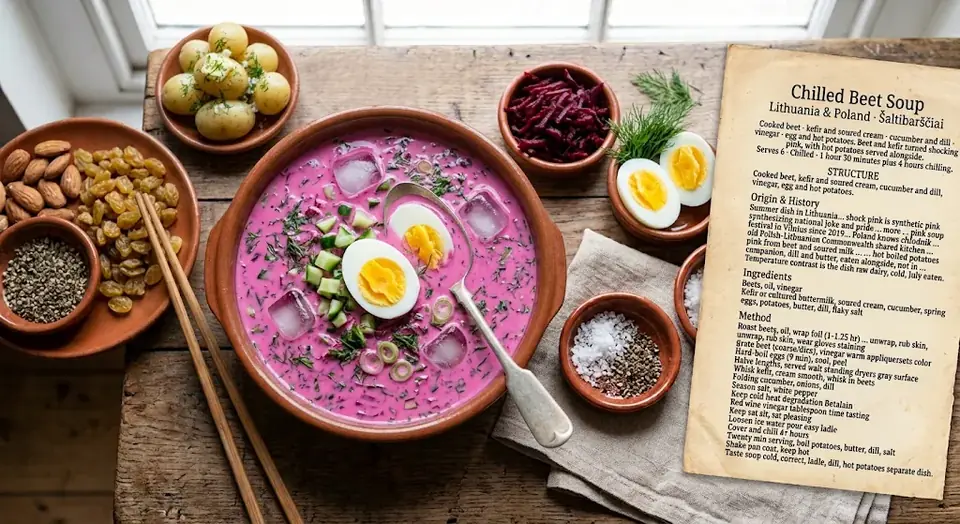
Lithuania & Poland · Šaltibarščiai · 52.13° N, 19.34° E
Chilled Beet Soup
Beet and kefir turned shocking pink, with hot potatoes served alongside.
At a glance.
Chilled Beet Soup comes from Lithuania & Poland · Šaltibarščiai and appears in The Soup Atlas, in the chapter Chilled & Light Soups. It serves 6, takes about 5 hr 30 min, and uses 16 ingredients and 10 steps.
- Yield
- Serves 6
- Method
- Chilled
- Time
- 5 hr 30 min
Ingredients
Tap an ingredient to tick it off.
- For the beets
- For the base
- For the eggs and potatoes
Method
-
Heat the oven to 200°C (400°F). Rub the beets with the oil, wrap them individually in foil and roast for 1–1¼ hours, until a skewer slides into the largest without resistance. Roasting keeps sugar and pigment inside the beet instead of leaching both into a pan of water.
-
Unwrap the beets while still warm and rub the skins off with a paper towel — they slip away in one piece. Wear gloves and use a board you do not mind staining, because betalain pigment dyes wood, plastic and fingernails on contact.
-
Grate the warm beets coarsely, or cut them into 5 mm dice for a chunkier bowl, and toss them at once with the 2 tablespoons of vinegar. Acid applied while they are still warm sets the color, and it is the first of two moves that keep this soup pink rather than brown.
-
Hard-boil the eggs for 9 minutes, cool them under running water and peel them. Halve them lengthways only when you are ready to serve; a cut yolk left standing in the refrigerator dries and greys at the surface.
-
Whisk the kefir and soured cream together in a large bowl until entirely smooth, then whisk in the cold beets and their vinegar. The change is immediate and worth watching for: deep crimson turns to fuchsia the moment the pigment is dispersed through opaque white dairy.
-
Fold in the cucumber, spring onions and dill, then season with the salt and white pepper. Keep the mixture cold throughout and do not be tempted to warm any part of it — heat above about 60°C degrades betalain to a dull brown within minutes.
-
Add the remaining vinegar a tablespoon at a time, tasting as you go. Beet is earthy and sweet, and this soup is meant to be assertively sour; keep going until it makes you sit up rather than stopping at pleasant. Kefir contributes acidity of its own, so taste before the last addition.
-
Loosen with ice water until it pours easily from a ladle but still holds the diced vegetables in suspension rather than letting them sink. Cover and chill for at least 4 hours; it must be aggressively cold, not merely cool.
-
Twenty minutes before serving, boil the potatoes in well-salted water for 15–18 minutes until tender, drain them, and return them to the hot pan with the butter, chopped dill and flaky salt. Shake the pan to coat them and keep them hot.
-
Taste the soup cold and correct the salt and vinegar one last time. Ladle it into chilled bowls, set half a boiled egg in each, scatter dill over, and bring the hot potatoes to the table in a separate dish for people to eat between spoonfuls.
Cook’s notes
- The technique
- The color is chemistry, not luck. Beets owe their pigment to betalains rather than the anthocyanins of red cabbage, and betalains are most stable and most vivid in mildly acidic conditions, around pH 4 to 5 — exactly where kefir and vinegar put this soup. They are also heat-sensitive and degrade steadily above 60°C, which is why the beets are roasted whole, dressed with acid while warm, and never cooked again. The shift from crimson to fluorescent pink comes from light scattering: pigment dispersed through opaque dairy reflects rather than absorbs, and the bowl reads far brighter than its ingredients.
- Make ahead
- Roast the beets up to three days ahead and keep them dressed with vinegar in a sealed box; they are better for the wait. The assembled soup holds two days, improving on the first as the dill and onion infuse, though the cucumber softens. Boil the eggs a day ahead and leave them whole in their shells. It cannot be frozen — kefir separates irreversibly. Cook the potatoes to order.
- Troubleshooting
- Brown rather than pink — the beets were boiled or the soup was warmed, and the pigment is gone for good. Muddy and sweet — not enough vinegar, which is the near-universal fault here. Curdled specks — very acidic kefir met salt too early; whisk in fresh soured cream. Vegetables sunk to the bottom — thinned too far with ice water.
- Variations
- Polish chłodnik often includes young beet leaves and stems, chopped and briefly cooked, and sometimes crayfish tails. Some Lithuanian cooks use pickled beets and a splash of their brine for extra sourness. Ukrainian versions lean on soured milk rather than kefir. A vegan version made with cashew cream and lemon holds the color but not the tang.
- To serve and keep
- Serve in deep chilled bowls with the halved egg on top, and the hot buttered potatoes in a bowl of their own — that hot-cold alternation is the tradition and the pleasure. Dark rye bread, cold beer or plain kefir all belong at the same table. Made in full within this recipe — Roasted and Acidulated Beets, Kefir and Soured Cream Base, Boiled Eggs, Hot Buttered Potatoes. Also listed in the Component Index at the back.

Where it comes from
Šaltibarščiai is Lithuania's summer dish in a way that admits no competition, and its color — a fluorescent, almost synthetic pink — has become a national joke and a point of pride at once. Vilnius has held a Pink Soup Festival since 2019, closing streets for it. Poland knows essentially the same soup as chłodnik litewski, literally the Lithuanian cold soup, a name that records the shared kitchen of the old Polish-Lithuanian Commonwealth, and versions run on through Belarus and into Ukraine. The pink comes from the meeting of beet and soured milk, and the accompaniment is fixed: a plate of hot boiled potatoes, usually dressed with dill and butter, eaten alongside the cold soup rather than in it. That contrast of temperatures is the dish, and Lithuanians will tell you a bowl served without the potatoes is incomplete. Keep it clear of its relatives elsewhere in this book. The hot roasted beet purée at 24 is smooth, warm and sharpened with horseradish, and the borscht at 90 is a full Ukrainian meat pot; this is raw dairy, cold, and eaten in July.
Chilled Beet Soup: quick answers
How long does Chilled Beet Soup take?
About 5 hr 30 min.
How many does this Chilled Beet Soup recipe make?
This recipe serves 6.
Where does Chilled Beet Soup come from?
Šaltibarščiai is Lithuania's summer dish in a way that admits no competition, and its color — a fluorescent, almost synthetic pink — has become a national joke and a point of pride at once. Vilnius has held a Pink Soup Festival since 2019, closing streets for it. Poland knows essentially the same soup as chłodnik litewski, literally the Lithuanian cold soup, a name that records the shared kitchen of the old Polish-Lithuanian Commonwealth, and versions run on through Belarus and into Ukraine. The pink comes from the meeting of beet and soured milk, and the accompaniment is fixed: a plate of hot boiled potatoes, usually dressed with dill and butter, eaten alongside the cold soup rather than in it. That contrast of temperatures is the dish, and Lithuanians will tell you a bowl served without the potatoes is incomplete. Keep it clear of its relatives elsewhere in this book. The hot roasted beet purée at 24 is smooth, warm and sharpened with horseradish, and the borscht at 90 is a full Ukrainian meat pot; this is raw dairy, cold, and eaten in July.
More from Poland

More in Chilled & Light Soups






https://www.atlasserie.com/recipes/soup/chilled-beet-soup/