United States · The Pan Roll · 39.87° N, 98.73° W
Cinnamon Swirl Rolls
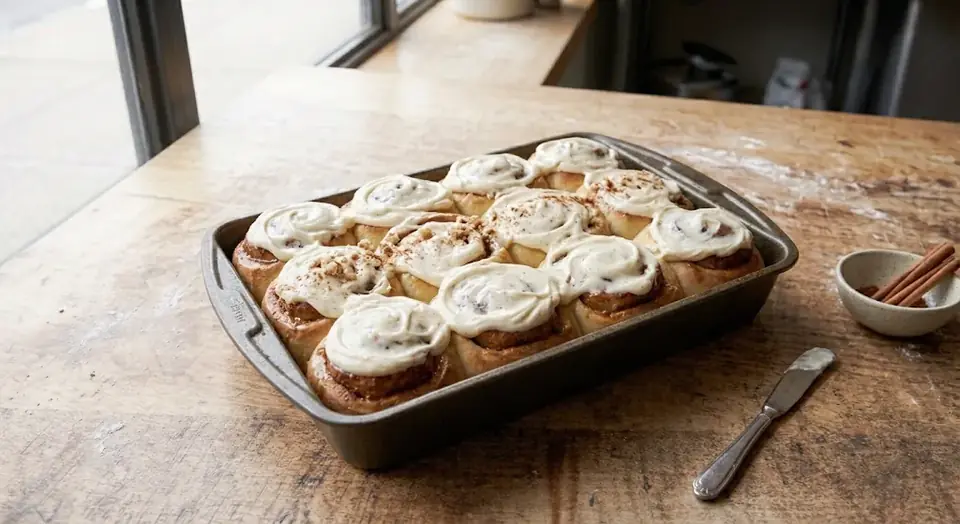
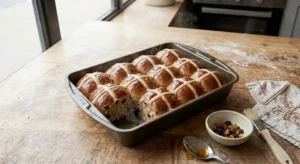
The American spiral: dark filling, soft sides, cream cheese frosting.
At a glance.
Cinnamon Swirl Rolls comes from United States · The Pan Roll and appears in The Bread Atlas, in the chapter Sweet & Enriched Breads. It makes 12 rolls, takes about 4 hours, and uses 19 ingredients and 11 steps.
- Yield
- Makes 12 rolls
- Method
- Oven 180°C / 350°F
- Time
- 4 hours
Ingredients
Tap an ingredient to tick it off.
- Tangzhong Scald
- The Dough
- Brown Sugar Filling
- Cream Cheese Frosting
Method
-
Whisk the scald flour into its milk in a small pan and cook over medium heat, stirring, for 2 minutes until it thickens into a slack paste that a spoon can draw a line through. Scrape it into the mixer bowl and cool to 25°C.
-
Add the dough milk at 22°C, the egg, flour, sugar, salt and yeast to the cooled scald and mix on low to a rough dough. Rest 20 minutes, then knead 8 minutes on second speed until smooth and strong.
-
Add the softened butter in three additions and continue to a full windowpane, 5–6 minutes more. The dough will be soft and a little slack from the scald; do not correct it with flour. Final dough temperature 25°C.
-
Bulk ferment 75–90 minutes at 25°C until doubled, or refrigerate overnight for the softer, better-tasting roll — the cold bulk is what makes this a bread you can start after dinner and bake for breakfast.
-
Beat the filling to a paste: brown sugar, very soft butter, cinnamon, salt and the tablespoon of flour, which absorbs the melting butter and stops the filling running out into the tin and burning.
-
Roll the dough to a rectangle 45 × 33 cm, long side toward you, and spread the filling over all of it except a 2 cm strip on the far edge. Press the filling down with the flat of a palette knife so it grips the dough.
-
Roll up firmly, keeping the tension even and stopping to straighten the log each half turn. Pinch the seam, then roll the log gently under both hands to even it out to 45 cm. Trim 1 cm off each ragged end.
-
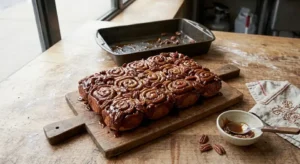
Cut 12 rolls with dental floss and set them cut-side up in a buttered 33 × 23 cm tin, three across and four down, with 1 cm between them. They will grow into each other; that contact is what gives the pale, tender sides.
-
Prove 60–75 minutes at 24°C — or 2 hours if the dough came from the refrigerator — until the rolls are touching, puffed, and slow to fill a dent. Set the oven to 180°C / 350°F with a rack in the middle.
-
Bake 24–28 minutes, until the tops are golden brown and the center roll reads 88–90°C. Pull them at the lower end of that range: these rolls are eaten soft, and the difference between soft and dry is about three minutes.
-
Beat the frosting while they bake — butter and cream cheese first until smooth, then the icing sugar, cream, vanilla and salt. Spread half over the rolls after 10 minutes, so it melts into the crevices, and the rest once they are barely warm.
Cook’s notes
- To serve and keep
- Warm, from the tin, on a weekend morning, one to a plate with a fork and coffee. In much of the American Midwest a cinnamon roll is also served alongside chili, which sounds implausible until you have done it. Cover the tin with foil at room temperature and eat within a day, or refrigerate once frosted.

Where it comes from
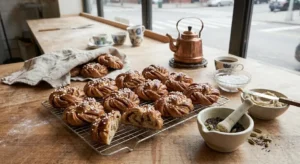
The American cinnamon roll came out of Central European and Scandinavian immigrant baking in the Midwest, where German Schnecken and Swedish sweet-dough buns were already in every settlement, and it diverged from both by moving into a shared tin and acquiring frosting. Baking the rolls packed against each other rather than spaced on a tray produces the format the country now recognizes: pale, tender sides where the dough touched, a single browned top, and a crumb soft enough to unwind in one strand. Frosting arrived later and cream cheese later still, a post-war addition that gave the roll its characteristic sweet-sour finish. The shopping-mall version standardized it. Cinnabon opened at Seattle-Tacoma airport in 1985 and built a business on an outsize roll, a heavy frosting and the smell pumped into a concourse; refrigerated dough in a tube had already put the same thing in home ovens. It is a sweeter, softer and less restrained bun than its European ancestors, and it is not pretending otherwise.
Cinnamon Swirl Rolls: quick answers
How long does Cinnamon Swirl Rolls take?
About 4 hours.
How many does this Cinnamon Swirl Rolls recipe make?
This recipe makes 12 rolls.
Where does Cinnamon Swirl Rolls come from?
The American cinnamon roll came out of Central European and Scandinavian immigrant baking in the Midwest, where German Schnecken and Swedish sweet-dough buns were already in every settlement, and it diverged from both by moving into a shared tin and acquiring frosting. Baking the rolls packed against each other rather than spaced on a tray produces the format the country now recognizes: pale, tender sides where the dough touched, a single browned top, and a crumb soft enough to unwind in one strand. Frosting arrived later and cream cheese later still, a post-war addition that gave the roll its characteristic sweet-sour finish. The shopping-mall version standardized it. Cinnabon opened at Seattle-Tacoma airport in 1985 and built a business on an outsize roll, a heavy frosting and the smell pumped into a concourse; refrigerated dough in a tube had already put the same thing in home ovens. It is a sweeter, softer and less restrained bun than its European ancestors, and it is not pretending otherwise.
More from United States




More in Sweet & Enriched Breads
https://www.atlasserie.com/recipes/bread/cinnamon-swirl-rolls/