United States · The Stacked Loaf · 39.87° N, 98.73° W
Pull-Apart Bread
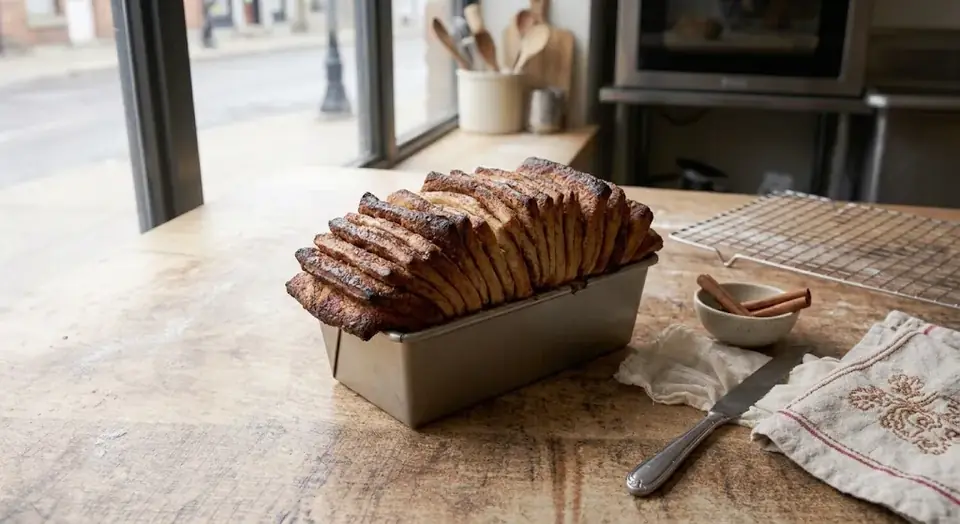
Buttered sheets stacked on edge, baked as a book of pages.
At a glance.
Pull-Apart Bread comes from United States · The Stacked Loaf and appears in The Bread Atlas, in the chapter Sweet & Enriched Breads. It makes 1 loaf, is made by oven 180°c / 350°f, and uses 14 ingredients and 11 steps.
- Yield
- Makes 1 loaf
- Method
- Oven 180°C / 350°F, 3¾ hours
Ingredients
Tap an ingredient to tick it off.
- The Dough
- Cinnamon-Sugar Butter
- Vanilla Glaze
Method
-
Mix the flour, sugar, salt and yeast with milk at 24°C and the eggs to a rough dough and rest 20 minutes. Knead 8 minutes, add the softened butter in three additions, and continue to a smooth, elastic windowpane. Target 25°C.
-
Bulk ferment 75–90 minutes at 25°C until doubled. Meanwhile mix the sugar, cinnamon and salt in one bowl and keep the melted butter in another — they go on separately, and that matters more than it sounds.
-
Knock the dough back gently and roll it on a lightly floured bench to a rectangle 50 × 30 cm, an even 3 mm thick. Take your time squaring the corners: uneven sheeting gives a lopsided loaf that leans as it rises.
-
Brush the whole sheet with the melted butter, right to the edges, then scatter the cinnamon sugar evenly over it. Buttering first and sugaring second glues the sugar in place; mixed to a paste it slides off the vertical faces later.
-
Cut the sheet into five strips 10 cm wide with a pizza wheel or a long knife, then cut across into five, giving 25 squares of about 10 cm. A ruler is not out of place here; even squares stand up straight in the tin.
-
Stack the squares into five piles of five, sugared faces all the same way up. Handle them by the edges — pressing the flats together squeezes the butter out from between the layers, and it is that butter that lets them separate later.
-
Butter and line a 23 × 13 cm loaf tin. Turn the piles on their sides and slot them into the tin like books on a shelf, cut edges upward, working the stacks together until they fill the length of the tin loosely.
-
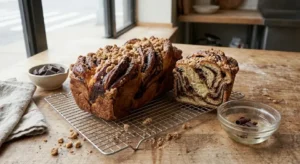
The stacks will not fill the tin at this stage and should not. Cover and prove 50–65 minutes at 24°C, until the dough has risen to the rim and the layers have swollen apart into visible pages with sugar showing between them.
-
Set the oven to 180°C / 350°F with a rack low. Bake 30–35 minutes on a low rack, tenting with foil at 20 minutes once the exposed edges are dark gold. The center is baked at 88–90°C — check between two layers, not at the very edge.
-
Cool in the tin 10 minutes, then run a knife round and lift the loaf out on the lining. Some caramel will have run into the base of the tin; scrape it up while it is warm and spread it back over the top.
-
Whisk the glaze to a pouring consistency and drizzle it across the crown while the loaf is still warm. Serve within the hour, pulled apart at the table one layer at a time.
Cook’s notes
- To serve and keep
- Set the whole loaf on a board in the middle of the table and let people pull the layers off with their fingers — a knife defeats the object. Best at brunch or with afternoon coffee. Store what is left in foil at room temperature and reheat rather than eat it cold.

Where it comes from
This loaf is a form rather than a recipe with a birthplace, and the form is a simple one: dough rolled into a thin sheet, buttered and sugared, cut into squares, stacked in piles and set on edge in a loaf tin so it bakes as a fan of pages. Central European baking had been layering butter into sweet doughs for centuries, and American home baking has stacked dough in pans since at least the mid-twentieth century, when bubble loaves and butterflake rolls appeared in community cookbooks. The version now known everywhere traces most directly to Flo Braker's cinnamon-sugar pull-apart bread in Baking for All Occasions of 2008, which food blogs took up around 2011 and reproduced until it became a fixture — an unusually well-documented case of a shape spreading by photograph. What recommends it is that no piping bag, mould or skill is involved; a rolling pin and a knife produce a loaf that looks considerably harder to make than it is, and it works as readily with garlic and cheese as with cinnamon.
Pull-Apart Bread: quick answers
How many does this Pull-Apart Bread recipe make?
This recipe makes 1 loaf.
Where does Pull-Apart Bread come from?
This loaf is a form rather than a recipe with a birthplace, and the form is a simple one: dough rolled into a thin sheet, buttered and sugared, cut into squares, stacked in piles and set on edge in a loaf tin so it bakes as a fan of pages. Central European baking had been layering butter into sweet doughs for centuries, and American home baking has stacked dough in pans since at least the mid-twentieth century, when bubble loaves and butterflake rolls appeared in community cookbooks. The version now known everywhere traces most directly to Flo Braker's cinnamon-sugar pull-apart bread in Baking for All Occasions of 2008, which food blogs took up around 2011 and reproduced until it became a fixture — an unusually well-documented case of a shape spreading by photograph. What recommends it is that no piping bag, mould or skill is involved; a rolling pin and a knife produce a loaf that looks considerably harder to make than it is, and it works as readily with garlic and cheese as with cinnamon.
More from United States



More in Sweet & Enriched Breads
https://www.atlasserie.com/recipes/bread/pull-apart-bread/