United States · Moravian Pennsylvania · 39.87° N, 98.73° W
Sticky Buns
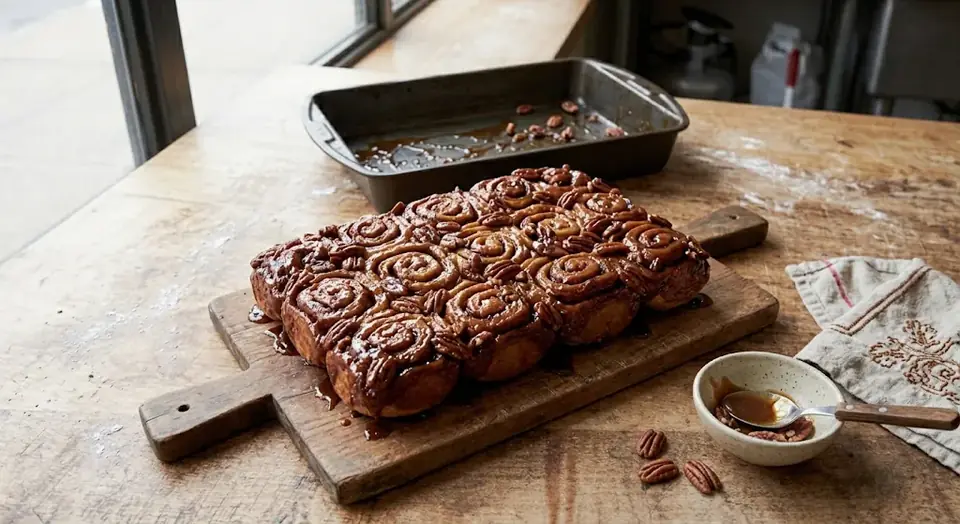
Buns baked over caramel and pecans, then turned upside down.
At a glance.
Sticky Buns comes from United States · Moravian Pennsylvania and appears in The Bread Atlas, in the chapter Sweet & Enriched Breads. It makes 12 buns, takes about 4 hours, and uses 16 ingredients and 11 steps.
- Yield
- Makes 12 buns
- Method
- Oven 180°C / 350°F
- Time
- 4 hours
Ingredients
Tap an ingredient to tick it off.
- The Dough
- Caramel Goo
- Cinnamon Filling
Method
-
Mix the flour, sugar, salt and yeast with milk at 24°C and the egg yolks to a rough dough, and rest 15 minutes. Yolks rather than whole eggs: the fat and lecithin enrich the crumb without the drying effect of the whites.
-
Knead 8 minutes, then add the soft butter in three pieces and work each in before the next. Continue until the dough is smooth and stretches to a thin membrane, about 5 minutes more. Final dough temperature 25°C.
-
Bulk ferment 75–90 minutes at 25°C, until doubled. Meanwhile toast the pecans 8 minutes at 170°C and let them cool — untoasted nuts go soft and tallowy under the caramel, and the difference is obvious.
-
Make the goo: melt the butter with the brown sugar, honey and cream over low heat, stirring only until the sugar dissolves and the mixture is smooth. Do not boil it to a caramel; it is meant to be a syrup that thickens in the oven, not a set toffee.
-
Pour the warm goo into a 33 × 23 cm baking tin and tilt it into an even layer. Scatter the pecans over, flat side up, and let it cool and stiffen while you shape. A cold base holds the buns in place as they prove.
-
Roll the dough to a rectangle 45 × 30 cm, long side toward you. Beat the filling butter, brown sugar and cinnamon to a paste and spread it right to the edges, leaving a bare 2 cm strip along the far side.
-
Roll up firmly from the near edge, pressing the log gently after each turn so no air is trapped. Pinch the far seam to seal. The log should be about 45 cm long and even along its length; roll it back and forth once to true it up.
-
Cut into 12 rounds with unwaxed dental floss or a length of thread — slide it under the log, cross the ends over the top and pull. A knife squashes the spiral flat; floss cuts it round.
-
Set the buns cut-side up on the cooled goo, four by three, with a finger's gap between them. Cover and prove 60–75 minutes at 24°C, until they have swollen into each other and a fingertip leaves a dent that fills back slowly.
-
Bake at 180°C / 350°F for 28–32 minutes, until deep gold and an internal 90°C. The goo will be bubbling furiously up the sides; set the tin on a tray first, because it will boil over if the pan is at all shallow.
-
Rest exactly 5 minutes, then run a knife round the edge, lay a board over the tin and invert in one movement. Leave the tin in place a minute to let the caramel run down, then lift it away and serve warm.
Cook’s notes
- To serve and keep
- Eaten warm with the fingers and strong coffee, at breakfast or mid-morning, never with a fork. Serve them from the board they were turned out onto and spoon back any caramel that has run. Store covered at room temperature; the refrigerator turns the goo to cement.

Where it comes from
Sticky buns belong to the German-speaking settlement of eastern Pennsylvania. Moravians founded Bethlehem in 1741 and Lititz in 1756, bringing with them a tradition of sweet yeast baking for the Lovefeast — the Moravian sugar cake, pressed with butter and brown sugar, is its plainest surviving expression. Around them the wider Pennsylvania German community baked Schnecken, snails, the same rolled spiral set over butter, sugar and nuts. The bun that emerged is defined by a single decision: it is baked upside down. The sugar mixture goes into the tin first, the buns are set on top, and the pan is inverted while hot so what was the base becomes a lacquered topping. That is the whole difference from a cinnamon roll, which is baked right side up and iced afterwards, and it changes the eating — no cool frosting, but a hot caramel that has soaked back up into the crumb. Philadelphia claimed the bun commercially by the late nineteenth century, though no bakery's ledger settles who did it first.
Sticky Buns: quick answers
How long does Sticky Buns take?
About 4 hours.
How many does this Sticky Buns recipe make?
This recipe makes 12 buns.
Where does Sticky Buns come from?
Sticky buns belong to the German-speaking settlement of eastern Pennsylvania. Moravians founded Bethlehem in 1741 and Lititz in 1756, bringing with them a tradition of sweet yeast baking for the Lovefeast — the Moravian sugar cake, pressed with butter and brown sugar, is its plainest surviving expression. Around them the wider Pennsylvania German community baked Schnecken, snails, the same rolled spiral set over butter, sugar and nuts. The bun that emerged is defined by a single decision: it is baked upside down. The sugar mixture goes into the tin first, the buns are set on top, and the pan is inverted while hot so what was the base becomes a lacquered topping. That is the whole difference from a cinnamon roll, which is baked right side up and iced afterwards, and it changes the eating — no cool frosting, but a hot caramel that has soaked back up into the crumb. Philadelphia claimed the bun commercially by the late nineteenth century, though no bakery's ledger settles who did it first.
More from United States
More in Sweet & Enriched Breads
https://www.atlasserie.com/recipes/bread/sticky-buns/