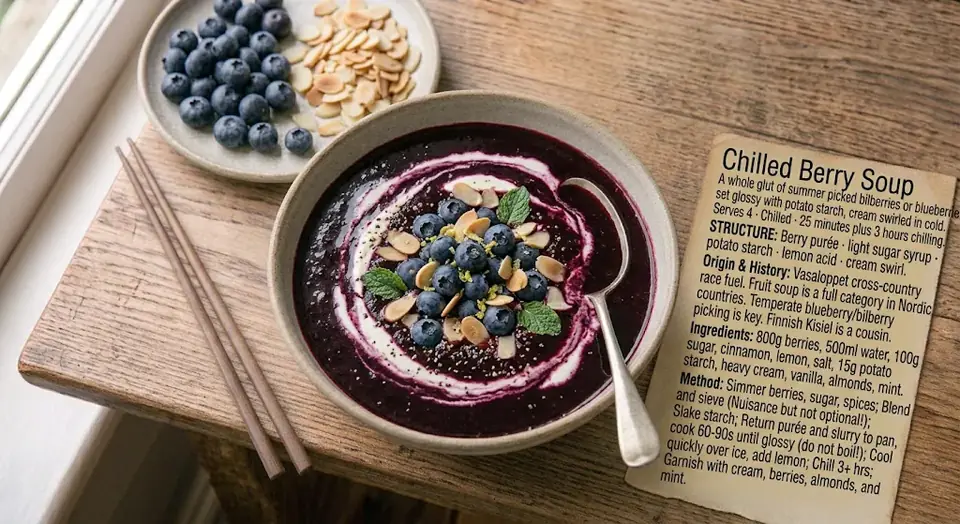
Sweden & Finland · Blåbärssoppa · 62.42° N, 16.11° E
Chilled Berry Soup
Berries barely cooked, set glossy with potato starch, cream swirled in cold.
At a glance.
Chilled Berry Soup comes from Sweden & Finland · Blåbärssoppa and appears in The Soup Atlas, in the chapter Chilled & Light Soups. It serves 4, takes about 3 hr 25 min, and uses 13 ingredients and 10 steps.
- Yield
- Serves 4
- Method
- Chilled
- Time
- 3 hr 25 min
Ingredients
Tap an ingredient to tick it off.
- For the berry base
- For the thickener
- To finish
Method
-
Set aside 100 g of the best berries for the finish. Put the rest in a saucepan with the water, sugar, cinnamon stick, lemon zest and salt, and bring to a simmer over medium heat, stirring once or twice to dissolve the sugar.
-
Simmer for 8–10 minutes only, until the skins have split and the fruit has slumped into the liquid and turned it deep purple. Stop there. Long cooking drives off the fresh, sharp aromatics and leaves you with something closer to jam than to fruit.
-
Lift out the cinnamon stick and the strip of zest. Both go on giving while the soup chills, and a cinnamon stick left in overnight will take the bowl over completely.
-
Blend the fruit and its liquid until smooth, then pass it through a fine sieve set over a clean pan, pressing hard with a ladle. Berry seeds are small enough to be missed in the jug and impossible to ignore in a spoonful. This is a nuisance and it is not optional.
-
Slake the potato starch in the cold water and stir until no white settles at the bottom of the cup. Starch added dry to hot liquid seizes into lumps on contact; slaked, it disperses evenly through the pan.
-
Bring the sieved purée back to a bare simmer, stir the slurry through it, and cook for 60–90 seconds only, stirring constantly, until it thickens very slightly and turns glossy. Take it off the heat the moment it does.
-
Do not let it boil hard after the starch goes in. Potato starch thickens fast at around 65°C (150°F) and then breaks down under continued heat and agitation, which leaves you with a soup that is thin at the table and weeping in the fridge.
-
Cool it quickly over an iced water bath, stirring, then add the lemon juice off the heat. Acid added to hot starch weakens the set, and lemon added cold keeps its brightness rather than cooking away into a dull background sourness.
-
Chill for at least 3 hours, until properly cold. Taste it there and adjust the sugar and the lemon against each other — cold suppresses sweetness sharply, and the balance you struck in a warm pan will read as sour and thin now.
-
Whip the cream to soft peaks with the vanilla. Ladle the soup into chilled bowls, spoon the cream into the middle and draw a knife once through it, then scatter the reserved berries, the almonds and a few mint leaves.
Cook’s notes
- The technique
- Potato starch is the Nordic thickener for good reason. Its granules are unusually large and swell at a lower temperature than corn or wheat starch, so a small quantity thickens fast and sets clear and glossy rather than pasty. That slight set is doing structural work: a fruit purée is a suspension of pulp in sugar water, and without it the solids sink and the liquid separates within hours. The trade-off is fragility. Potato starch cannot take a hard boil or a long hold, so it goes in at the very end and the pan comes off the heat immediately.
- Make ahead
- It keeps three days refrigerated and is arguably better on the second day, once the cinnamon has settled through. Freeze the base before the cream goes anywhere near it — up to three months — and let it thaw in the refrigerator overnight, then whisk to bring the starch back into suspension. Whip the cream fresh; it weeps if held.
- Troubleshooting
- Separated into clear liquid and sludge — the starch boiled after thickening, or was never slaked. Gritty on the tongue — the seeds went through unsieved. Cloudy and pasty — cornstarch was used and over-cooked. Cloying — it needs the lemon, and it needs it added cold, not more sugar.
- Variations
- Nyponsoppa, made with dried rosehips, is the Swedish winter version and is served warm with almond flakes. Finnish mustikkakeitto is thinner and drunk from a cup. Polish kisiel firms up further and sets almost to a jelly. A rhubarb and strawberry version needs a third more sugar and no cinnamon at all.
- To serve and keep
- Serve cold in shallow bowls as a light first course, or in glasses as a pudding, with a crisp almond biscuit. Swedes eat it with pancakes at the end of a meal and drink it hot from a thermos in the snow. Cold milk alongside is the traditional partner, not wine. Made in full within this recipe — Sieved Berry Purée, Potato Starch Slurry, Vanilla Cream Swirl. Also listed in the Component Index at the back.

Where it comes from
Fruit soup is a full category in the Nordic countries rather than a curiosity. Sweden has blåbärssoppa, made from wild bilberries, and nyponsoppa from rosehips; Finland makes mustikkakeitto and a whole family of kiisseli; Denmark and Norway have their own versions, and the Baltic and Polish kisiel is a first cousin, thickened the same way with potato starch. It is drunk hot from a thermos in winter and eaten cold from a bowl in summer, which is why it refuses to sit neatly as either a starter or a pudding. Its most public appearance is athletic: blåbärssoppa has been handed to skiers at the feed stations of the Vasaloppet, the 90-kilometre Swedish cross-country race, for the best part of a century, and Swedes associate the smell of it with cold hands and long distances. In the kitchen it is a way of using up the short, heavy glut of a summer picking, and Swedish children meet it in school lunches long before they meet it in a restaurant.
Chilled Berry Soup: quick answers
How long does Chilled Berry Soup take?
About 3 hr 25 min.
How many does this Chilled Berry Soup recipe make?
This recipe serves 4.
Where does Chilled Berry Soup come from?
Fruit soup is a full category in the Nordic countries rather than a curiosity. Sweden has blåbärssoppa, made from wild bilberries, and nyponsoppa from rosehips; Finland makes mustikkakeitto and a whole family of kiisseli; Denmark and Norway have their own versions, and the Baltic and Polish kisiel is a first cousin, thickened the same way with potato starch. It is drunk hot from a thermos in winter and eaten cold from a bowl in summer, which is why it refuses to sit neatly as either a starter or a pudding. Its most public appearance is athletic: blåbärssoppa has been handed to skiers at the feed stations of the Vasaloppet, the 90-kilometre Swedish cross-country race, for the best part of a century, and Swedes associate the smell of it with cold hands and long distances. In the kitchen it is a way of using up the short, heavy glut of a summer picking, and Swedish children meet it in school lunches long before they meet it in a restaurant.
More from Sweden



More in Chilled & Light Soups



https://www.atlasserie.com/recipes/soup/chilled-berry-soup/