United Kingdom · The Tea Room Counter · 53.77° N, 2.57° W
Cheese Scones
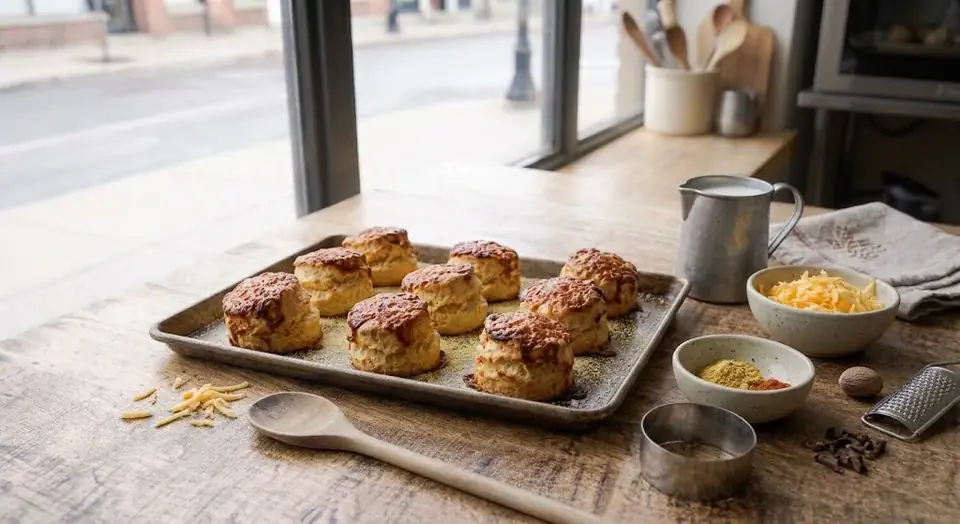
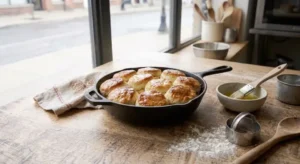
Mature cheddar, mustard powder, and a lacy browned cap of cheese.
At a glance.
Cheese Scones comes from United Kingdom · The Tea Room Counter and appears in The Bread Atlas, in the chapter Quick Breads & Batter Loaves. It makes 10 scones, takes about 35 minutes, and uses 11 ingredients and 11 steps.
- Yield
- Makes 10 scones
- Method
- Oven 220°C / 425°F
- Time
- 35 minutes
Ingredients
Tap an ingredient to tick it off.
- The Dough
- Cheese and Mustard Top
Method
-
Heat the oven to 220°C / 425°F and line a heavy tray. Grate all 180 g of the cheddar on the coarse holes and keep the 50 g for the tops in a separate bowl in the fridge — cold cheese browns rather than running off the sides.
-
Whisk the flour, baking powder, mustard powder, cayenne and salt together. Mustard powder contributes almost no heat at this quantity; it works on the cheese, amplifying its savour, and the cayenne does the same from the other direction. Neither should be identifiable in the finished scone.
-
Rub in the cold butter until the mixture resembles coarse breadcrumbs. Note that there is a third less butter here than in a sweet scone. The cheese will contribute its own fat — roughly a third of cheddar's weight is butterfat — and using the full quantity of butter as well makes a greasy, collapsing scone.
-
Stir the 130 g of grated cheddar through the dry mixture with your fingers, separating the shreds so they are coated in flour and spread evenly. Cheese added later, into the wet dough, clumps and drops to the base.
-
Beat the egg into the cold milk and pour four-fifths of it in, cutting the dough together with a round-bladed knife. Cheese absorbs no liquid, so this dough takes slightly more milk than a plain scone dough of the same flour weight. Add the rest if it looks dry.
-
Bring it together into a soft, rough, sticky mass and turn onto a floured surface. Fold it over on itself two or three times to consolidate, patting between folds, and no further — the aim is to distribute, not to develop.
-
Pat out to a depth of 3 cm. A savory scone is generally cut a little wider and flatter than a sweet one, but not thinner; the height is where the soft interior comes from.
-
Cut with a floured 6 cm cutter, pushing down cleanly and lifting away without rotating the cutter, and set the rounds on the tray with 4 cm between them. Gather and re-pat the offcuts once.
-
Brush the tops with milk and pile the reserved cheddar on them, mounded rather than sprinkled, keeping it clear of the edges. Cheese that hangs over the side will melt onto the tray and fry into a hard skirt that welds the scone down.
-
Bake 12–15 minutes, until risen with a clear break around the waist and the cheese on top blistered, lacy and deep brown at its peaks. That browning is the Maillard reaction working on the cheese's own proteins and amino acids, and it is the best flavor in the scone.
-
Cool on a rack 10 minutes. Eat warm, but not straight from the oven — molten cheddar is scalding, and the crumb needs a few minutes to set before it will split without tearing.
Cook’s notes
- To serve and keep
- Split warm and butter thickly — the butter is not optional, whatever the cheese content. They go with tomato soup, with a plate of pickles and ham, or alone at eleven in the morning. Keep them in a tin, never a plastic box, which softens the browned cap within hours.

Where it comes from
The savory scone is the tea room's answer to the sandwich, and it depends on a cheese that Britain happens to produce in quantity. Cheddaring — stacking and turning slabs of curd to expel whey and build acidity — takes its name from the Somerset village and was described in scientific detail by Joseph Harding in the mid-nineteenth century, whose methods spread the style worldwide. What matters at the oven is age: a young cheddar is mild and rubbery, while a cheese matured 12 to 18 months has lost water, concentrated its salt and glutamates, and browns rather than melts to a puddle. Cheese scones as a fixed item on British café and canteen menus are a twentieth-century development, and they carry the marks of institutional baking — mustard powder and a pinch of cayenne, both cheap, both there to push a modest quantity of cheese further. They are eaten at eleven in the morning, warm, with butter, and rarely written about at all.
Cheese Scones: quick answers
How long does Cheese Scones take?
About 35 minutes.
How many does this Cheese Scones recipe make?
This recipe makes 10 scones.
Where does Cheese Scones come from?
The savory scone is the tea room's answer to the sandwich, and it depends on a cheese that Britain happens to produce in quantity. Cheddaring — stacking and turning slabs of curd to expel whey and build acidity — takes its name from the Somerset village and was described in scientific detail by Joseph Harding in the mid-nineteenth century, whose methods spread the style worldwide. What matters at the oven is age: a young cheddar is mild and rubbery, while a cheese matured 12 to 18 months has lost water, concentrated its salt and glutamates, and browns rather than melts to a puddle. Cheese scones as a fixed item on British café and canteen menus are a twentieth-century development, and they carry the marks of institutional baking — mustard powder and a pinch of cayenne, both cheap, both there to push a modest quantity of cheese further. They are eaten at eleven in the morning, warm, with butter, and rarely written about at all.
More from United Kingdom


More in Quick Breads & Batter Loaves
https://www.atlasserie.com/recipes/bread/cheese-scones/