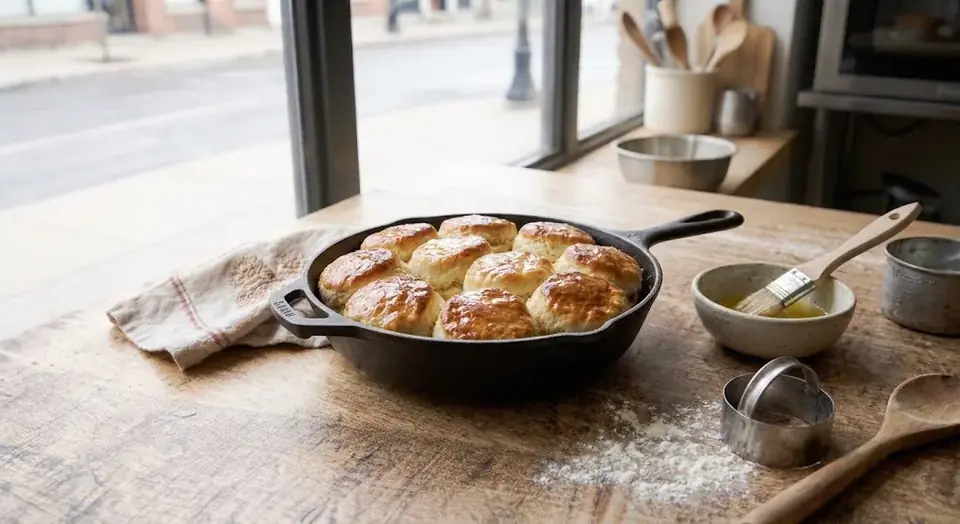
American South · The Soft-Wheat Belt · 33.52° N, 86.80° W
Buttermilk Biscuits
Cold fat, soft flour, a folded dough and a cutter pressed straight down.
At a glance.
Buttermilk Biscuits comes from American South · The Soft-Wheat Belt and appears in The Bread Atlas, in the chapter Quick Breads & Batter Loaves. It makes 10 biscuits, takes about 40 minutes, and uses 8 ingredients and 11 steps.
- Yield
- Makes 10 biscuits
- Method
- Oven 230°C / 450°F
- Time
- 40 minutes
Ingredients
Tap an ingredient to tick it off.
- The Dough
- Butter Finish
Method
-
Heat the oven to 230°C / 450°F with a rack just above centre. Line a baking sheet, or better, get out a 23 cm cast-iron skillet — biscuits baked shoulder to shoulder in a pan support one another as they rise and climb higher than biscuits set apart.
-
Whisk the flour, baking powder, soda, salt and optional sugar together. If all-purpose flour at 10–11% protein is all you can get, replace 60 g of it with cornflour to bring the effective protein down; the crumb will be noticeably more tender for it.
-
Add the frozen butter cubes and cut them in with a pastry blender or your fingertips, working fast and lifting the mixture as you go to keep it cool. Stop when the largest pieces are the size of a pea and the rest is coarse and floury.
-
Pour in the cold buttermilk all at once and stir with a fork — 10 or 12 turns, no more — until a shaggy, sticky mass forms with dry patches still showing. Overworked biscuit dough goes elastic, and elastic dough bakes into a bread roll.
-
Tip it onto a floured surface and pat, do not roll, into a rough rectangle 2 cm thick. Flour your hands rather than the dough; excess surface flour bakes into a dusty seam.
-
Fold the rectangle in thirds like a letter, turn it 90 degrees, pat out again and repeat twice more. Three folds give you roughly two dozen alternating layers of butter and dough — lamination, done crudely and fast, and the reason a biscuit pulls apart in sheets.
-
Pat the folded dough to a final thickness of 2.5 cm. Thin dough gives thin biscuits; there is no rise in the oven that will rescue a slab rolled out to a centimetre.
-
Dip a 6.5 cm cutter in flour and press it straight down through the dough, then lift it straight out. Do not twist. Twisting shears and seals the cut edge, gluing the laminated layers to one another so that one side of the biscuit rises and the other stays where it was.
-
Set the rounds in the skillet with their sides just touching. Press the scraps together gently — do not knead them — pat out and cut again, and bake those in a second batch, accepting that they will be a little tougher.
-
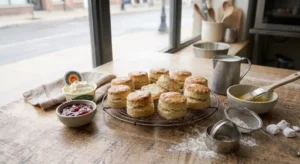
Bake 12–15 minutes, until risen tall, the tops deep gold and the sides pale where they touched. The internal temperature will be 96°C. Brush the tops with melted butter the moment they come out, while the crust is still open enough to drink it in.
-
Serve within twenty minutes. A biscuit's life is short — this is a bread designed to be eaten standing at the stove, and it is measurably worse an hour later and a different food the next morning.
Cook’s notes
- To serve and keep
- Split by hand rather than cut — a knife compresses the layers — and fill with country ham, or flood with sausage gravy, or eat with butter and sorghum syrup. They are also the lid of a chicken pie and the base of a strawberry shortcake in the southern manner.

Where it comes from
The biscuit belongs to a specific field. Soft red winter wheat grows through the mild, damp winters of the mid-South and mills to a flour of 8–9% protein — too weak for a raised loaf, ideal for a tender chemically leavened one — and the region's kitchens built a bread around it. White Lily, milled in Knoxville, Tennessee under that name since 1883, is the flour most southern bakers name, and the difference between it and northern all-purpose is large enough to change a recipe's outcome. Before chemical leavening the same dough was raised by beating, folding and hard labor; commercial baking powder from the 1850s onward, and later the self-rising flours sold across the South, made a hot bread possible at every meal. The biscuit then became institutional — breakfast under sausage gravy, supper with ham, and the ceremonial companion to fried chicken. It is not a scone, and no southern cook would confuse the two.
Buttermilk Biscuits: quick answers
How long does Buttermilk Biscuits take?
About 40 minutes.
How many does this Buttermilk Biscuits recipe make?
This recipe makes 10 biscuits.
Where does Buttermilk Biscuits come from?
The biscuit belongs to a specific field. Soft red winter wheat grows through the mild, damp winters of the mid-South and mills to a flour of 8–9% protein — too weak for a raised loaf, ideal for a tender chemically leavened one — and the region's kitchens built a bread around it. White Lily, milled in Knoxville, Tennessee under that name since 1883, is the flour most southern bakers name, and the difference between it and northern all-purpose is large enough to change a recipe's outcome. Before chemical leavening the same dough was raised by beating, folding and hard labor; commercial baking powder from the 1850s onward, and later the self-rising flours sold across the South, made a hot bread possible at every meal. The biscuit then became institutional — breakfast under sausage gravy, supper with ham, and the ceremonial companion to fried chicken. It is not a scone, and no southern cook would confuse the two.
More from United States


More in Quick Breads & Batter Loaves
https://www.atlasserie.com/recipes/bread/buttermilk-biscuits/