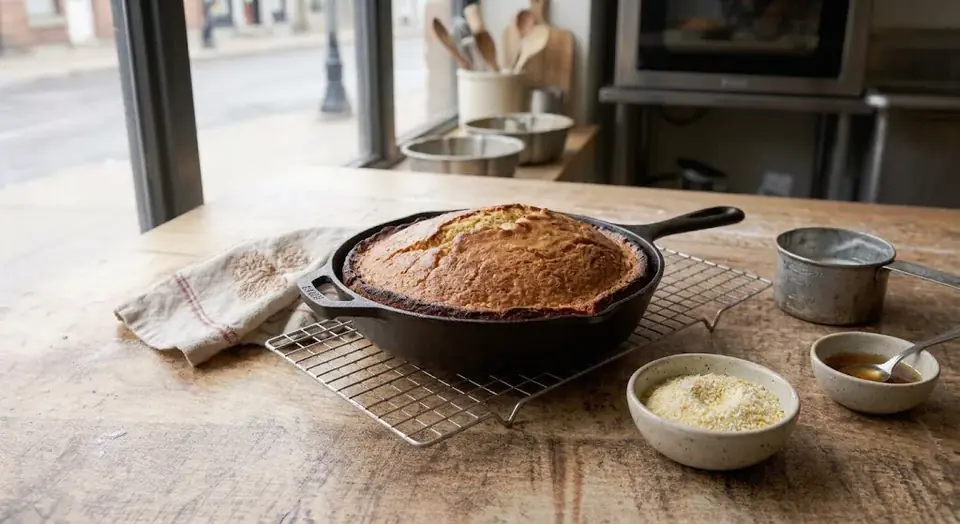
American South · The Cast-Iron Skillet · 33.52° N, 86.80° W
Cornbread
No sugar, no wheat, buttermilk and a crust set in hot bacon fat.
At a glance.
Cornbread comes from American South · The Cast-Iron Skillet and appears in The Bread Atlas, in the chapter Quick Breads & Batter Loaves. It makes 1 skillet, takes about 45 minutes, and uses 9 ingredients and 11 steps.
- Yield
- Makes 1 skillet
- Method
- Oven 220°C / 425°F
- Time
- 45 minutes
Ingredients
Tap an ingredient to tick it off.
- The Skillet
- The Batter
Method
-
Put a 25 cm (10 in) cast-iron skillet on the middle rack and heat the oven to 220°C / 425°F. The pan heats empty for a full 15 minutes. Everything that distinguishes this bread from a corn muffin happens in the first three seconds of contact with that surface.
-
While it heats, whisk the cornmeal, the optional flour, the soda, the baking powder and the salt together in a wide bowl. Stone-ground meal is uneven by nature, with flecks of germ and bran visible in it, and it will smell faintly sweet and grassy if it is fresh.
-
Whisk the buttermilk and eggs together in a jug until uniform. Buttermilk is doing two jobs — it is the liquid, and it is the acid that will react with the soda. Cultured buttermilk from a carton works; thin plain yogurt with water to the same consistency if you have none.
-
Take the skillet out and set it on the hob over medium heat. Add the 30 g of bacon drippings and swirl until the fat runs thin and shimmers, tilting the pan so it climbs 2 cm up the sides. It should smell of bacon, not of smoke.
-
Pour the remaining 30 g of melted fat into the buttermilk and whisk it in — warm fat into cold liquid, quickly, so it disperses rather than setting into shards.
-
Pour the wet into the dry and stir with a spoon perhaps 20 times, until no dry meal remains. Cornmeal has no gluten to overdevelop, so this batter is more forgiving than a wheat one, but the wheat flour in it is not, and stirring beyond this point tightens the crumb.
-
Pour the batter straight into the hot skillet in one motion. It must hiss loudly and the edges must begin to set and lift within seconds. That instant sear is what produces the lacquered, crisp brown wall that a cold pan cannot give you at any temperature.
-
Return the skillet to the oven at once and bake 20–25 minutes without opening the door. The bread rises, cracks across the top, and pulls very slightly away from the sides of the pan.
-
It is done when the top is a deep even gold, the edges are dark brown, and the centre reads 96°C. A skewer will come out clean a few minutes before that; trust the thermometer, because cornmeal holds water invisibly.
-
Run a knife around the edge and turn the bread out immediately, upside down onto a rack first so the crust does not steam soft, then back the right way up. Left sitting in the pan it sweats and the whole point is lost.
-
Rest 10 minutes only, then cut into wedges and eat hot. This is the one bread in the chapter that is worse cold — the crumb is coarse and dries within hours, which is why the South has always eaten it at the meal it was baked for.
Cook’s notes
- To serve and keep
- It goes with the food it was built for: greens cooked with pork, pinto beans and their liquor, chili, or a plate of fried fish. Butter it hot. In parts of Appalachia the last piece is crumbled into a glass of cold buttermilk and eaten with a spoon.

Where it comes from
Maize was the grain of the American South before it was anyone's choice to be, grown across the continent by Indigenous farmers long before European arrival and adopted by settlers who found wheat unreliable in southern heat and soil. Unlike Mesoamerican cooks, southern kitchens did not nixtamalize their corn; they ground it and baked it — as ash cake, hoecake, pone and finally as the skillet bread of the last century and a half. Buttermilk came from the churn, the fat came from the pig, and the vessel came from the hearth, where a cast-iron pan or a lidded spider sat directly in the coals. Two industrial changes reshaped the bread around 1900: steam-powered degerminating mills produced a shelf-stable meal stripped of germ and oil, and cheap refined sugar became universal. Southern cooks resisted both, and the older water-ground meal survives at working mills across Appalachia and the Piedmont. Cornbread made this way is a bread of the meal table, not a cake.
Cornbread: quick answers
How long does Cornbread take?
About 45 minutes.
How many does this Cornbread recipe make?
This recipe makes 1 skillet.
Where does Cornbread come from?
Maize was the grain of the American South before it was anyone's choice to be, grown across the continent by Indigenous farmers long before European arrival and adopted by settlers who found wheat unreliable in southern heat and soil. Unlike Mesoamerican cooks, southern kitchens did not nixtamalize their corn; they ground it and baked it — as ash cake, hoecake, pone and finally as the skillet bread of the last century and a half. Buttermilk came from the churn, the fat came from the pig, and the vessel came from the hearth, where a cast-iron pan or a lidded spider sat directly in the coals. Two industrial changes reshaped the bread around 1900: steam-powered degerminating mills produced a shelf-stable meal stripped of germ and oil, and cheap refined sugar became universal. Southern cooks resisted both, and the older water-ground meal survives at working mills across Appalachia and the Piedmont. Cornbread made this way is a bread of the meal table, not a cake.
More from United States


More in Quick Breads & Batter Loaves
https://www.atlasserie.com/recipes/bread/cornbread/