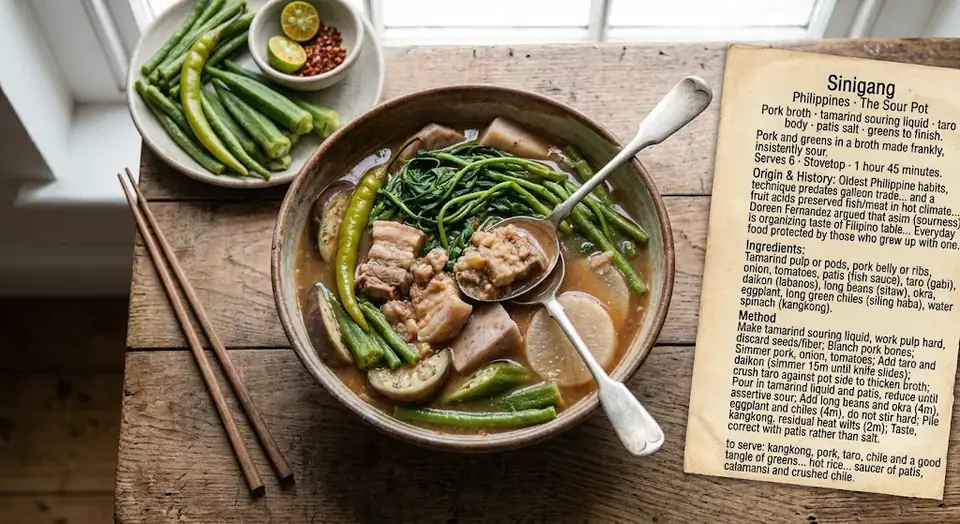
Philippines · The Sour Pot · 15.74° N, 121.55° E
Sinigang
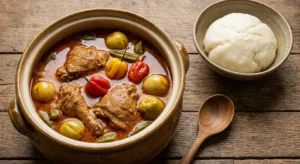
Pork and greens in a broth made frankly, insistently sour.
At a glance.
Sinigang comes from Philippines · The Sour Pot and appears in The Soup Atlas, in the chapter Soups Around the World. It serves 6, takes about 1 hr 45 min, and uses 17 ingredients and 10 steps.
- Yield
- Serves 6
- Method
- Stovetop
- Time
- 1 hr 45 min
Ingredients
Tap an ingredient to tick it off.
- For the tamarind souring liquid
- For the pot
- For the vegetables
- To serve
Method
-
Make the souring liquid first. Simmer the tamarind pulp in the hot water for 15 minutes, mashing it against the side of the pan with a spoon until the flesh slips off the seeds. Push the whole lot through a fine sieve, working the pulp hard, and discard the seeds and fiber.
-
Put the pork in a large pot with the cold water and bring it slowly to a boil. Skim the gray foam for ten minutes until the surface stays clear, then lower the heat to a steady tremble and add the onion. Simmer, uncovered, for 45 minutes.
-
Add the tomatoes and cook another 15 minutes, crushing them against the side of the pot with a spoon as they collapse. They are not there for flavor so much as for the faint body and color their pulp gives the broth.
-
Wear gloves or peel under running water when you prepare the taro — raw corms carry calcium oxalate crystals that itch badly on bare hands. Add the taro and daikon and simmer 15 minutes, until a knife slides into the taro with almost no resistance.
-
Crush two or three pieces of the softened taro against the side of the pot and stir them back in. That released starch is the only thickening this soup gets, and it is what stops the broth from tasting like sour water.
-
Pour in the tamarind liquid and the patis. Bring it back to a simmer and taste. It should be assertively, almost startlingly sour with a strong salt line underneath; if it reads timid, reduce it a few minutes rather than adding more tamarind.
-
Add the long beans and okra and cook for 4 minutes. Add the eggplant and whole green chiles and cook 4 minutes more, until the eggplant is translucent at the edges but still holding together. Do not stir hard from here on.
-
Take the pot off the heat and pile the kangkong on top. Push it under with a spoon, put the lid on and leave it for 2 minutes. Residual heat is all it needs; on the heat it goes drab and stringy within a minute.
-
Taste one final time and correct with patis rather than salt — the fermented note is part of the flavor and plain salt lands differently. If it has gone too sour, a small ladle of hot water rather than sugar is the traditional correction.
-
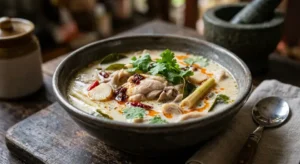
Ladle into deep bowls, giving each person pork, taro, a chile and a good tangle of greens, and serve with hot rice and a saucer of patis, calamansi and crushed chile for dipping the meat.
Cook’s notes
- The technique
- Sourness in sinigang is structural, not a garnish, and it has to go in late. Tamarind acid added early will keep the pork fibers from softening and toughen the beans, so the pot is built and the meat brought fully tender before the souring liquid arrives. The taro does the other half of the job: its starch gives the broth enough body to cling to rice, which is why sinigang made without gabi tastes correct but drinks thin. Crush a few pieces deliberately rather than hoping they break down.
- Make ahead
- The pork stage can be cooked a day ahead and refrigerated in its broth, which makes it easy to lift the fat off. Add the souring liquid and every vegetable on the day. Reheated sinigang is decent but the kangkong will be gone, so hold a fresh bunch back and wilt it into the reheated pot. It does not freeze gracefully.
- Troubleshooting
- Sour but hollow — you used acid in place of seasoning; add patis until the salt line comes up under the sourness. Broth thin and watery — no taro, or it was left whole; mash a few pieces in. Meat tough after an hour — the tamarind went in too early. Vegetables collapsed to mush — everything was added at once instead of in order of density.
- Variations
- Sinigang na hipon uses head-on shrimp, added for the last three minutes, and is lighter and sweeter. Sinigang sa bayabas swaps tamarind for ripe guava simmered and sieved, giving a perfumed, gentler sourness that suits fish. Sinigang na baka runs on beef shank and needs three hours. In the Visayas, batwan fruit gives a cleaner, sharper acid that locals insist tamarind cannot match.
- To serve and keep
- It goes in a communal bowl at the center of the table with a mountain of rice, and it is eaten as part of a spread rather than as a course. The dipping saucer of patis, calamansi and chile is expected. Drink cold water, or San Miguel if the meal runs late. Made in full within this recipe — Tamarind Souring Liquid, Pork Broth, Patis and Calamansi Dip. Also listed in the Component Index at the back.

Where it comes from
Souring a pot is one of the oldest habits in Philippine cooking and one of the few that owes nothing to Spain. The word sinigang comes from the root sigang, to stew, and the technique predates the galleon trade: fruit acids preserved fish and meat in a hot climate long before vinegar arrived as an import. The late food historian Doreen Fernandez argued that asim, sourness, is the organizing taste of the Filipino table in the way that sweetness organizes some cuisines and heat others, and sinigang is her clearest evidence. What sours the pot depends on where you stand. Luzon reaches for sampalok, tamarind, and for kamias when it is dropping off the tree. Iloilo and Negros use batwan, a fruit almost unknown elsewhere. Guava gives sinigang sa bayabas its rounder, perfumed sourness; green mango, calamansi and unripe santol all have their partisans. It is everyday food rather than occasion food, cooked on weeknights, eaten with rice, and defended fiercely by people who grew up with one particular version of it.
Sinigang: quick answers
How long does Sinigang take?
About 1 hr 45 min.
How many does this Sinigang recipe make?
This recipe serves 6.
Where does Sinigang come from?
Souring a pot is one of the oldest habits in Philippine cooking and one of the few that owes nothing to Spain. The word sinigang comes from the root sigang, to stew, and the technique predates the galleon trade: fruit acids preserved fish and meat in a hot climate long before vinegar arrived as an import. The late food historian Doreen Fernandez argued that asim, sourness, is the organizing taste of the Filipino table in the way that sweetness organizes some cuisines and heat others, and sinigang is her clearest evidence. What sours the pot depends on where you stand. Luzon reaches for sampalok, tamarind, and for kamias when it is dropping off the tree. Iloilo and Negros use batwan, a fruit almost unknown elsewhere. Guava gives sinigang sa bayabas its rounder, perfumed sourness; green mango, calamansi and unripe santol all have their partisans. It is everyday food rather than occasion food, cooked on weeknights, eaten with rice, and defended fiercely by people who grew up with one particular version of it.
More from Philippines
More in Soups Around the World
https://www.atlasserie.com/recipes/soup/sinigang/