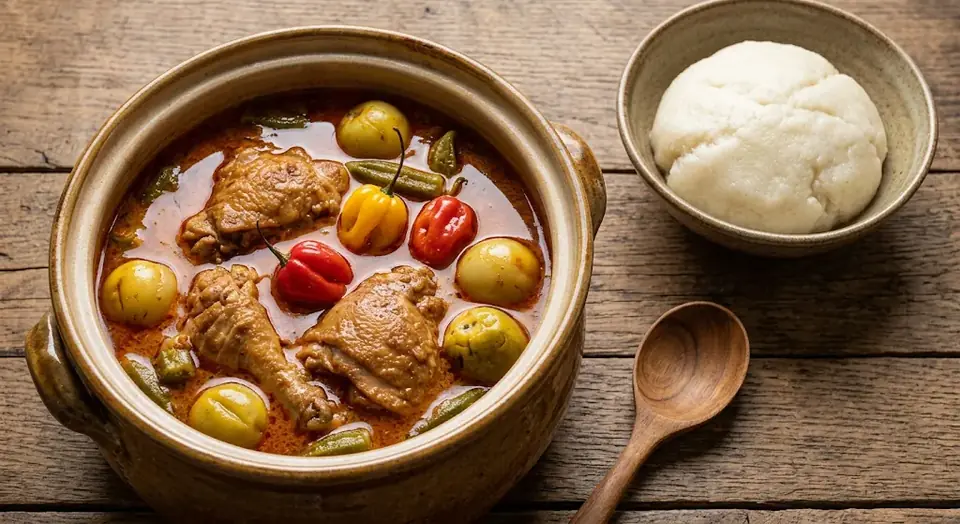
West Africa · Ghana & Nigeria · 10.00° N, 5.00° W
Groundnut Soup
Peanut, tomato and scotch bonnet around slow-cooked chicken or goat.
At a glance.
Groundnut Soup comes from West Africa · Ghana & Nigeria and appears in The Soup Atlas, in the chapter Soups Around the World. It serves 6, takes about 2 hours, and uses 15 ingredients and 10 steps.
- Yield
- Serves 6
- Method
- Stovetop
- Time
- 2 hours
Ingredients
Tap an ingredient to tick it off.
- For the meat and broth
- For the peanut base
- To serve
Method
-
Read this first: the dish is built on peanuts and there is no substitution that preserves it. If anyone at your table has a peanut allergy, cook something else and clean your equipment thoroughly, because peanut protein persists on utensils and in blender seals.
-
Season the chicken or goat with the chopped onion, ginger, garlic and salt and let it sit for 20 minutes. Put it in a heavy pot with 500 ml of the water, cover, and steam over medium heat for 15 minutes, until the meat has given up its own juices and gone opaque.
-
Add the remaining water and simmer, covered, until tender — around 30 minutes for chicken, 1½ hours for goat. Skim the surface as it goes. Lift the meat out with a slotted spoon and reserve the broth; you should have roughly 1.2 liters.
-
Loosen the peanut butter before it goes anywhere near the pot. Put it in a bowl and whisk in 400 ml of the hot broth, a ladle at a time, until you have a smooth, pourable cream with no lumps. Stiff paste dropped into a hot pot will seize into knots that never disperse.
-
Heat the groundnut oil in the cleaned pot and fry the blended onion for 6 minutes, until it thickens and loses its raw smell. Add the tomato paste and cook 3 minutes more, stirring, until it darkens to brick and starts to catch at the edges.
-
Pour in the blended tomatoes and cook, uncovered, for 12–15 minutes over medium heat. Stir often. It is ready when the mixture has reduced by about a third and you can see a rim of red oil separating out at the sides of the pot.
-
Stir in the loosened peanut cream, the rest of the broth, the bay leaves and the scotch bonnet — whole if you want its fruity perfume without much heat, blended into the base if you want the pot genuinely hot. Bring it to a low simmer.
-
Simmer uncovered for 30–40 minutes, stirring every few minutes and scraping the base with a flat spoon. Peanut solids sink and scorch readily, and a burnt bottom flavors the entire pot. It thickens as it goes and should end up coating the back of a spoon.
-
Watch for the oil. When a glossy layer of golden-red peanut oil rises and pools on the surface, the base is cooked out and the soup is done. Ghanaian cooks treat that oil slick as the sign to stop, and many keep it rather than skimming it away.
-
Return the meat, add the garden eggs or okra if using, and warm through for 10 minutes. Fish out the whole chile before it bursts. Taste and salt hard — peanut absorbs an unusual amount of salt and an underseasoned pot tastes chalky.
Cook’s notes
- The technique
- Two rules govern the pot. First, allergen safety: this is one of the most concentrated peanut dishes anyone cooks, and it must be declared plainly to every guest, with no cross-contaminated equipment. Second, loosen the paste before it goes in. Peanut butter is a fat-and-solid suspension; dropped whole into hot liquid it seizes into lumps coated with oil that water cannot penetrate. Whisked gradually with hot broth, it thins into a stable cream that disperses in seconds and thickens the whole pot evenly.
- Make ahead
- It improves overnight as the peanut fat and broth come fully together, and it keeps four days refrigerated. Reheat gently with a splash of water, stirring often, because it thickens considerably when cold and will catch on the base. It freezes for three months. Add okra or garden eggs fresh on reheating rather than freezing them in.
- Troubleshooting
- Lumpy and grainy — the peanut butter went in undiluted; blend the pot smooth and start whisking properly next time. Scorched and bitter — the base caught, so pour off the unburnt top and never scrape. Oily and split — normal, and the sign of a finished pot; stir it back in or skim. Thin and pale — the tomato base was not reduced far enough.
- Variations
- Senegalese and Malian mafé thickens further, often uses lamb, and sometimes carries a spoonful of sugar and a squeeze of lime. Nigerian groundnut stew runs drier and is served over rice rather than eaten with fufu. Ghanaian cooks make a version with smoked fish and no meat. A vegetable pot on mushroom broth, with sweet potato and spinach stirred in, works well.
- To serve and keep
- In Ghana it comes with omo tuo, rice balls pressed into the bowl and torn off by hand, or with fufu pounded from cassava and plantain. Rice is the everyday alternative. Serve in wide bowls, eat with the right hand if you are eating it traditionally, and drink cold water or ginger beer. Made in full within this recipe — Meat Broth, Loosened Peanut Cream, Tomato and Onion Base. Also listed in the Component Index at the back.

Where it comes from
Peanuts are American in origin, carried across the Atlantic by Portuguese traders in the sixteenth century, and they landed in a region that already had a groundnut of its own — Vigna subterranea, the Bambara groundnut, which had been cultivated in the savannah for centuries. The newcomer grew better and largely replaced it, but the cooking technique it slotted into was already there. What resulted is one of the most widespread dish families on the continent. In Ghana it is nkate nkwan, an Akan soup eaten with omo tuo or fufu and treated as Sunday food. Across the border in Nigeria it appears as a groundnut stew served over rice. Further north and west the same idea becomes mafé in Senegal and Mali, thicker and often built on lamb, and there are Gambian, Guinean and Ivorian versions besides. The differences are real — Ghanaian versions run soupier, Sahelian ones thicker and sweeter — but the architecture is shared: ground peanuts, tomato, chile and meat, cooked until the oil rises.
Groundnut Soup: quick answers
How long does Groundnut Soup take?
About 2 hours.
How many does this Groundnut Soup recipe make?
This recipe serves 6.
Where does Groundnut Soup come from?
Peanuts are American in origin, carried across the Atlantic by Portuguese traders in the sixteenth century, and they landed in a region that already had a groundnut of its own — Vigna subterranea, the Bambara groundnut, which had been cultivated in the savannah for centuries. The newcomer grew better and largely replaced it, but the cooking technique it slotted into was already there. What resulted is one of the most widespread dish families on the continent. In Ghana it is nkate nkwan, an Akan soup eaten with omo tuo or fufu and treated as Sunday food. Across the border in Nigeria it appears as a groundnut stew served over rice. Further north and west the same idea becomes mafé in Senegal and Mali, thicker and often built on lamb, and there are Gambian, Guinean and Ivorian versions besides. The differences are real — Ghanaian versions run soupier, Sahelian ones thicker and sweeter — but the architecture is shared: ground peanuts, tomato, chile and meat, cooked until the oil rises.
More from West Africa
More in Soups Around the World
https://www.atlasserie.com/recipes/soup/groundnut-soup/