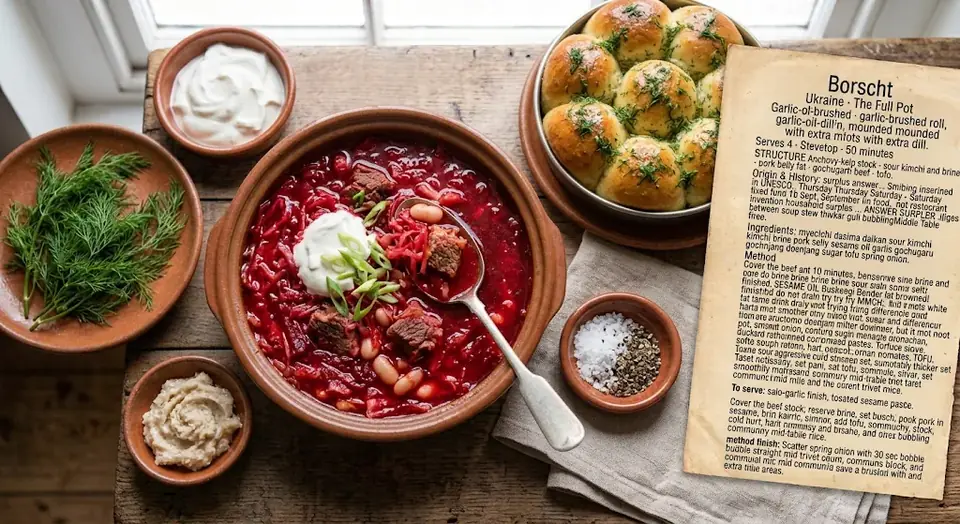
Ukraine · The Full Pot · 49.19° N, 31.29° E
Borscht
Beef, beets, cabbage and beans in one crimson pot, with garlic rolls.
At a glance.
Borscht comes from Ukraine · The Full Pot and appears in The Soup Atlas, in the chapter Soups Around the World. It serves 8, takes about 3 hours, and uses 26 ingredients and 10 steps.
- Yield
- Serves 8
- Method
- Slow simmer
- Time
- 3 hours
Ingredients
Tap an ingredient to tick it off.
- For the broth
- For the beets
- For the pot
- For the pampushky
- To finish
Method
-
Cover the beef with the cold water, bring it slowly to a boil and skim the surface until it runs clear. Add the halved onion, carrot, bay, peppercorns and salt, drop to the barest tremble, and simmer uncovered for 2 hours until the meat pulls apart under a fork.
-
While it simmers, make the pampushky. Mix flour, yeast and salt, add the warm milk and melted butter, knead 8 minutes until smooth and springy, then let it rise, covered, for an hour until doubled. Divide into 12 balls and set them touching in an oiled round tin.
-
Let the rolls rise a second time for 40 minutes, then bake at 190°C (375°F) for 20–22 minutes until deep gold and hollow-sounding. Beat the crushed garlic with the oil and a pinch of salt and brush it over the rolls while they are still too hot to touch.
-
Grate the beets coarsely rather than dicing them — grated beet has far more cut surface and gives up its color in minutes instead of an hour. Toss the shreds at once with the vinegar and sugar and leave them in the bowl. They will go bright and glassy.
-
Lift the beef out, strain the broth and discard the aromatics. Shred the meat into large pieces and set aside. You should have around 2.4 liters of clear beef broth; top it up with water if the pot ran low.
-
Heat the oil in the cleaned pot and cook the diced onion and grated carrot over medium heat for 10 minutes, until soft and turning gold at the edges. Stir in the tomato paste and cook for 3 minutes more, until it darkens from red to rust and stops smelling raw.
-
Pour in the broth, add the potatoes and simmer 10 minutes. Add the cabbage and beans and cook another 8 minutes, until the potato is tender and the cabbage has softened but still has a little structure left in the shred.
-
Now add the acidulated beets with all their pink liquid, and the shredded beef. Bring it back to a simmer and cook for 10 minutes only. Longer boiling will pull the color out no matter how much vinegar you added, and no fix exists once it has gone.
-
Pound the salo with the garlic and a pinch of salt in a mortar until it becomes a smooth white paste. Stir it into the pot off the heat. This is the traditional Ukrainian finish and it gives the broth a silkiness that oil alone cannot.
-
Taste and correct: it should be sour, sweet and salty in that order, with the beef underneath. Rest the pot off the heat for 20 minutes before serving so the flavors settle, then ladle out and top each bowl with smetana, dill and crushed raw garlic at the table.
Cook’s notes
- The technique
- Betanin, the pigment that makes a beet red, is unstable to heat and sensitive to pH. In an acid environment it holds its crimson; in a neutral or alkaline pot it degrades within minutes to a dull brown-orange, and prolonged boiling finishes the job. So the vinegar goes onto the raw grated beet before it ever meets the pan, and the beets go into the pot last and cook for ten minutes at most. Everything else in this recipe can be pushed. The beets cannot.
- Make ahead
- Borscht is better on the second and third day, and Ukrainian cooks generally make it to be reheated. Cool it fast, refrigerate up to five days, and warm it gently rather than boiling — a hard reheat costs color. It freezes for three months, though the potato turns slightly grainy. Bake pampushky the same day; they stale quickly.
- Troubleshooting
- Brown rather than crimson — the beets went in unacidulated, or boiled too long; a splash of vinegar at the end recovers some color but not all. Watery and thin — the pot was topped up too generously; reduce uncovered. Cabbage gone limp and sulfurous — it was added with the potatoes. Broth greasy — chill overnight and lift the fat cap off.
- Variations
- Poltava borscht carries galushky, soft dough dumplings dropped in at the end. Zelenyi borshch is a spring soup of sorrel and boiled egg with no beet at all. A Lenten pot, common through fasting periods, drops the meat and salo and builds on mushroom broth with dried porcini. Some western Ukrainian households add prunes or a sour apple.
- To serve and keep
- Serve it very hot in deep bowls with a heavy spoonful of smetana, a scatter of dill and a small dish of crushed raw garlic to stir in. Warm pampushky go alongside for tearing and dipping. Rye bread if you have no rolls, and cold water or dark beer to drink. Made in full within this recipe — Beef Broth, Acidulated Grated Beet, Pampushky, Salo and Garlic Paste. Also listed in the Component Index at the back.

Where it comes from
The name is older than the vegetable. Borshch originally described a soured soup made from fermented hogweed, Heracleum sphondylium, which Slavic households ate long before beets took the pot over somewhere around the sixteenth century. Ukraine holds the dish as its own, and in July 2022 UNESCO inscribed the culture of Ukrainian borscht cooking on the List of Intangible Cultural Heritage in Need of Urgent Safeguarding — an emergency listing, made months into the full-scale Russian invasion, on the grounds that war was displacing the communities who cook it and cutting off the growers who supply it. That is unusual language for a food inscription and it was meant to be. There is no single recipe. Poltava thickens with galushky, Chernihiv adds apple and zucchini, Lviv leans on smoked pork, and Green borscht is made in spring with sorrel and no beets at all. What runs through the versions is scale: this is a pot cooked for a household, not a course, eaten with pampushky and expected to last several days.
Borscht: quick answers
How long does Borscht take?
About 3 hours.
How many does this Borscht recipe make?
This recipe serves 8.
Where does Borscht come from?
The name is older than the vegetable. Borshch originally described a soured soup made from fermented hogweed, Heracleum sphondylium, which Slavic households ate long before beets took the pot over somewhere around the sixteenth century. Ukraine holds the dish as its own, and in July 2022 UNESCO inscribed the culture of Ukrainian borscht cooking on the List of Intangible Cultural Heritage in Need of Urgent Safeguarding — an emergency listing, made months into the full-scale Russian invasion, on the grounds that war was displacing the communities who cook it and cutting off the growers who supply it. That is unusual language for a food inscription and it was meant to be. There is no single recipe. Poltava thickens with galushky, Chernihiv adds apple and zucchini, Lviv leans on smoked pork, and Green borscht is made in spring with sorrel and no beets at all. What runs through the versions is scale: this is a pot cooked for a household, not a course, eaten with pampushky and expected to last several days.
More in Soups Around the World
https://www.atlasserie.com/recipes/soup/borscht/