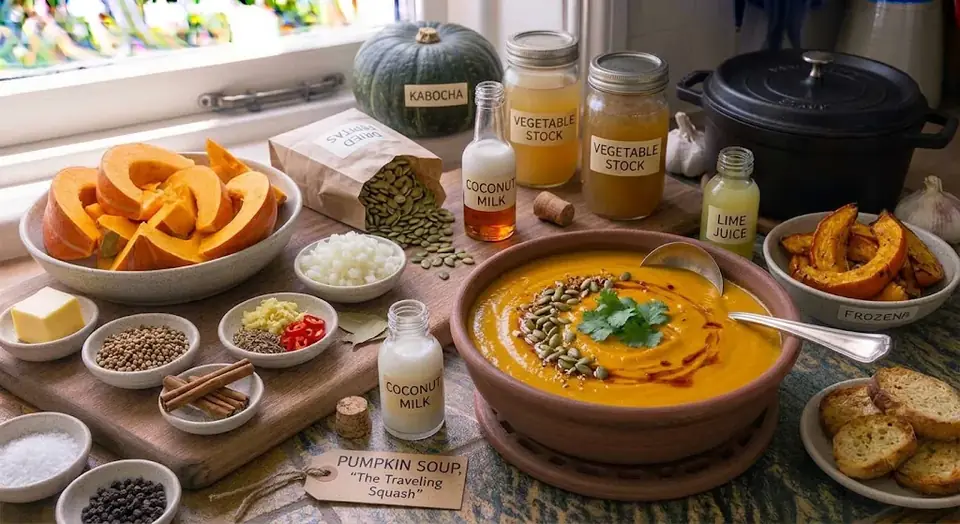
The Americas · The Traveling Squash · 39.87° N, 98.73° W
Pumpkin Soup
Savory and warm-spiced, made with a dense culinary pumpkin and no sugar at all.
At a glance.
Pumpkin Soup comes from The Americas · The Traveling Squash and appears in The Soup Atlas, in the chapter Creamy & Pureed Soups. It serves 6, takes about 1 hr 15 min, and uses 20 ingredients and 11 steps.
- Yield
- Serves 6
- Method
- Stovetop & Oven
- Time
- 1 hr 15 min
Ingredients
Tap an ingredient to tick it off.
- For the pumpkin
- For the soup
- For the pepita and chile oil
Method
-
Buy the right pumpkin, and be blunt about it: a carving pumpkin is bred for a thin wall, a wide cavity and enough size to sit on a doorstep. It is watery, stringy and close to flavorless. Ask for a sugar or pie pumpkin, or use kabocha, crown prince or Queensland Blue, all of which are dense and dry-fleshed.
-
Heat the oven to 220°C (425°F). Halve the pumpkin, scoop out the seeds and fibers into a bowl of water, then cut the flesh into 4 cm wedges. Kabocha and crown prince skins are edible once roasted; on a sugar pumpkin, peel after cooking.
-
Toss the wedges with the olive oil and teaspoon of salt, spread them on two trays so they are not touching, and roast for 35–40 minutes, turning once, until the edges are brown and a wedge collapses when pressed.
-
Rub the seeds clean of fiber under water, dry them on a cloth, then toast them in a dry pan over medium heat for 4–5 minutes until they swell and pop. Tip them out, and in the same pan warm the 4 tablespoons of olive oil with the chile flakes for 60 seconds off direct heat. Stir the seeds and half teaspoon of salt back in.
-
Toast the cumin and coriander seed in a dry pot over medium heat for about 90 seconds, until they darken a shade and smell of curry rather than dust. Tip them into a mortar and crush them coarsely.
-
Add the neutral oil to the same pot and cook the onion over medium heat for 8 minutes until soft. Add the garlic, ginger and chile and cook for 2 minutes more, then return the crushed spice with the cinnamon and stir for 30 seconds in the hot fat.
-
Add the roasted pumpkin — scraping every browned edge off the trays — and the stock. Simmer, uncovered, for 15 minutes so the spice moves into the liquid and the pumpkin slackens completely.
-
Blend in batches, a third of a jug at a time, lid vented and covered with a folded towel. Run each batch 60 seconds until it turns glossy and pours in a single ribbon.
-
Return it to low heat and stir in the coconut milk. Do not let it boil after this point: coconut milk is a fragile emulsion of oil and water held by protein, and a hard boil breaks it into grease and curds within a minute.
-
Season with the 2 teaspoons of salt and the lime juice, then taste. Pumpkin roasted this hard runs sweet, and the soup should land savory, warm and slightly sour — if it tastes like dessert, it wants more lime and more salt, not more spice.
-
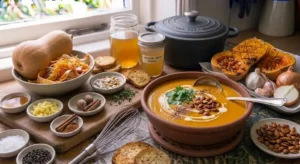
Ladle into bowls and finish with the toasted seeds, a spoonful of the chile oil dragged across the surface, cilantro leaves and a lime wedge on the side.
Cook’s notes
- The technique
- Everything here follows from the fruit you buy. Carving pumpkins are selected for a thin, easily cut wall and a large hollow, and they carry high water and low sugar; culinary types like kabocha or crown prince can run to double the dry matter, which is what lets a soup thicken on the vegetable alone. Roast that flesh rather than boiling it, because the water has to leave before browning can start. Then treat the result as savory. Toasted whole spice ground fresh, chile heat, salt and lime give the sweetness something to push against, and the coconut milk carries the fat-soluble aromatics that would otherwise be lost.
- Make ahead
- Roast the pumpkin up to two days ahead and refrigerate it in a sealed box; it loses nothing. The blended soup keeps four days and freezes three months, though freeze it before the coconut milk goes in if you can, since thawed coconut fat separates and needs whisking back. Reheat to steaming, not boiling. Make the chile oil fresh — toasted seeds go soft within a day.
- Troubleshooting
- Watery and bland — a carving pumpkin, and the only fix is to reduce it hard and add more spice. Split and greasy — the coconut milk boiled; pull the pot off, cool it slightly and blend it back together. Sweet and flat — under-salted and under-limed. Fibrous — the pumpkin was overgrown, so pass it through a sieve.
- Variations
- Thai-leaning cooks stir in a tablespoon of red curry paste with the aromatics and finish with fish sauce and basil. An Australian pub bowl skips the chile entirely and finishes with cream and nutmeg. West African versions cook the squash with groundnut paste and scotch bonnet. For a spice-free bowl, roast the pumpkin with sage and finish with brown butter and Parmesan.
- To serve and keep
- Serve it hot in wide bowls with the oil spooned on at the table so it stays separate and bright. Flatbread or roti for scooping. A drink with some sweetness of its own works best: an off-dry Riesling, a Vouvray, or a spiced chai if the soup is lunch. Made in full within this recipe — Roasted Pumpkin, Pepita and Chile Oil. Also listed in the Component Index at the back.

Where it comes from
Squash is one of the earliest crops of the Americas: seeds from Guilá Naquitz cave in Oaxaca have been dated to roughly ten thousand years ago, older than the maize grown beside them. The word pumpkin arrives through French and English from the Greek pepon, a ripe gourd, and it has never described a botanical group so much as a shape. What matters is where the plant went after 1492. Portuguese and Spanish ships carried squashes east within a generation: they took root in West Africa, in Mughal India, and in Japan, where kabocha is traditionally said to be named for Cambodia, the port the Portuguese carried it from. Australia built a whole national soup on the Queensland Blue. Meanwhile the American pumpkin took a separate turn into ritual — the jack-o'-lantern is an Irish turnip custom transplanted to a bigger, softer American gourd in the nineteenth century — and that ritual bred a fruit for size and hollowness. This soup goes back to the eating kind, and treats it as a savory vegetable rather than a pie filling.
Pumpkin Soup: quick answers
How long does Pumpkin Soup take?
About 1 hr 15 min.
How many does this Pumpkin Soup recipe make?
This recipe serves 6.
Where does Pumpkin Soup come from?
Squash is one of the earliest crops of the Americas: seeds from Guilá Naquitz cave in Oaxaca have been dated to roughly ten thousand years ago, older than the maize grown beside them. The word pumpkin arrives through French and English from the Greek pepon, a ripe gourd, and it has never described a botanical group so much as a shape. What matters is where the plant went after 1492. Portuguese and Spanish ships carried squashes east within a generation: they took root in West Africa, in Mughal India, and in Japan, where kabocha is traditionally said to be named for Cambodia, the port the Portuguese carried it from. Australia built a whole national soup on the Queensland Blue. Meanwhile the American pumpkin took a separate turn into ritual — the jack-o'-lantern is an Irish turnip custom transplanted to a bigger, softer American gourd in the nineteenth century — and that ritual bred a fruit for size and hollowness. This soup goes back to the eating kind, and treats it as a savory vegetable rather than a pie filling.
The same dish in another volume
More from United States




More in Creamy & Pureed Soups
https://www.atlasserie.com/recipes/soup/pumpkin-soup/