Iran · The Tehran Bakery · 32.47° N, 54.45° E
Barbari Bread
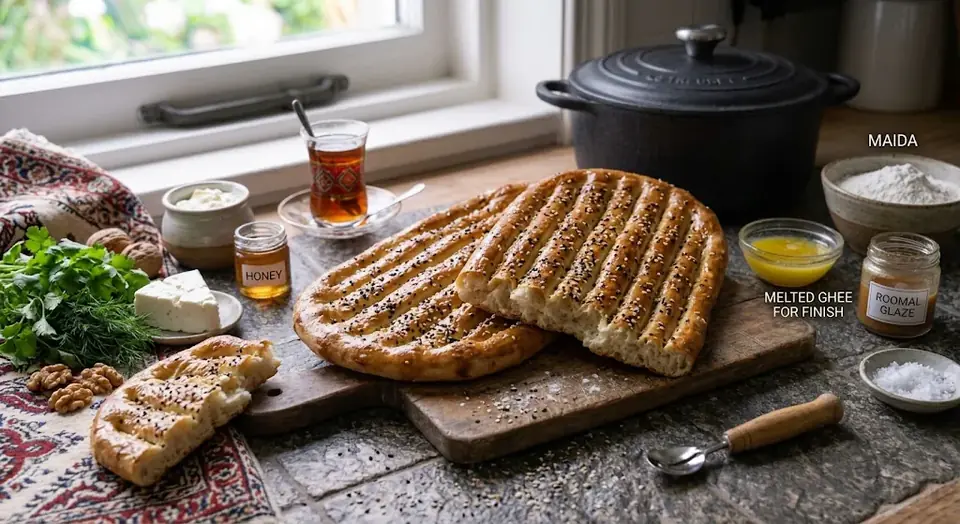
A long ridged Persian bread, glazed and seeded, bought hot at breakfast.
At a glance.
Barbari Bread comes from Iran · The Tehran Bakery and appears in The Bread Atlas, in the chapter Flatbreads. It makes 2 breads, takes about 4 hours, and uses 13 ingredients and 11 steps.
- Yield
- Makes 2 breads
- Method
- Oven 260°C / 500°F
- Time
- 4 hours
Ingredients
Tap an ingredient to tick it off.
- The Dough
- Roomal (Flour and Water Glaze)
- The Seeds
Method
-
Whisk the flour, salt, sugar and yeast together, add the water at 26°C and the oil, and mix to a soft, slightly sticky dough. Rest 20 minutes, then knead 8 minutes until smooth and extensible. Target a final dough temperature of 25°C.
-
Bulk ferment 2 hours at 24°C with a set of folds at 40 and 80 minutes. Barbari wants a long, gentle rise — the open, slightly chewy crumb comes from fermentation rather than from high hydration alone.
-
Make the roomal well before you need it. Whisk the flour into the cold water until no lumps remain, bring it to a simmer over medium heat, stirring constantly, and cook 1–2 minutes until it thickens to the consistency of single cream.
-
Take it off the heat and stir in the bicarbonate of soda, sugar and oil. The alkali raises the surface pH, which speeds browning dramatically at a given temperature and is why a bakery barbari has that even tan sheen. Cool it to room temperature; it thickens further as it cools.
-
Divide the dough into two pieces of about 530 g. Round each gently, cover, and rest 20 minutes. Meanwhile heat the oven to 260°C with a stone or steel on the middle rack, and give it 45 minutes.
-
Working on a well-floured sheet of parchment, press and stretch one piece into a long oval of about 45 × 18 cm and 1.5 cm thick. Handle it with flat hands rather than a pin, keeping the gas in the outer centimeter so the rim rises.
-
Prove uncovered 30 minutes, until the surface looks pillowy and a finger leaves a dent that fills slowly. A slight skin is welcome here — the roomal will remoisten it.
-
Brush the roomal over the whole surface in a generous even layer, right to the edges. It should look wet and slack, not painted on.
-
Dip four fingers in the roomal and draw them lengthways down the bread, pressing firmly to the base, to leave parallel channels about 3 cm apart, with a border of a finger's width at each end. Press once around the rim to define it.
-
Scatter the sesame and nigella along the ridges and into the channels. Slide the bread on its parchment onto the hot stone and bake 12–14 minutes, until the ridges are deep gold, the channels amber and the base sounds hollow.
-
Cool 10 minutes on a rack — no longer if you can help it. Barbari is a bread of the first hour, and Iranian bakeries sell it on that understanding.
Cook’s notes
- To serve and keep
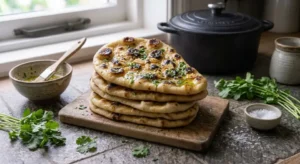
- The Persian breakfast bread: torn by hand with sarshir and honey, or with feta, walnuts and fresh herbs, alongside tea. It also carries kabab well, and is used to line the plate under rice. Fold it once for carrying, keep it in a cloth, and eat it the day it is baked.

Where it comes from
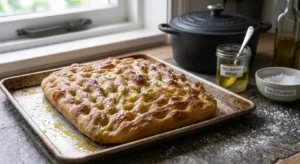
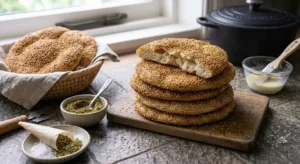
Nan-e barbari is one of the four breads an Iranian bakery is organized around, and each has its own shop: sangak, taftoon, lavash and this. Barbari is the thick one — a long flat oval, ridged lengthways with deep finger-drawn channels, glossy tan on top and studded with sesame and nigella. Bakeries specializing in it open before dawn and sell straight from the oven mouth, and the sight of people walking home with a meter of hot bread folded over one arm is ordinary in every Iranian city. The name is generally explained as a reference to the Barbari people of Khorasan, said to have brought the bread to Tehran during the Qajar period; the account is repeated in most Persian sources but rests on tradition rather than documentation, and it should be held loosely. What is not in doubt is where the bread sits socially. Barbari is breakfast: bought hot, torn at the table with sarshir and honey, or with feta, walnuts and a bunch of herbs, and drunk down with black tea.
Barbari Bread: quick answers
How long does Barbari Bread take?
About 4 hours.
How many does this Barbari Bread recipe make?
This recipe makes 2 breads.
Where does Barbari Bread come from?
Nan-e barbari is one of the four breads an Iranian bakery is organized around, and each has its own shop: sangak, taftoon, lavash and this. Barbari is the thick one — a long flat oval, ridged lengthways with deep finger-drawn channels, glossy tan on top and studded with sesame and nigella. Bakeries specializing in it open before dawn and sell straight from the oven mouth, and the sight of people walking home with a meter of hot bread folded over one arm is ordinary in every Iranian city. The name is generally explained as a reference to the Barbari people of Khorasan, said to have brought the bread to Tehran during the Qajar period; the account is repeated in most Persian sources but rests on tradition rather than documentation, and it should be held loosely. What is not in doubt is where the bread sits socially. Barbari is breakfast: bought hot, torn at the table with sarshir and honey, or with feta, walnuts and a bunch of herbs, and drunk down with black tea.
More from Iran


More in Flatbreads
https://www.atlasserie.com/recipes/bread/barbari-bread/