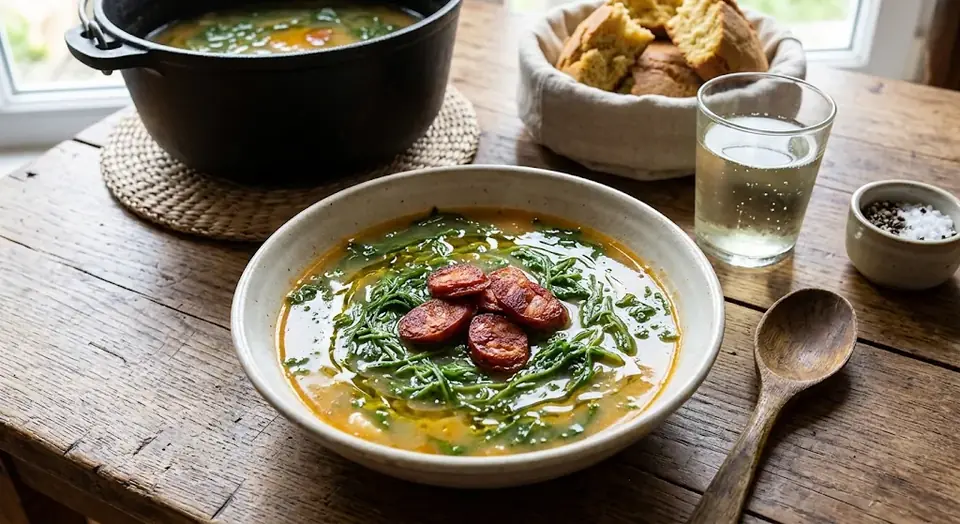
Russia · The Tavern Pot · 65.94° N, 95.72° E
Solyanka
Smoked meats, brined cucumbers, olives and capers in a sour-salt broth.
At a glance.
Solyanka comes from Russia · The Tavern Pot and appears in The Soup Atlas, in the chapter Soups Around the World. It serves 6, takes about 2 hours, and uses 20 ingredients and 10 steps.
- Yield
- Serves 6
- Method
- Stovetop
- Time
- 2 hours
Ingredients
Tap an ingredient to tick it off.
- For the broth
- For the meats
- For the sour base
- To serve
Method
-
Cover the beef with cold water, bring it slowly to a boil and skim the surface until nothing more rises. Add the onion, carrot, bay, peppercorns and allspice, and hold at a bare tremble, uncovered, for 1½ hours until the meat is tender enough to shred.
-
Strain the broth and discard the aromatics. Shred or dice the beef and set it aside. You are aiming for around 2 liters of clean, well-flavored broth; no salt goes in at this stage, and this matters more here than in almost any other soup in the book.
-
Melt the butter in a wide pot and cook the sliced onions over medium heat for 12 minutes, until soft, sweet and starting to color. Stir in the tomato paste and cook for 3 minutes more, until it turns from red to rust and clings to the onions.
-
Add the cucumber batons and cook for 5 minutes, stirring, until they turn from bright to olive and lose their raw squeak. Cooking them briefly in fat before liquid arrives keeps them from turning to floppy shreds later in the pot.
-
Add all four cured and smoked meats and turn them in the base for 3 minutes. They need warming and coating rather than cooking — each one arrives already cooked and already salted, and the point is to let their fat and smoke bleed into the onions.
-
Pour in the strained broth and the shredded beef and simmer, uncovered, for 15 minutes. The pot will start to smell like a delicatessen; that concentration of smoke and salt is what solyanka is, and it is why the broth was left unseasoned.
-
Now add the cucumber brine, off the boil, in stages. Pour in half, stir, and taste. Add more until the broth reads sharply sour underneath the salt. Brine varies enormously in strength between jars and brands, so this cannot be done by measurement alone.
-
Add the capers and olives and simmer 5 minutes only. Both are packed in salt or brine of their own and both go bitter with extended cooking, so they arrive near the end and are treated as seasonings rather than vegetables.
-
Taste before adding any salt at all. Between the cured meats, the brine, the capers and the olives, the pot is very often already at its limit, and salting on habit rather than by tasting is the single most common way this soup is ruined.
-
Rest it off the heat for 15 minutes, which lets the smoke and sour settle into each other. Ladle into bowls, lay a lemon slice on each, add a heavy spoonful of smetana and a scatter of dill, and serve with dark rye.
Cook’s notes
- The technique
- The acid here is rassol, the brine from lacto-fermented cucumbers, and it is not interchangeable with vinegar. Fermented brine carries lactic acid, which is rounder and less volatile than acetic acid, along with salt, dissolved cucumber sugars and the residue of the ferment itself — so it seasons in three directions at once. Vinegar pickles, packed in acetic acid, give a thin, hard sourness and no depth. Add the brine off the boil and in stages, tasting between each, because concentration varies wildly from jar to jar.
- Make ahead
- Solyanka is better made a day ahead; the smoked meats need overnight to give up their character into the broth. It holds four days refrigerated and reheats without complaint. Freezing works, though the cucumbers soften further. Add lemon, smetana and dill only at the table — lemon left in the pot turns bitter and cream stirred in early can split.
- Troubleshooting
- Too salty to eat — the pot was seasoned before the cured meats went in; dilute with unsalted broth or water, never with more brine. Flat and one-dimensional — not enough brine, or vinegar was used in its place. Cucumbers gone to threads — they were added raw to liquid rather than cooked in the fat first. Broth greasy — chill and lift off the cap.
- Variations
- Rybnaya solyanka replaces the meat with sturgeon, salmon or smoked fish and uses fish broth, keeping every other element. Gribnaya solyanka, the fasting version, is built on dried porcini soaking liquid with fresh mushrooms and often sauerkraut in place of some cucumber. German kitchens adopted a sweeter, paprika-heavy soljanka during the DDR period, which is now a dish in its own right.
- To serve and keep
- Serve very hot in deep bowls, each with its lemon slice, a spoonful of smetana and a great deal of dill. Dark rye bread and butter alongside, and nothing else — this is a rich, salty bowl that needs no accompaniment. Cold water, kvass, or a small glass of vodka. Made in full within this recipe — Beef Broth, Onion and Tomato Base, Cucumber Brine Seasoning. Also listed in the Component Index at the back.

Where it comes from
The dish appears in sixteenth-century Russian sources under the name selyanka, usually read as a village soup, and the modern spelling solyanka draws it toward sol, salt — a shift that suits the recipe but whose origins are disputed among etymologists rather than settled. What is clear is where it ended up. By the nineteenth century solyanka had become tavern food, a traktir dish that let a kitchen turn the ends of the charcuterie counter into something substantial: whatever ham, tongue, kidney, smoked sausage and boiled beef were on hand, thrown into one pot and made coherent by salt and acid. It survived the Soviet period on restaurant and canteen menus, and it retains a durable reputation as a hangover cure. Three lines are recognized. Myasnaya solyanka is the meat version described here. Rybnaya is built on sturgeon or salmon with the same brine and capers. Gribnaya is made with mushrooms, fresh and dried together, and is the version eaten during Orthodox fasts, when meat is off the table.
Solyanka: quick answers
How long does Solyanka take?
About 2 hours.
How many does this Solyanka recipe make?
This recipe serves 6.
Where does Solyanka come from?
The dish appears in sixteenth-century Russian sources under the name selyanka, usually read as a village soup, and the modern spelling solyanka draws it toward sol, salt — a shift that suits the recipe but whose origins are disputed among etymologists rather than settled. What is clear is where it ended up. By the nineteenth century solyanka had become tavern food, a traktir dish that let a kitchen turn the ends of the charcuterie counter into something substantial: whatever ham, tongue, kidney, smoked sausage and boiled beef were on hand, thrown into one pot and made coherent by salt and acid. It survived the Soviet period on restaurant and canteen menus, and it retains a durable reputation as a hangover cure. Three lines are recognized. Myasnaya solyanka is the meat version described here. Rybnaya is built on sturgeon or salmon with the same brine and capers. Gribnaya is made with mushrooms, fresh and dried together, and is the version eaten during Orthodox fasts, when meat is off the table.
More from Russia
More in Soups Around the World
https://www.atlasserie.com/recipes/soup/solyanka/