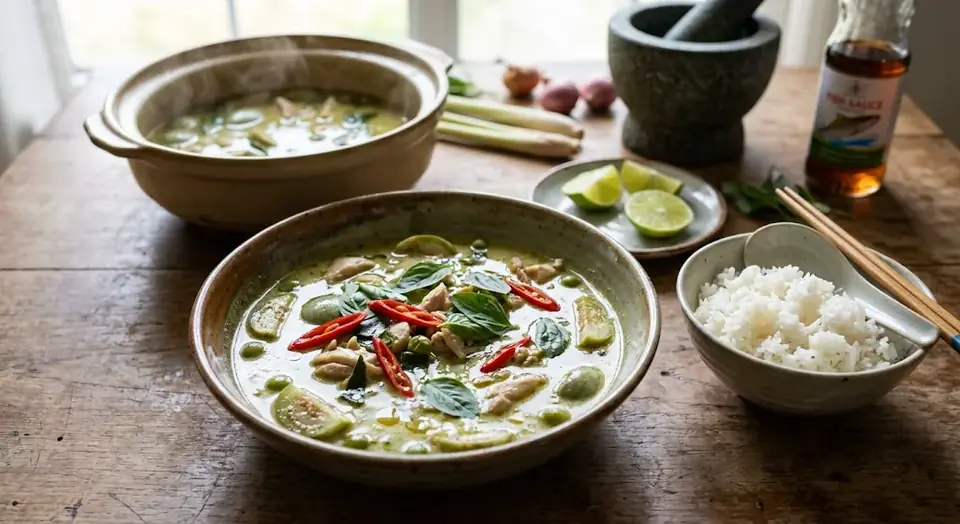
Thailand · The Thin Green Curry · 14.98° N, 101.00° E
Green Curry Soup
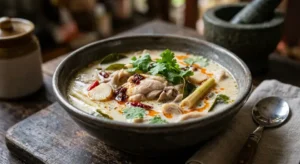
Green curry loosened to a drinkable broth, pounded paste and all.
At a glance.
Green Curry Soup comes from Thailand · The Thin Green Curry and appears in The Soup Atlas, in the chapter Soups Around the World. It serves 4, takes about 1 hr, and uses 23 ingredients and 10 steps.
- Yield
- Serves 4
- Method
- Stovetop
- Time
- 1 hr
Ingredients
Tap an ingredient to tick it off.
- For the green curry paste
- For the soup
- To finish
Method
-
Pound the paste in the order of hardness, which is the whole logic of a Thai mortar. Start with the salt, white peppercorns and toasted ground spices, then add the lemongrass and pound until it stops being fibrous and starts being pulp. This takes several minutes and no shortcut exists.
-
Add the galangal, then the makrut zest, then the coriander roots, pounding each one down before the next goes in. Follow with the garlic and shallots, then finally the chiles, and pound until the whole is a fine, uniformly green paste with no visible fibers.
-
Work in the toasted shrimp paste last, mashing it through until evenly dispersed. If you use a food processor instead, add a splash of water to keep it turning and expect a coarser, wetter result — pounding ruptures cells and releases oils that a blade merely chops.
-
On shop-bought paste, honestly: Maesri, Mae Ploy and Nittaya are all genuinely good and are used in Thailand. They run saltier and heavier on shrimp paste than a fresh one, so use about two-thirds the quantity, cut the fish sauce accordingly, and add fresh makrut zest and torn lime leaves to lift them.
-
Open the coconut milk without shaking it and spoon the thick cream from the top into a wide pot. Reserve the thin milk beneath. Heat the cream over medium heat, stirring, for 4–6 minutes until it splits and clear oil pools on the surface.
-
Add 4 tablespoons of the paste to that split oil and fry hard for 3 full minutes, stirring constantly. It will darken, tighten and then loosen again as it fries, and the smell will change from raw and grassy to deep and aromatic. This is the step that makes the dish.
-
Slide in the chicken and turn it in the fried paste until every piece is coated and has begun to firm at the edges, about 2 minutes. Coating the protein in fried paste before liquid arrives is what carries the seasoning into the meat rather than leaving it in the broth.
-
Pour in the stock and the reserved thin coconut milk, add the torn lime leaves, and bring it to a gentle simmer. The ratio here is deliberate — roughly two and a half parts stock to one of coconut — and it is what makes this a soup rather than a curry.
-
Simmer 10 minutes, never letting it boil hard, then add the eggplants and cook 5–6 minutes until tender but not collapsing. Check the chicken is cooked through to 74°C (165°F). The broth should be thin enough to drink from a spoon and stained pale green.
-
Take it off the heat, season with fish sauce and palm sugar, and taste: salty first, hot second, sweet barely there. Stir in the basil leaves, which need only residual heat to release their anise scent, scatter over the red chile and serve with lime and rice.
Cook’s notes
- The technique
- Frying the paste in cracked coconut cream is not optional and it is not a browning step. Coconut cream is an emulsion; held over heat it breaks, releasing clear coconut oil, and that oil is the frying medium. Curry paste stirred straight into liquid tastes raw and grassy because its aromatics are largely fat-soluble and water will not extract them. Three minutes in hot coconut oil pulls them out, cooks off the sulfurous rawness of the garlic and shallot, and turns the paste from a suspension into seasoning.
- Make ahead
- The paste is the thing worth making ahead: it keeps two weeks refrigerated under a film of oil and freezes for six months in tablespoon portions, which is how most Thai home cooks store it. The finished soup does not keep well — the basil blackens and the coconut dulls — so cook the broth base ahead if you must and add chicken, vegetables and basil to order.
- Troubleshooting
- Grassy and sharp — the paste was underfried, or stirred into liquid. Split and greasy — the pot boiled after the thin coconut milk went in. Dull olive rather than green — the paste was overcooked, or the chiles were old. Cloying — too much palm sugar; correct with fish sauce and lime, not with more stock.
- Variations
- Kaeng khiao wan pla makes the same soup with firm white fish, added for the last four minutes. A version with pea eggplants alone and no meat, seasoned with light soy in place of fish sauce and kapi, works for vegetarians. Restaurants in central Thailand often add fish balls or slices of krachai. Beef, cooked longer, is traditional in older recipes.
- To serve and keep
- Serve it in a communal bowl with jasmine rice and at least one dry dish alongside — an omelette, or grilled pork. Diners spoon broth over their own rice. Lime wedges and a dish of nam pla prik on the table. Cold lager or iced tea rather than wine. Made in full within this recipe — Green Curry Paste, Cracked Coconut Cream, Chicken and Aubergine Broth. Also listed in the Component Index at the back.

Where it comes from
Kaeng khiao wan is documented in Thai cookery from the early twentieth century, and its color comes entirely from fresh green chiles pounded raw into the paste — nothing else in it is green. The wan of the name means sweet, but it describes the rounded, mellow quality coconut milk lends the finished dish rather than any added sugar; a green curry that tastes sweet has been mishandled. Thai cooking does not draw a firm line between kaeng, curry, and a soup. A kaeng can be thick enough to sit on rice or loose enough to drink, and the same paste serves both; the amount of stock is a decision the cook makes on the day, not a difference of recipe. This version sits at the loose end deliberately. It carries less coconut and more broth than the version usually served abroad, which puts the pounded aromatics rather than the fat at the front of the bowl, and it is eaten from a shared pot with rice rather than ladled over it.
Green Curry Soup: quick answers
How long does Green Curry Soup take?
About 1 hr.
How many does this Green Curry Soup recipe make?
This recipe serves 4.
Where does Green Curry Soup come from?
Kaeng khiao wan is documented in Thai cookery from the early twentieth century, and its color comes entirely from fresh green chiles pounded raw into the paste — nothing else in it is green. The wan of the name means sweet, but it describes the rounded, mellow quality coconut milk lends the finished dish rather than any added sugar; a green curry that tastes sweet has been mishandled. Thai cooking does not draw a firm line between kaeng, curry, and a soup. A kaeng can be thick enough to sit on rice or loose enough to drink, and the same paste serves both; the amount of stock is a decision the cook makes on the day, not a difference of recipe. This version sits at the loose end deliberately. It carries less coconut and more broth than the version usually served abroad, which puts the pounded aromatics rather than the fat at the front of the bowl, and it is eaten from a shared pot with rice rather than ladled over it.
More from Thailand
More in Soups Around the World
https://www.atlasserie.com/recipes/soup/green-curry-soup/