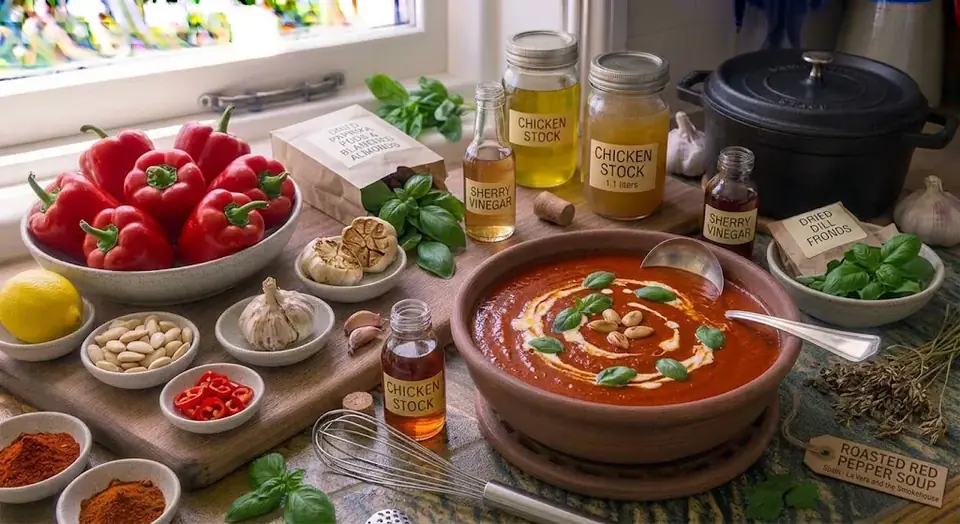
Spain · La Vera and the Smokehouse · 40.32° N, 3.62° W
Roasted Red Pepper Soup
Peppers blistered black and peeled dry, with smoked paprika and no tomato.
At a glance.
Roasted Red Pepper Soup comes from Spain · La Vera and the Smokehouse and appears in The Soup Atlas, in the chapter Creamy & Pureed Soups. It serves 4, takes about 1 hr, and uses 18 ingredients and 11 steps.
- Yield
- Serves 4
- Method
- Stovetop
- Time
- 1 hr
Ingredients
Tap an ingredient to tick it off.
- For the peppers
- For the soup
- For the garlic croutons
Method
-
Blacken the peppers. Set them whole directly on a gas flame, or under a broiler at its highest setting, or on a grill over coals, turning with tongs every couple of minutes until the skin is blistered and black on every surface, 12–18 minutes. Half-charred patches will not peel.
-
Rub the halved garlic head with the tablespoon of oil and char its cut faces alongside, 4–5 minutes, until they are dark brown and soft.
-
Put the peppers straight into a bowl and cover it tightly with a plate or a cloth. The steam they give off in the next quarter of an hour is what lifts the skin off the flesh; skip this and you will be picking at them with a knife.
-
After 15 minutes the skins slip off under your thumbs. Do not rinse them under the tap. Running water carries away the smoky, oily residue you spent a quarter of an hour creating, and it takes the flavor straight down the drain.
-
Pull out the stems and seed cores over the bowl, tear the flesh into strips and keep every drop of the red juice that has collected underneath. That juice is concentrated pepper and it goes into the pot.
-
Make the croutons while the peppers steam. Toss the torn bread with the 3 tablespoons of oil and the salt, spread it on a tray and bake at 190°C (375°F) for 12–14 minutes until brown at the edges and dry through, then rub each piece with the cut garlic clove while still hot.
-
Warm the 3 tablespoons of olive oil in a heavy pot over medium-low heat and cook the onions with a pinch of salt for 12–15 minutes, until completely soft and beginning to turn gold. Add the chile for the last 2 minutes.
-
Pull the pot off the heat and stir in both paprikas. Smoked paprika scorches at a touch and turns acrid, so let the residual heat bloom it for 30 seconds rather than the flame.
-
Add the peppers with their juice, the squeezed-out roast garlic, the toasted almonds and the stock. Simmer for 20 minutes. There is no tomato in this pot and there should not be: tomato brings its own acidity and its own loud flavor, and within one spoonful the soup stops tasting of pepper.
-
Blend in batches, filling the jug a third full, lid vented under a folded towel, running each batch a full 90 seconds. Then pass it through a fine sieve to catch any fleck of skin that escaped the peeling — one is enough to be noticed.
-
Season with the 1½ teaspoons of salt, add the sherry vinegar off the heat, and taste. Stir in the cream if you want it softer, or leave it out and finish with olive oil for a sharper, more Spanish result. Serve with the croutons and torn basil.
Cook’s notes
- The technique
- Char harder than feels reasonable. The pepper's skin is a thin cuticle that separates from the flesh only once the layer beneath it has been steamed by its own moisture, and that requires the surface to be genuinely burnt, not tanned. The blackened skin also leaves behind phenolic compounds in the oil on the flesh, which is the smokiness worth having, and it is water-soluble enough that rinsing removes it. Work dry, over a bowl, and accept blackened fingers. Almonds do the second job here: a small handful blended in gives body and a faint sweetness where a roux would give paste.
- Make ahead
- Char and peel the peppers up to three days ahead and store them in a box under a film of olive oil, which is worth doing for its own sake. The finished soup keeps four days and freezes three months — freeze it before the cream. Reheat to steaming and re-sharpen with vinegar, which fades in cold storage faster than salt does. Croutons are a same-day job.
- Troubleshooting
- Acrid and bitter — the paprika hit direct heat, and nothing recovers it. Skins in the spoon — the char was uneven, or the sieve was skipped. Thin — too much stock; reduce it uncovered before blending rather than adding starch. Dull and sweet — it needs vinegar and salt, in that order, added off the heat and tasted between additions.
- Variations
- Blend in a slice of stale bread with the almonds and serve it cold and you are within sight of salmorejo. A Balkan version stirs in a spoonful of ajvar and finishes with feta. Add a roasted eggplant for something darker and closer to escalivada. For heat, use two hot peppers and finish with a spoon of harissa rather than cream.
- To serve and keep
- Serve it hot, in shallow bowls, croutons scattered at the last second so they stay crisp, with a hard trickle of green olive oil. Manchego and quince paste afterwards. Drink a chilled fino, a Spanish rosado, or a young Garnacha lightly cooled. Made in full within this recipe — Charred Peppers, Garlic Croutons. Also listed in the Component Index at the back.

Where it comes from
Capsicum came back with Columbus. Peppers were growing in Spanish monastery gardens within a few decades of 1493, and Extremadura's Jeronymite houses at Yuste and Guadalupe are traditionally credited with spreading the cultivation that became pimentón. The Spanish habit of drying peppers over slow-burning oak smoke for a fortnight, which produces pimentón de la Vera, gave European cooking a spice that no American kitchen had: smoke as a seasoning, in powdered form. Charring the fresh pepper is the same instinct applied directly. It runs along the whole northern Mediterranean and beyond — Catalan escalivada takes peppers, eggplant and onion straight into the embers; Balkan ajvar is built on peppers roasted over fire in autumn and put up in jars; Turkish and Levantine kitchens char them for salads and pastes. A smooth pepper soup is a modern restaurant idea rather than a village one, but the technique underneath it is old and it is unforgiving of half-measures. Timid charring gives neither loose skin nor smoke.
Roasted Red Pepper Soup: quick answers
How long does Roasted Red Pepper Soup take?
About 1 hr.
How many does this Roasted Red Pepper Soup recipe make?
This recipe serves 4.
Where does Roasted Red Pepper Soup come from?
Capsicum came back with Columbus. Peppers were growing in Spanish monastery gardens within a few decades of 1493, and Extremadura's Jeronymite houses at Yuste and Guadalupe are traditionally credited with spreading the cultivation that became pimentón. The Spanish habit of drying peppers over slow-burning oak smoke for a fortnight, which produces pimentón de la Vera, gave European cooking a spice that no American kitchen had: smoke as a seasoning, in powdered form. Charring the fresh pepper is the same instinct applied directly. It runs along the whole northern Mediterranean and beyond — Catalan escalivada takes peppers, eggplant and onion straight into the embers; Balkan ajvar is built on peppers roasted over fire in autumn and put up in jars; Turkish and Levantine kitchens char them for salads and pastes. A smooth pepper soup is a modern restaurant idea rather than a village one, but the technique underneath it is old and it is unforgiving of half-measures. Timid charring gives neither loose skin nor smoke.
More from Spain

More in Creamy & Pureed Soups
https://www.atlasserie.com/recipes/soup/roasted-red-pepper-soup/