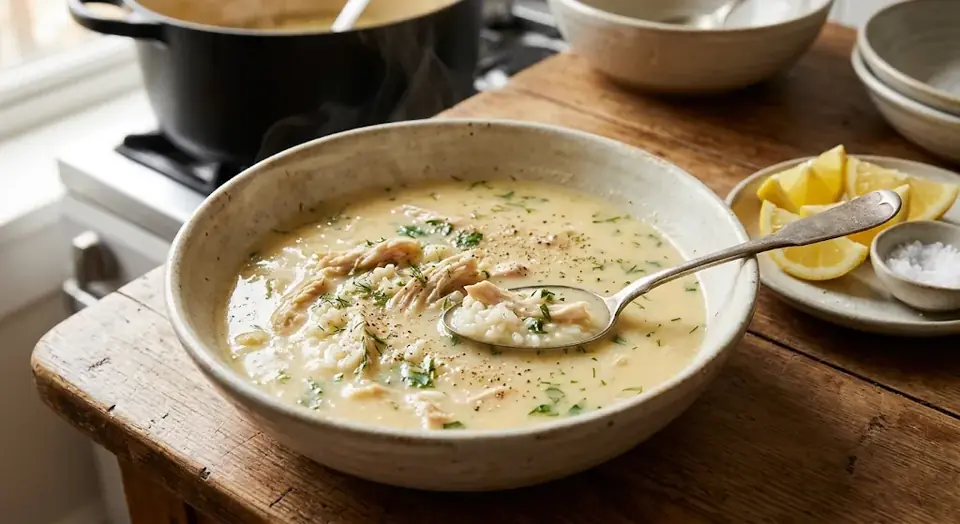
Greece · The Egg-and-Lemon Bond · 39.32° N, 22.55° E
Avgolemono
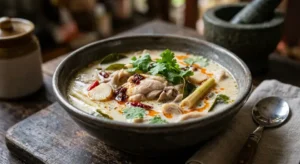
Chicken broth thickened with egg and lemon into pale, silky gold.
At a glance.
Avgolemono comes from Greece · The Egg-and-Lemon Bond and appears in The Soup Atlas, in the chapter Soups Around the World. It serves 6, takes about 40 minutes, and uses 15 ingredients and 10 steps.
- Yield
- Serves 6
- Method
- Stovetop
- Time
- 40 minutes
Ingredients
Tap an ingredient to tick it off.
- For the broth
- For the body
- For the liaison
- To finish
Method
-
Cover the chicken with the cold water, bring it slowly to a boil and skim until the surface runs clear. Add the onion, carrot, celery, peppercorns, bay and salt, and hold at a bare shiver for 1 hour, until the leg meat pulls away from the bone.
-
Lift the chicken out and strain the broth through a fine sieve. Pull the meat from the bones in generous shreds, discarding skin and cartilage, and set it aside covered. Return 2 liters of the strained broth to a clean pot.
-
Simmer the rice in the broth for 15–18 minutes, until it is fully tender and beginning to break at the edges. Do not rinse it first: the starch it gives up is doing structural work here, and rinsed rice leaves the soup with no protection at all.
-
Take the pot down to a temperature where no bubbles break the surface — around 80°C (175°F) — and leave it there. Beyond this point the pot must never simmer again, and holding it at the right temperature now is easier than rescuing it later.
-
Separate one egg and set the extra yolk aside with it. Whisk the 3 whole eggs and the extra yolk in a large bowl for a full minute, until pale, thickened and holding a soft ribbon. This aeration gives the liaison structure and makes it more forgiving.
-
Whisk in the strained lemon juice in a steady stream. The mixture will loosen and turn opaque. Adding the acid before any hot liquid, rather than after, distributes it evenly and avoids a concentrated pocket of acid meeting hot egg later on.
-
Now temper. Ladle roughly 100 ml of hot broth into the eggs while whisking hard and without pause. Then another ladle. Then a third and a fourth, slowly, until the bowl is warm against the back of your hand and holds close to a liter.
-
Pour the tempered mixture back into the pot in a thin stream, stirring the pot constantly with a wooden spoon, reaching into the corners. Do not tip it in at once — a mass of egg hitting hot broth in one go will set into strands before it can disperse.
-
Stir over the lowest heat for 2–3 minutes until it thickens perceptibly and turns opaque pale gold, coating the back of the spoon so that a finger drawn through leaves a clean line. Take it off the heat the moment it does. It will thicken slightly further as it stands.
-
Return the shredded chicken, season with salt and white pepper, and let it stand 5 minutes off the heat. Stir in the dill and parsley and serve at once in warm bowls, with lemon wedges for anyone who wants it sharper still.
Cook’s notes
- The technique
- Egg proteins begin to set from about 62°C and are fully coagulated by 80°C, and acid lowers those temperatures further, which is why an egg-and-lemon soup curdles so readily. Two things protect it. Tempering raises the eggs slowly so no part of the mixture leaps past its setting point while the rest is still cold. The rice starch does the rest: dispersed starch physically obstructs the protein strands as they unfold, so they thicken the liquid rather than knitting into curds. Never let the finished pot boil.
- Make ahead
- Broth, rice and shredded chicken can all be prepared two days ahead and refrigerated separately. The liaison is made at the last moment and cannot be prepared in advance. A finished avgolemono keeps overnight but must be reheated over the lowest heat, stirring, and will thicken as it stands. It cannot be frozen; the emulsion breaks irrecoverably on thawing.
- Troubleshooting
- Grainy with visible flecks — the broth was too hot, or tempering went too fast; blend it hard and pass it through a sieve, which rescues most of it. Thin and pale — not enough egg, or it never reached 75°C. Split into liquid and curd — it boiled. Metallic aftertaste — an aluminum pot reacting with the lemon.
- Variations
- Magiritsa, the Easter soup broken after Lent, uses the same liaison over lamb offal and spring greens. Kotosoupa with orzo instead of rice is the everyday version. Sephardic sopa de huevo y limón takes the same emulsion into a leaner broth without meat. Turkish terbiyeli tavuk çorbası adds flour to the egg for extra stability, which is a fair trade for a heavier texture.
- To serve and keep
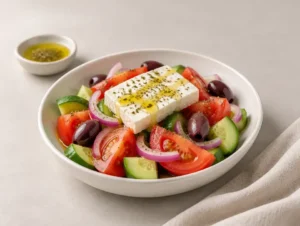
- Serve in warm shallow bowls with crusty bread and a plate of feta, olives and cucumber. The lemon wedge goes on the side, never in the pot. It is a first course, a convalescent's dish and a late supper in equal measure. Drink assyrtiko, or plain cold water. Made in full within this recipe — Chicken Broth, Egg and Lemon Liaison. Also listed in the Component Index at the back.

Where it comes from
Avgolemono is a technique before it is a soup — avgo, egg, and lemoni, lemon, whisked together and let down with hot broth to thicken anything it touches. Greek cooks use the same liaison on lamb fricassee, over dolmades, in magiritsa at Easter and on artichokes in spring, and only then in a bowl. The method has a wide family across the eastern Mediterranean. Sephardic Jewish cooking knows it as agristada or salsa blanca, carried out of Iberia after the expulsion of 1492 and used on fish and vegetables; Turkish kitchens call the same technique terbiye and use it in soups and stuffed vegetables; Arabic-speaking cooks use tarbiya. Which community originated it is not resolvable, and claims that it is uniquely Greek or uniquely Sephardic both outrun the evidence. What is clear is that lemons arrived in the region through Arab agricultural expansion, that egg-thickened sauces are older still, and that the combination settled into every kitchen around the eastern Mediterranean well before anyone thought to write it down.
Avgolemono: quick answers
How long does Avgolemono take?
About 40 minutes.
How many does this Avgolemono recipe make?
This recipe serves 6.
Where does Avgolemono come from?
Avgolemono is a technique before it is a soup — avgo, egg, and lemoni, lemon, whisked together and let down with hot broth to thicken anything it touches. Greek cooks use the same liaison on lamb fricassee, over dolmades, in magiritsa at Easter and on artichokes in spring, and only then in a bowl. The method has a wide family across the eastern Mediterranean. Sephardic Jewish cooking knows it as agristada or salsa blanca, carried out of Iberia after the expulsion of 1492 and used on fish and vegetables; Turkish kitchens call the same technique terbiye and use it in soups and stuffed vegetables; Arabic-speaking cooks use tarbiya. Which community originated it is not resolvable, and claims that it is uniquely Greek or uniquely Sephardic both outrun the evidence. What is clear is that lemons arrived in the region through Arab agricultural expansion, that egg-thickened sauces are older still, and that the combination settled into every kitchen around the eastern Mediterranean well before anyone thought to write it down.
More from Greece
More in Soups Around the World
https://www.atlasserie.com/recipes/soup/avgolemono/