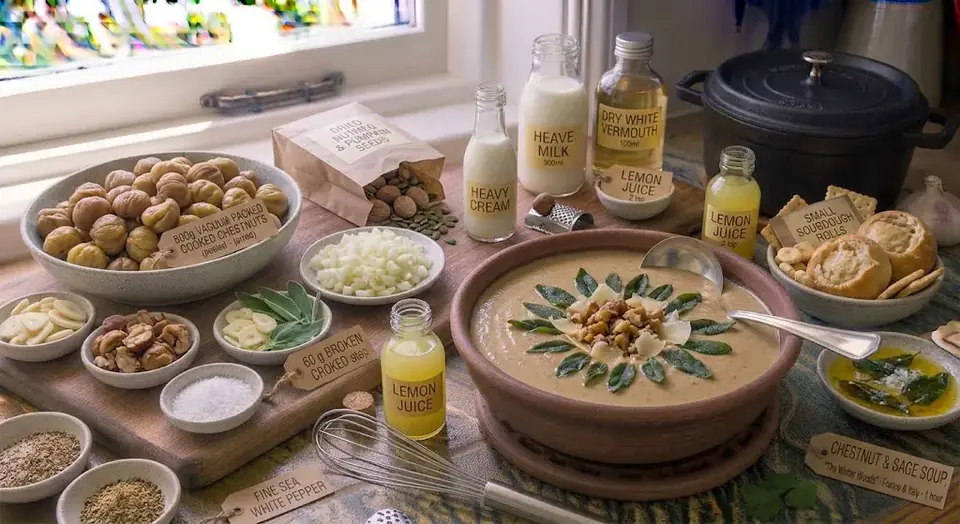
France & Italy · The Winter Woods · 46.56° N, 2.35° E
Chestnut & Sage Soup
Chestnuts treated as a starch, sharpened with lemon and finished with fried sage.
At a glance.
Chestnut & Sage Soup comes from France & Italy · The Winter Woods and appears in The Soup Atlas, in the chapter Creamy & Pureed Soups. It serves 6, takes about 1 hr, and uses 20 ingredients and 12 steps.
- Yield
- Serves 6
- Method
- Stovetop
- Time
- 1 hr
Ingredients
Tap an ingredient to tick it off.
- For the soup
- For the fried sage
- To finish
Method
-
Decide on your chestnuts first. Vacuum-packed cooked chestnuts are the honest shortcut and this recipe is written for them: they are already peeled, they taste clean, and they cost you a little sweetness and a slightly softer texture against roughly forty minutes of scalded fingers.
-
If you are using fresh ones, cut a deep cross through the shell on the domed side of each nut, cover them with cold water, bring to a boil and simmer 20 minutes. Lift out three or four at a time and peel while they are too hot to hold comfortably — shell and the bitter inner pellicle both come away only while hot.
-
Set aside 60 g of the chestnuts for the garnish. Break the rest into rough pieces with your hands.
-
Melt the 45 g of butter with the olive oil in a heavy pot over medium-low heat. Add the onion, leek, celery and a pinch of salt and sweat for 12 minutes, covered, stirring occasionally, until everything is soft and sweet with no color at all.
-
Add the garlic and the 6 sage leaves and cook for 2 minutes, until the sage smells resinous and the garlic has lost its raw edge.
-
Pour in the vermouth, turn the heat up and let it bubble for 2–3 minutes until the pan is almost dry and the alcohol has burnt off. Chestnut is a soft, sweet flavor and it needs something aromatic underneath it.
-
Add the broken chestnuts and the stock. Bring to a simmer and cook, uncovered, for 25 minutes. The chestnuts will slump and start to dissolve at the edges, and the liquid will thicken visibly as their starch is released.
-
Blend in batches, filling the jug no more than a third full with hot liquid, venting the lid and holding a folded towel over the top. Run each batch 90 seconds. Chestnut starch behaves nothing like potato — it will not turn elastic, and it takes long blending well.
-
Pass it through a fine sieve for the smoothest result, then return it to low heat and loosen with stock until it falls from the ladle in a thick ribbon. Chestnut soup thickens as it stands, so make it looser than you think you want it.
-
Fry the sage. Melt the 60 g of butter in a small pan over medium heat until it foams, drop in the dry sage leaves in a single layer and cook 30–40 seconds a side, until they stop bubbling and go stiff and translucent. Lift them onto paper, salt them, and keep the butter.
-
Season the soup with the 2 teaspoons of salt, the white pepper and the lemon juice, then stir in the cream off the heat. Taste, and expect to add more of both salt and lemon — chestnut carries almost no acid and very little savoriness of its own, so it swallows seasoning that would over-salt any other soup in this chapter.
-
Serve topped with the fried leaves, the crumbled chestnuts, shaved Parmesan and a spoonful of the sage butter poured over.
Cook’s notes
- The technique
- Season chestnut soup harder than instinct allows, and taste it three times. Chestnuts are unusual among nuts in being mostly starch rather than oil — roughly 45 percent carbohydrate and under 3 percent fat, closer in composition to a grain than to an almond — which is why they thicken a pot on their own and why they taste sweet and slightly flat. What they lack is acid and free glutamate, the two things that make a savory soup register as savory. Lemon juice supplies the first; Parmesan, and a well-made stock, supply the second. Add both at the end, off the heat, and keep tasting until the sweetness reads as depth.
- Make ahead
- It keeps four days refrigerated and freezes for three months, and it thickens dramatically in both, so plan to thin it with stock as you reheat. Freeze it before the cream goes in. The fried sage must be done within the hour — the leaves go limp and the butter loses its nutty edge. Fresh chestnuts can be boiled and peeled two days ahead and kept covered in the refrigerator.
- Troubleshooting
- Flat and sweet — under-salted and under-acidified; add lemon half a teaspoon at a time. Bitter — fragments of pellicle went into the pot with fresh chestnuts, and a sieve will catch most but not all. Gluey and stiff — it was left to stand; loosen with hot stock. Sage gone brown and acrid — the butter was too hot, or the leaves were damp when they went in.
- Variations
- The Piedmontese pair chestnut with porcini, adding a small handful of dried mushrooms and their strained liquor. A Tuscan version drops the cream and finishes with olive oil and rosemary. Add a bulb of fennel with the onion for a lighter, more aromatic pot. Pancetta rendered at the start and crisped for the top makes it a winter main course rather than a first course.
- To serve and keep
- Serve it hot, in small bowls — it is rich, and a modest portion goes further than a generous one. Bread toasted over a fire if you have one, or good sourdough. Drink a Savoie white, an oaked Chardonnay, or a light Piedmontese red such as Dolcetto served slightly cool. Made in full within this recipe — Fried Sage Leaves, Sage Butter. Also listed in the Component Index at the back.

Where it comes from
For centuries the sweet chestnut was bread. In the Cévennes and the Ardèche, in Corsica, in the Tuscan Garfagnana and across the hills of Piedmont, Castanea sativa was the staple carbohydrate of villages sited too high and too steep for wheat, and both French and Italian call it the bread tree — l'arbre à pain, l'albero del pane. The nuts were dried over slow fires in stone huts, the clède in the Cévennes and the metato in Tuscany, then hulled, stored through winter and ground to flour. Maize and then the potato began displacing that economy in the eighteenth and nineteenth centuries; two imported diseases, ink disease and then the chestnut blight, finished much of what remained in the twentieth. What survives survives deliberately: the châtaigne d'Ardèche holds a French AOC granted in 2006, and the marroni of Cuneo carry their own protection. Chestnuts belong to soup in both traditions, thickened with nothing else and eaten in the weeks around the winter solstice.
Chestnut & Sage Soup: quick answers
How long does Chestnut & Sage Soup take?
About 1 hr.
How many does this Chestnut & Sage Soup recipe make?
This recipe serves 6.
Where does Chestnut & Sage Soup come from?
For centuries the sweet chestnut was bread. In the Cévennes and the Ardèche, in Corsica, in the Tuscan Garfagnana and across the hills of Piedmont, Castanea sativa was the staple carbohydrate of villages sited too high and too steep for wheat, and both French and Italian call it the bread tree — l'arbre à pain, l'albero del pane. The nuts were dried over slow fires in stone huts, the clède in the Cévennes and the metato in Tuscany, then hulled, stored through winter and ground to flour. Maize and then the potato began displacing that economy in the eighteenth and nineteenth centuries; two imported diseases, ink disease and then the chestnut blight, finished much of what remained in the twentieth. What survives survives deliberately: the châtaigne d'Ardèche holds a French AOC granted in 2006, and the marroni of Cuneo carry their own protection. Chestnuts belong to soup in both traditions, thickened with nothing else and eaten in the weeks around the winter solstice.
More from France






More in Creamy & Pureed Soups


https://www.atlasserie.com/recipes/soup/chestnut-and-sage-soup/