Jewish Tradition · Rosh Hashanah · 31.78° N, 35.22° E
Sesame Challah
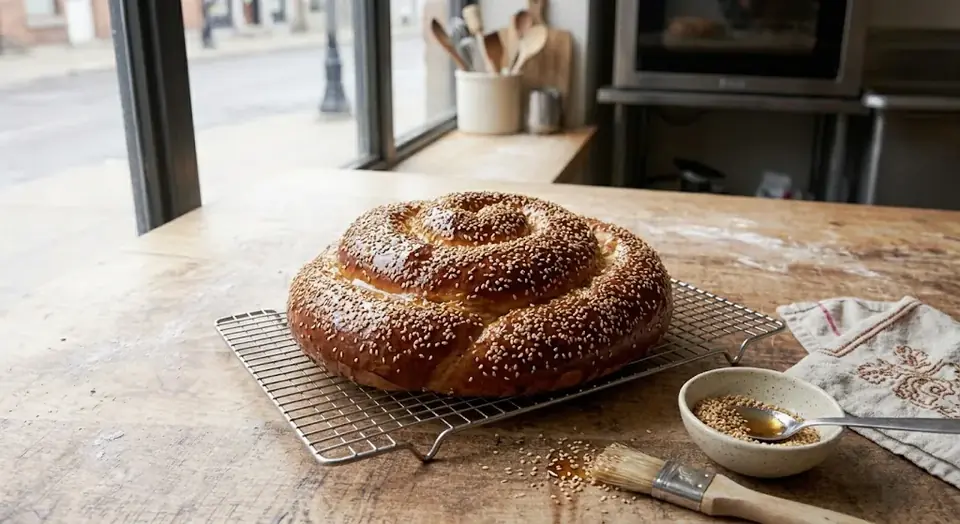
The New Year crown: coiled, honeyed, thick with toasted sesame.
At a glance.
Sesame Challah comes from Jewish Tradition · Rosh Hashanah and appears in The Bread Atlas, in the chapter Sweet & Enriched Breads. It makes 1 round coiled loaf, is made by oven 175°c / 350°f, and uses 10 ingredients and 11 steps.
- Yield
- Makes 1 round coiled loaf
- Method
- Oven 175°C / 350°F, 4¾ hours
Ingredients
Tap an ingredient to tick it off.
- Toasted Sesame
- The Dough
- Honey Egg Wash
Method
-
Toast the sesame seeds in a dry pan over medium heat, shaking constantly for 3–4 minutes until they turn straw-gold and smell of nuts. Tip them straight out of the pan — left in it they carry on cooking and turn bitter. Set aside a third for the dough.
-
Whisk the honey into water at 28°C, then add the eggs and oil. Mix into the flour, salt and yeast to a rough dough, and rest 20 minutes. This dough is deliberately firmer than a braided challah: a coil needs to hold its steps rather than relax into a dome.
-
Knead 10 minutes to a smooth, slightly stiff dough that windowpanes with a little resistance. In the last minute work in a third of the sesame, and the raisins if you are using them, folding rather than kneading so the fruit is not torn. Aim for 25°C.
-
Bulk ferment 90–105 minutes at 25°C. Honey is more hygroscopic than sugar and its fructose is quickly available to the yeast, so the dough rises steadily but the crust will darken fast later — remember this when you set the oven.
-
Turn out and shape a single rope. Press the dough into a thick rectangle, roll it up tightly, then work it under your palms from the middle outward into a rope 75–80 cm long, thick as a thumb at one end and tapering to a finger at the other.
-
Rest the rope 10 minutes, then lengthen it a further 10 cm if it has shortened. A tapered rope is what makes a coil that steps down neatly instead of climbing to a stub in the middle.
-
Coil it: start with the thick end and wind it flat on the bench in a tight spiral, keeping each turn pressed against the last, with the thin end finishing on the outside. Tuck that tail underneath and pinch it to the base.
-
Lift the coil onto a lined tray. For a taller loaf, set it inside a 20 cm cake ring, which stops it spreading and forces the spiral upward. Brush thinly with the honey wash, cover, and prove 60–75 minutes at 24°C.
-
The loaf is ready when the grooves between the coils have narrowed to shallow valleys and a fingertip leaves a dent that fills slowly. Heat the oven to 175°C / 350°F — lower than a plain challah, because honey browns sooner than sugar.
-
Wash again, scatter the remaining sesame heavily over the top and into the grooves, and bake 32–38 minutes. Tent with foil at 20 minutes. The loaf is done at an internal 88–91°C and should sound hollow when the base is tapped.
-
Cool on a rack for at least an hour. Serve it whole and uncut on the table, with a bowl of honey beside it for dipping, and tear rather than slice for the blessing.
Cook’s notes
- To serve and keep
- Brought to the table whole for the New Year meal, blessed, torn and dipped in honey rather than salt. Leftovers are the best possible French toast for the second day of the festival. Keep it wrapped in a cloth at room temperature; the sesame goes soft in plastic.

Where it comes from
For the ten days from Rosh Hashanah, and in many households through to Hoshana Rabbah, the Sabbath loaf changes shape. It is coiled into a round instead of braided into a long plait, and the reasons given are several: a crown, for the kingship declared in the New Year liturgy; a circle for the turning year; a form with no ends, for a life without one; and a spiral climbing upward, for prayers doing the same. Explanations this abundant usually mean the custom came first and the interpretations were fitted afterwards. Two other changes come with it. Honey replaces sugar, and the loaf is dipped in honey rather than salted, in the same spirit as apples and honey and the other simanim, the symbolic foods eaten for a sweet year. Sesame is old in Middle Eastern and Sephardi baking and travels well onto the New Year loaf; seeds on challah are commonly explained as a reminder of manna, which Exodus describes as fine as coriander seed.
Sesame Challah: quick answers
How many does this Sesame Challah recipe make?
This recipe makes 1 round coiled loaf.
Where does Sesame Challah come from?
For the ten days from Rosh Hashanah, and in many households through to Hoshana Rabbah, the Sabbath loaf changes shape. It is coiled into a round instead of braided into a long plait, and the reasons given are several: a crown, for the kingship declared in the New Year liturgy; a circle for the turning year; a form with no ends, for a life without one; and a spiral climbing upward, for prayers doing the same. Explanations this abundant usually mean the custom came first and the interpretations were fitted afterwards. Two other changes come with it. Honey replaces sugar, and the loaf is dipped in honey rather than salted, in the same spirit as apples and honey and the other simanim, the symbolic foods eaten for a sweet year. Sesame is old in Middle Eastern and Sephardi baking and travels well onto the New Year loaf; seeds on challah are commonly explained as a reminder of manna, which Exodus describes as fine as coriander seed.
More from Jewish tradition

More in Sweet & Enriched Breads
https://www.atlasserie.com/recipes/bread/sesame-challah/