United States · The Citrus Breakfast Table · 39.87° N, 98.73° W
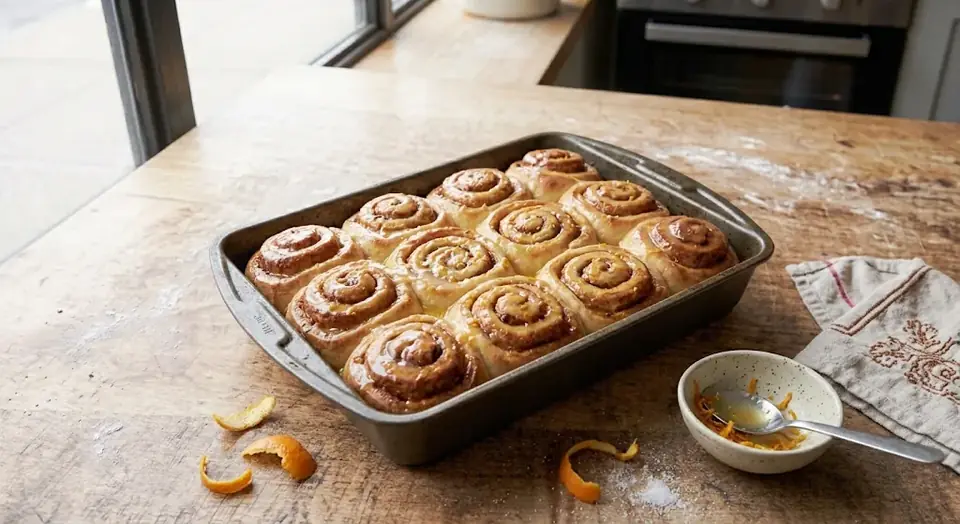
Orange Sweet Rolls
Zest-scented spirals under a bright, thin orange glaze.
At a glance.
Orange Sweet Rolls comes from United States · The Citrus Breakfast Table and appears in The Bread Atlas, in the chapter Sweet & Enriched Breads. It makes 12 rolls, is made by oven 180°c / 350°f, and uses 16 ingredients and 11 steps.
- Yield
- Makes 12 rolls
- Method
- Oven 180°C / 350°F, 3¾ hours
Ingredients
Tap an ingredient to tick it off.
- The Dough
- Orange Sugar
- Orange Glaze
Method
-
Zest five oranges over a bowl with a fine grater, taking only the colored layer and stopping at the white. Divide it: two oranges' worth for the dough, three for the filling. Work over the bowl so the oil that sprays as you grate is caught.
-
Rub the filling's zest into its 120 g of sugar with your fingertips for a full minute, until the sugar is damp, orange-flecked and intensely fragrant. This is an oleo-saccharum in miniature: the sugar's crystals abrade the peel and its hygroscopic surface holds the released oil.
-
Mix the flour, sugar, salt, yeast and the dough's zest with milk at 24°C and the eggs to a rough dough. Rest 20 minutes, knead 8 minutes, then add the soft butter in three additions and knead to a full windowpane. Target 25°C.
-
Bulk ferment 75–90 minutes at 25°C, covered, until doubled and domed. Beat the orange sugar together with the very soft butter and the pinch of salt to a spreadable paste, and leave it at room temperature.
-
Roll the dough to a rectangle 45 × 30 cm with a long side toward you, an even 5 mm thick, easing rather than forcing it into the corners. Rest the dough 5 minutes if it fights you; a stretched sheet contracts in the tin.
-
Spread the orange butter over the whole surface, leaving 2 cm bare along the far edge. Do not add juice here — water in the filling turns to steam, blows the spiral apart and leaves a soggy line through the crumb.
-
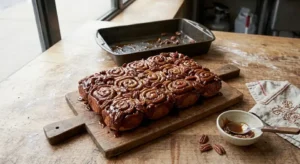
Roll up tightly from the near edge, keeping the ends level, and pinch the seam. Cut into 12 rounds with dental floss, and set them cut-side up in a buttered 33 × 23 cm tin, evenly spaced with room to grow into each other.
-
Prove 55–70 minutes at 24°C, until the rolls have swollen to fill the tin and touch along their sides, and the spirals have loosened visibly. Bring the oven up to 180°C / 350°F.
-
Bake 22–26 minutes, until the tops are golden and the centers read 89–90°C. Rolls in a shared tin bake unevenly — turn the tin at 15 minutes, and check the middle roll rather than a corner one.
-
Whisk the glaze while they bake: icing sugar, melted butter, the remaining zest and the juice added a teaspoon at a time until it pours in a thick ribbon. Juice belongs here, off the heat, where its acidity and freshness survive.
-
Cool the rolls 10 minutes — hot enough for the glaze to sink into the crevices, cool enough that it does not run off entirely — then spoon it over. Serve within the hour, warm, straight from the tin.
Cook’s notes
- To serve and keep
- Warm, at breakfast or brunch, pulled apart by hand from the tin, with black coffee to cut the sweetness. They are also the standard American Christmas-morning roll, assembled the night before. Store covered at room temperature and eat within a day; the glaze weeps if refrigerated.

Where it comes from
No single kitchen can claim the orange roll, and the honest account is one of supply. Citrus in European baking was for centuries a preserved ingredient — candied peel and orange flower water in festival breads from Portugal to Poland — because fresh fruit did not travel. Refrigerated rail cars changed that in the United States: by the 1890s Florida and California oranges reached northern cities in quantity, and by the 1920s the marketing cooperatives that became Sunkist had turned the orange from a Christmas-stocking luxury into a breakfast commodity. The sweet roll followed the fruit onto the breakfast table, and orange rolls became a fixture of church cookbooks and community collections across the American South and Midwest, then of refrigerated dough tubes from the 1960s. What matters technically is a distinction those cooks arrived at by trial: flavor lives in the peel, not the juice. Recipes that lean on juice are pale; the ones people copied out and passed on rub the zest into sugar first.
Orange Sweet Rolls: quick answers
How many does this Orange Sweet Rolls recipe make?
This recipe makes 12 rolls.
Where does Orange Sweet Rolls come from?
No single kitchen can claim the orange roll, and the honest account is one of supply. Citrus in European baking was for centuries a preserved ingredient — candied peel and orange flower water in festival breads from Portugal to Poland — because fresh fruit did not travel. Refrigerated rail cars changed that in the United States: by the 1890s Florida and California oranges reached northern cities in quantity, and by the 1920s the marketing cooperatives that became Sunkist had turned the orange from a Christmas-stocking luxury into a breakfast commodity. The sweet roll followed the fruit onto the breakfast table, and orange rolls became a fixture of church cookbooks and community collections across the American South and Midwest, then of refrigerated dough tubes from the 1960s. What matters technically is a distinction those cooks arrived at by trial: flavor lives in the peel, not the juice. Recipes that lean on juice are pale; the ones people copied out and passed on rub the zest into sugar first.
More from United States


More in Sweet & Enriched Breads
https://www.atlasserie.com/recipes/bread/orange-sweet-rolls/