Finland and Sweden · Pulla · 64.26° N, 26.14° E
Cardamom Bread
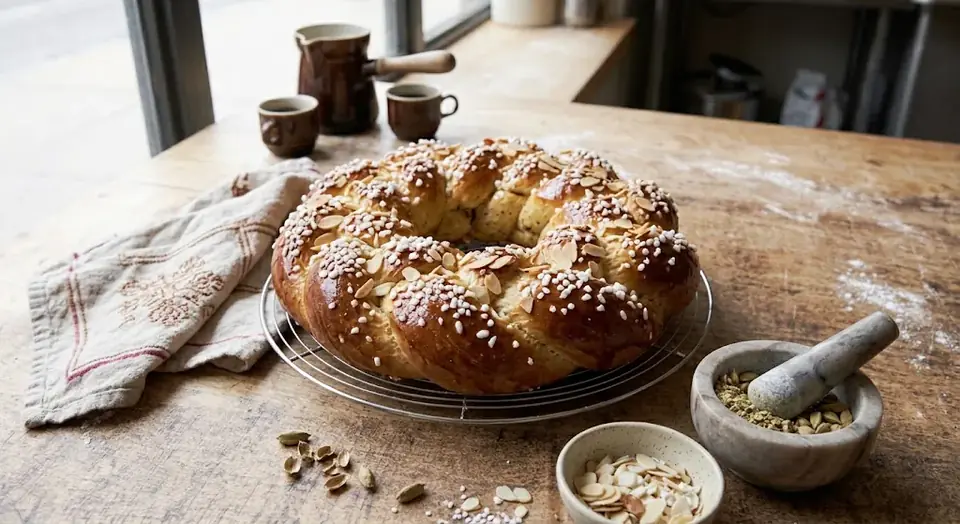
A braided wreath, heavy with cardamom, sugared and almond-strewn.
At a glance.
Cardamom Bread comes from Finland and Sweden · Pulla and appears in The Bread Atlas, in the chapter Sweet & Enriched Breads. It makes 1 braided wreath, is made by oven 190°c / 375°f, and uses 11 ingredients and 11 steps.
- Yield
- Makes 1 braided wreath
- Method
- Oven 190°C / 375°F, 3½ hours
Ingredients
Tap an ingredient to tick it off.
- Freshly Ground Cardamom
- The Dough
- Egg Wash and Nib Sugar
Method
-
Split the pods with the flat of a knife, pick out the black seeds and discard the pale husks. Grind the seeds in a mortar or a spice mill to a coarse, oily powder — you want visible specks, not dust. Do this immediately before mixing.
-
Warm the milk to 26°C. Whisk it with the eggs, then mix into the flour, sugar, salt, yeast and the whole of the ground cardamom. Bring together to a rough dough and rest 15 minutes.
-
Knead 8 minutes until smooth, then add the softened butter in three additions, working each in completely. Continue 5 minutes to a glossy dough that windowpanes cleanly. It should be soft but not sticky, at 26°C.
-
Bulk ferment 60–75 minutes at 26°C, until well risen and domed. This dough carries more yeast than most in the chapter — Nordic sweet doughs are traditionally worked fast and warm, and the cardamom masks nothing of the flavor a long ferment would build.
-
Turn out, divide into three pieces of about 340 g, and round each. Rest 15 minutes under a cloth, or the ropes will spring back to two-thirds of their length as fast as you roll them.
-
Roll each piece into a rope 55 cm long, even in thickness, working from the middle out. Lay the three side by side and pinch the far ends together.
-
Braid a plain three-strand plait: outside left over the middle, outside right over the middle, and repeat, keeping the tension even and the plait loose enough to grow. Pinch the near ends together when you reach them.
-
Curve the plait into a ring on a lined tray, bring the two ends together, and join them by tucking one under the other and pinching underneath — the join should sit where a braid crossing would, so that it disappears.
-
Cover and prove 45–55 minutes at 25°C, until the wreath has grown by half and the braid's grooves have shallowed. Take the oven up to 190°C / 375°F. Set an ovenproof bowl in the middle of the ring if you want it to hold a wide, even circle.
-
Brush with egg wash, scatter nib sugar and flaked almonds over the top, and bake 25–30 minutes to a deep gold, covering with foil at 18 minutes if the almonds color early. It is baked at an internal 90°C.
-
Slide onto a rack and cool 40 minutes under a cloth. Pulla is meant to be torn along the braid at the table rather than sliced, and it is at its best within an hour of the oven — which is when it is usually eaten.
Cook’s notes
- To serve and keep
- Torn at the coffee table, plain or with butter, alongside the strongest possible filter coffee — Finnish kahvipöytä convention sets out pulla first and richer cakes after. Day-old pulla toasts well and makes excellent bread pudding. Store under a cloth at room temperature; it dries quickly.

Where it comes from
Cardamom grows in the Western Ghats of southern India, some 8,000 kilometres from Helsinki, and how it became the defining spice of Nordic baking is a question with a confident answer and a thin evidence base. The story usually told has Vikings meeting it in Constantinople and carrying it north; it is repeated far more assuredly than the archaeology supports. What can be documented is trade: Hanseatic merchants moved eastern spices into the Baltic from the fourteenth century, and the Swedish East India Company, chartered at Gothenburg in 1731, brought cargoes home in bulk and at prices that reached ordinary kitchens. Sweden's per-head consumption of cardamom is often quoted as many times the European average, and while the figure varies with the telling, the habit it describes is real. In Finland the bread is pulla — nisu in the west of the country — braided into loaves or wreaths and served with coffee, which Finns drink in greater quantity per person than any other nation. The wreath is festival baking: Christmas, Easter, and any table with visitors at it.
Cardamom Bread: quick answers
How many does this Cardamom Bread recipe make?
This recipe makes 1 braided wreath.
Where does Cardamom Bread come from?
Cardamom grows in the Western Ghats of southern India, some 8,000 kilometres from Helsinki, and how it became the defining spice of Nordic baking is a question with a confident answer and a thin evidence base. The story usually told has Vikings meeting it in Constantinople and carrying it north; it is repeated far more assuredly than the archaeology supports. What can be documented is trade: Hanseatic merchants moved eastern spices into the Baltic from the fourteenth century, and the Swedish East India Company, chartered at Gothenburg in 1731, brought cargoes home in bulk and at prices that reached ordinary kitchens. Sweden's per-head consumption of cardamom is often quoted as many times the European average, and while the figure varies with the telling, the habit it describes is real. In Finland the bread is pulla — nisu in the west of the country — braided into loaves or wreaths and served with coffee, which Finns drink in greater quantity per person than any other nation. The wreath is festival baking: Christmas, Easter, and any table with visitors at it.
More from Finland

More in Sweet & Enriched Breads
https://www.atlasserie.com/recipes/bread/cardamom-bread/