Britain and Peshawar · The Stuffed Sweet Naan · 53.77° N, 2.57° W
Peshwari-Style Naan
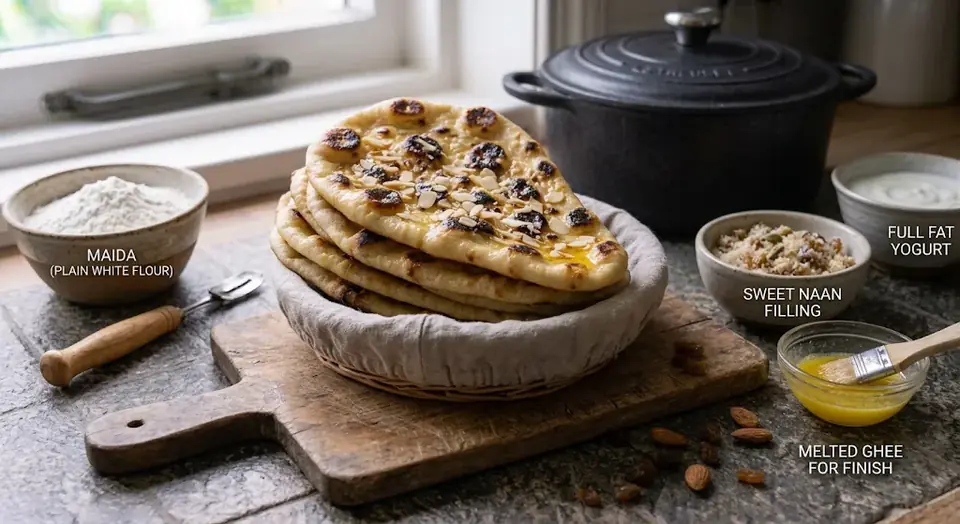
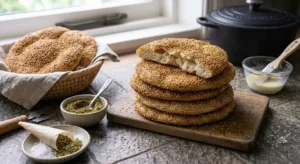
A sealed naan holding coconut, almond and sultanas, sweet and blistered.
At a glance.
Peshwari-Style Naan comes from Britain and Peshawar · The Stuffed Sweet Naan and appears in The Bread Atlas, in the chapter Flatbreads. It makes 6 naan, takes about 3 hours, and uses 15 ingredients and 11 steps.
- Yield
- Makes 6 naan
- Method
- Oven 260°C / 500°F under the grill
- Time
- 3 hours
Ingredients
Tap an ingredient to tick it off.
- The Dough
- Coconut, Almond and Sultana Filling
- To Finish
Method
-
Stir the sugar and yeast into the milk at 35°C, whisk in the yogurt, then mix with the flour, salt and melted ghee to a soft dough. Knead 8 minutes to a smooth, slack ball at 26°C and prove 90 minutes at 26°C until doubled.
-
Toast the desiccated coconut in a dry pan over low heat, stirring constantly, until it is the color of straw — 3–4 minutes. Tip it out to cool; left in the hot pan it goes on darkening and turns bitter.
-
Chop the sultanas small. Whole dried fruit inside a thin naan acts as a wedge — it concentrates the load at one point and tears the dough as the bread is rolled and again as it expands in the heat.
-
Combine the cooled coconut, ground almonds, chopped sultanas, sugar and cardamom, then work in the melted ghee with your fingers until the mixture holds together when squeezed. It should be barely damp; a wet filling steams and blows the naan open.
-
Divide the dough into 6 pieces of about 145 g and the filling into 6 portions of about 30 g. Rest the dough balls 15 minutes so they will stretch without fighting you.
-
Flatten one ball into a disc of about 12 cm, leaving the middle slightly thicker than the rim. Heap a portion of filling in the center, then draw the edges up and over it as you would close a purse, pinching the gathered dough hard into a knot.
-
Turn the parcel seam side down and rest it 10 minutes. The seal needs to relax before rolling or it will spring open, and every filled ball benefits from the same wait.
-
Roll from the center outward with light, short strokes, turning the parcel a quarter turn each time, into a teardrop of about 22 × 13 cm and 6 mm thick — thicker than a plain naan, because the filling needs a jacket. Stop if the surface starts to shine and thin; that is the point before a tear.
-
Set a cast-iron pan or baking steel 12 cm below the grill element, heat the oven to 260°C for 30 minutes and run the grill at full for 5. Brush the underside of the naan with water and lay it wet side down on the metal, scattering the flaked almonds over the top.
-
Grill 2 to 2½ minutes — longer than a plain naan, because there is filling to heat through. The surface blisters and blackens in spots and the bread swells around the filling. Check that the almonds have colored but not caught.
-
Brush heavily with melted ghee straight off the heat and stack in a cloth. Rest 5 minutes before cutting; the filling comes out of the grill hot enough to burn a mouth, and it needs the moment to settle.
Cook’s notes
- To serve and keep
- Served alongside a hot or heavily spiced dish, where the sweetness is meant to cut through rather than accompany. Cut it into wide strips at the table and pass it around. It does not keep past the day and is best eaten within the hour, while the filling is still soft.

Where it comes from
The name points to Peshawar, capital of Khyber Pakhtunkhwa in northwest Pakistan, and the spelling usually printed — Peshwari — is an anglicization that has drifted from Peshawari. The city's own tandoor bakeries turn out large plain naan and roghani naan enriched with milk and sesame; a fruit-and-nut stuffed sweet naan is not what a Peshawar bakery sells, and it is honest to say so. This is a British restaurant bread. It took its present form in the curry houses that spread through Britain from the 1960s, most of them run by families from Sylhet in what is now Bangladesh, and it was built for a market that wanted a sweet counterpoint to a hot sauce. Kashmiri naan, offered on the same menus with much the same filling, is a sibling under a different geographic label. None of this makes it fraudulent. Sweet enriched breads are genuinely at home across the region — sheermal, scented with saffron and milk, has been baked in Lucknow for a very long time — and stuffed naan is an established form. What is invented is the pairing of this filling with this city's name.
Peshwari-Style Naan: quick answers
How long does Peshwari-Style Naan take?
About 3 hours.
How many does this Peshwari-Style Naan recipe make?
This recipe makes 6 naan.
Where does Peshwari-Style Naan come from?
The name points to Peshawar, capital of Khyber Pakhtunkhwa in northwest Pakistan, and the spelling usually printed — Peshwari — is an anglicization that has drifted from Peshawari. The city's own tandoor bakeries turn out large plain naan and roghani naan enriched with milk and sesame; a fruit-and-nut stuffed sweet naan is not what a Peshawar bakery sells, and it is honest to say so. This is a British restaurant bread. It took its present form in the curry houses that spread through Britain from the 1960s, most of them run by families from Sylhet in what is now Bangladesh, and it was built for a market that wanted a sweet counterpoint to a hot sauce. Kashmiri naan, offered on the same menus with much the same filling, is a sibling under a different geographic label. None of this makes it fraudulent. Sweet enriched breads are genuinely at home across the region — sheermal, scented with saffron and milk, has been baked in Lucknow for a very long time — and stuffed naan is an established form. What is invented is the pairing of this filling with this city's name.
More from United Kingdom



More in Flatbreads

https://www.atlasserie.com/recipes/bread/peshwari-style-naan/