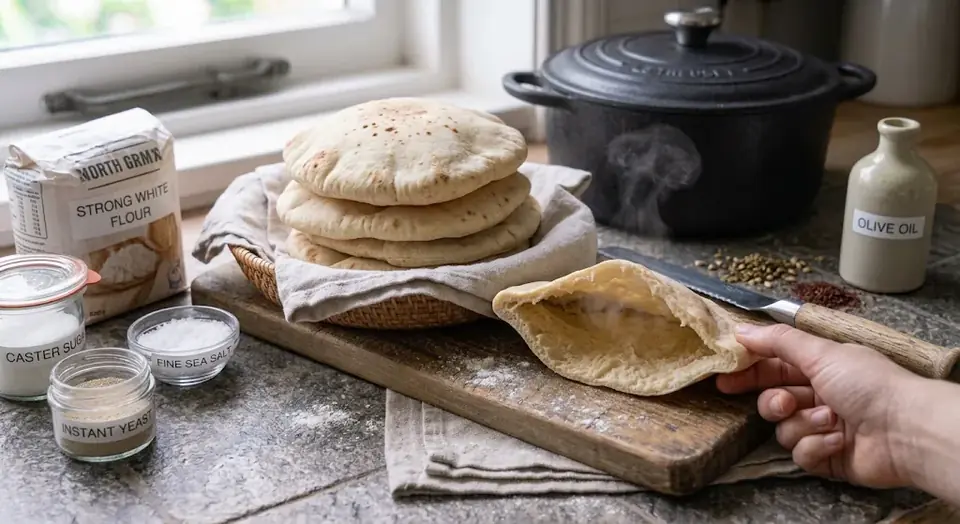
The Levant · Khubz Arabi · 31.50° N, 40.00° E
Pita Bread
Thin Levantine rounds that inflate into a hollow pocket in seconds.
At a glance.
Pita Bread comes from The Levant · Khubz Arabi and appears in The Bread Atlas, in the chapter Flatbreads. It makes 8 pitas, takes about 3 hours, and uses 6 ingredients and 11 steps.
- Yield
- Makes 8 pitas
- Method
- Oven 260°C / 500°F
- Time
- 3 hours
Ingredients
Tap an ingredient to tick it off.
- The Dough
Method
-
Whisk the flour, salt, yeast and sugar together, pour in the water at 30°C and the oil, and mix to a shaggy mass. Cover and leave 20 minutes; the flour hydrates on its own and the kneading that follows is halved.
-
Knead 8 minutes by hand or 5 on a mixer's second speed until the dough is smooth, elastic and slightly tacky rather than sticky. Aim for a final dough temperature of 26°C. Gluten has to be gas-tight here, so take the windowpane test seriously.
-
Round the dough, cover, and bulk ferment 75–90 minutes at 24–26°C until roughly doubled and domed. A finger pressed into the surface should leave a dent that fills back slowly, not one that springs shut.
-
Set a baking steel or a thick stone on a rack in the upper third of the oven and heat to 260°C for a full 45 minutes. The rack sits high so the oven roof throws radiant heat down onto the top skin while the steel drives heat up through the base.
-
Turn the dough out without deflating it more than necessary, divide into 8 pieces of about 105 g, and roll each into a tight ball under a cupped hand. Cover and rest 20 minutes — an unrested ball fights the pin and rolls unevenly.
-
Roll each ball on a lightly floured surface to a round of 20 cm and 3–4 mm thick, turning it a quarter turn between passes so it stays circular and, more importantly, of even thickness. A thin patch in a thick round is where the pocket fails.
-
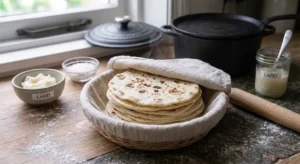
Lay the rolled rounds on a floured cloth, cover, and leave 10 minutes. Brush off loose flour before baking; flour left on the surface scorches on the steel and tastes of it.
-
Slide two rounds at a time straight onto the hot steel, working quickly and keeping the door open no longer than a few seconds. Within 30 seconds the surface blisters, then the whole round lifts and balloons taut.
-
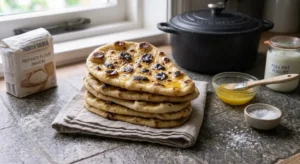
Bake 2–3 minutes in all. Take them out while still pale with a few brown freckles — a pita left for color turns into a cracker and loses the flexibility that lets the pocket open without splitting.
-
Stack them straight from the oven inside a folded kitchen towel. They collapse as they cool, which is correct; the trapped steam softens the crust and keeps the two layers from bonding back together.
-
Leave the stack wrapped for at least 15 minutes before opening it, then cool fully in the cloth. Bag them once cold, never while warm enough to condense, or the surface goes slick and grey.
Cook’s notes
- To serve and keep
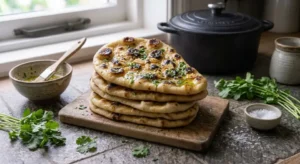
- Torn at the table beside hummus, moutabal and a plate of pickles, cut into wedges and toasted for fattoush, or split and packed with falafel, salad and tahina. Warm briefly on a dry pan before serving. Keep in a sealed bag at room temperature and use within two days.

Where it comes from
In Arabic this bread is khubz arabi, Arab bread, or khubz kmaj, Across Syria, Lebanon, Jordan and Palestine it is khubz — bread with no adjective attached, the default against which every other loaf is described. It is eaten as a utensil more often than as a food: torn, folded into a scoop, used to lift hummus and labneh and grilled meat off the plate so that no cutlery is required. Leavened flat loaves baked against the wall of a clay tannur are attested across the Fertile Crescent long before any modern national cuisine existed, and no one country can claim to have invented the pocket. What changed in the twentieth century was scale. Neighborhood bakeries, the furn, gave way in part to conveyor ovens that run rounds through a 500°C tunnel in under a minute and bag them while still steaming, which is why supermarket pita is uniformly soft and uniformly bland. The English word arrived mid-century from Greek pita, a term that in Greek covers a much wider family of flat breads and pies.
Pita Bread: quick answers
How long does Pita Bread take?
About 3 hours.
How many does this Pita Bread recipe make?
This recipe makes 8 pitas.
Where does Pita Bread come from?
In Arabic this bread is khubz arabi, Arab bread, or khubz kmaj, Across Syria, Lebanon, Jordan and Palestine it is khubz — bread with no adjective attached, the default against which every other loaf is described. It is eaten as a utensil more often than as a food: torn, folded into a scoop, used to lift hummus and labneh and grilled meat off the plate so that no cutlery is required. Leavened flat loaves baked against the wall of a clay tannur are attested across the Fertile Crescent long before any modern national cuisine existed, and no one country can claim to have invented the pocket. What changed in the twentieth century was scale. Neighborhood bakeries, the furn, gave way in part to conveyor ovens that run rounds through a 500°C tunnel in under a minute and bag them while still steaming, which is why supermarket pita is uniformly soft and uniformly bland. The English word arrived mid-century from Greek pita, a term that in Greek covers a much wider family of flat breads and pies.
More from Middle East



More in Flatbreads
https://www.atlasserie.com/recipes/bread/pita-bread/