North India & Pakistan · The Tandoor · 22.82° N, 79.54° E
Naan
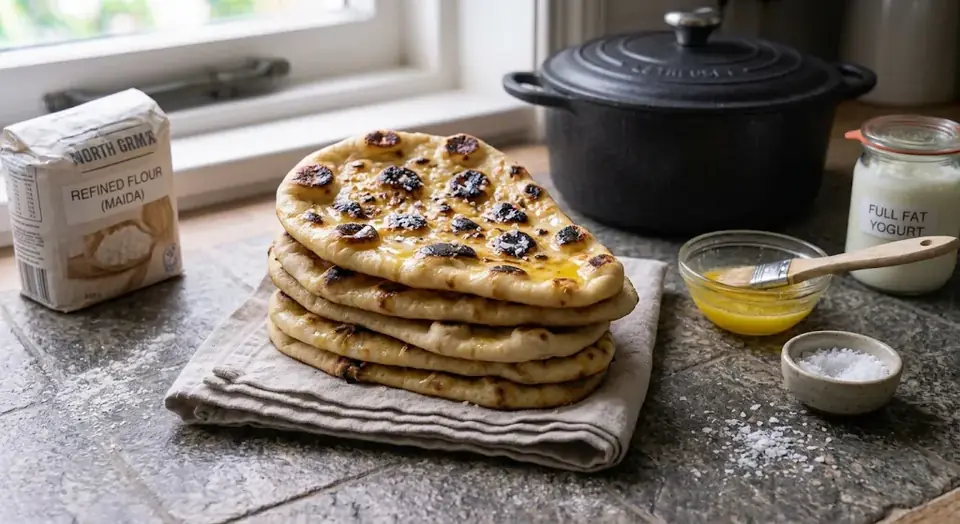
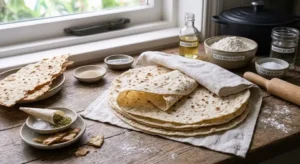
Yogurt-softened teardrops, blistered black and brushed with ghee.
At a glance.
Naan comes from North India & Pakistan · The Tandoor and appears in The Bread Atlas, in the chapter Flatbreads. It makes 6 naan, is made by oven 260°c / 500°f under the grill, and uses 9 ingredients and 11 steps.
- Yield
- Makes 6 naan
- Method
- Oven 260°C / 500°F under the grill, 2½ hours
Ingredients
Tap an ingredient to tick it off.
- The Dough
- Ghee Finish
Method
-
Warm the milk to 35°C and stir in the sugar and yeast. Whisk the yogurt into it until smooth — cold yogurt straight from the refrigerator will drag the dough temperature down and add an hour to the proof.
-
Add the flour and salt and mix to a soft, sticky dough, then work in the melted ghee. Knead 8 minutes until it is smooth and supple but still slack; naan dough should be softer than a bread dough and a shade short of unmanageable. Target 26°C.
-
Cover and prove 90 minutes at 26°C until doubled and visibly aerated. The acidity of the yogurt slackens the gluten as it works, so the dough will feel looser at the end of the proof than at the start.
-
Turn out onto an oiled surface, divide into 6 pieces of about 145 g, and round each one lightly. Cover and rest 20 minutes so the gluten relaxes enough to be pulled rather than rolled.
-
Set a cast-iron pan or a baking steel on a rack about 12 cm below the grill element. Heat the oven at its maximum, 260°C, for 30 minutes, then switch the grill to full and give it 5 minutes more.
-
Working one at a time, press a ball out with your fingertips, then hold the top edge and let the dough hang and stretch under its own weight into a teardrop of about 24 × 14 cm and 4 mm thick. The teardrop is not decorative — it is the shape a hung dough takes on a tandoor wall.
-
Wet the underside of the naan with a brush of water. Lay it wet side down on the searing pan; the water flashes to steam and grips the dough exactly as it does against the clay of a tandoor.
-
Grill 90 seconds to 2 minutes. The bread balloons in patches, the surface takes charred black blisters, and the edges lift. Do not wait for even color — the tandoor does not give it, and the black spots are the flavor.
-
For a hob alternative, heat a cast-iron skillet upside down over a gas burner until the convex base is smoking. Press the wetted naan onto it, cook 60–90 seconds, then invert the pan and hold the bread a few centimeters above the flame to blister the top.
-
Brush each naan with melted ghee the moment it leaves the heat and scatter a little crushed flaky salt. Hot bread absorbs the fat into the crumb; cooled bread only carries it on the surface.
-
Stack them in a folded cloth as they come off, and serve within the half hour. Naan is a bread of the moment it is baked, and no amount of wrapping makes a two-hour-old one taste like a fresh one.
Cook’s notes
- To serve and keep
- Torn by hand and used to lift dal, korma or a bowl of chana; never cut with a knife. In Punjab it comes to the table folded in a cloth with a pool of ghee melting into it. Leftovers are best chopped and fried into a breakfast hash rather than reheated whole.

Where it comes from
The word is Persian: nān, bread, and it travelled wherever Persian travelled as a court and administrative language — through Central Asia, into the Delhi Sultanate, and on into Mughal India, which is why versions of the name attach to breads from Tashkent to Dhaka. The reference usually cited as the earliest South Asian mention is the poet Amir Khusrau, writing in Delhi around 1300, who names naan-e-tanuri and naan-e-tunuk; the citation is repeated more often than it is checked, so hold it lightly. Firmer ground comes with Abu'l-Fazl's Ain-i-Akbari of 1590, the administrative record of Akbar's court, which describes the imperial kitchen's breads and distinguishes thin ones cooked on an iron plate from thick ones baked in the oven. That distinction still holds. Naan is refined-flour bread, leavened, enriched with dairy and baked in a tandoor, which is a communal or commercial object rather than a domestic one. For most households across northern India and Pakistan the daily bread is roti on a tawa; naan comes from the bakery, or from a restaurant.
Naan: quick answers
How many does this Naan recipe make?
This recipe makes 6 naan.
Where does Naan come from?
The word is Persian: nān, bread, and it travelled wherever Persian travelled as a court and administrative language — through Central Asia, into the Delhi Sultanate, and on into Mughal India, which is why versions of the name attach to breads from Tashkent to Dhaka. The reference usually cited as the earliest South Asian mention is the poet Amir Khusrau, writing in Delhi around 1300, who names naan-e-tanuri and naan-e-tunuk; the citation is repeated more often than it is checked, so hold it lightly. Firmer ground comes with Abu'l-Fazl's Ain-i-Akbari of 1590, the administrative record of Akbar's court, which describes the imperial kitchen's breads and distinguishes thin ones cooked on an iron plate from thick ones baked in the oven. That distinction still holds. Naan is refined-flour bread, leavened, enriched with dairy and baked in a tandoor, which is a communal or commercial object rather than a domestic one. For most households across northern India and Pakistan the daily bread is roti on a tawa; naan comes from the bakery, or from a restaurant.
More from India






More in Flatbreads


https://www.atlasserie.com/recipes/bread/naan/