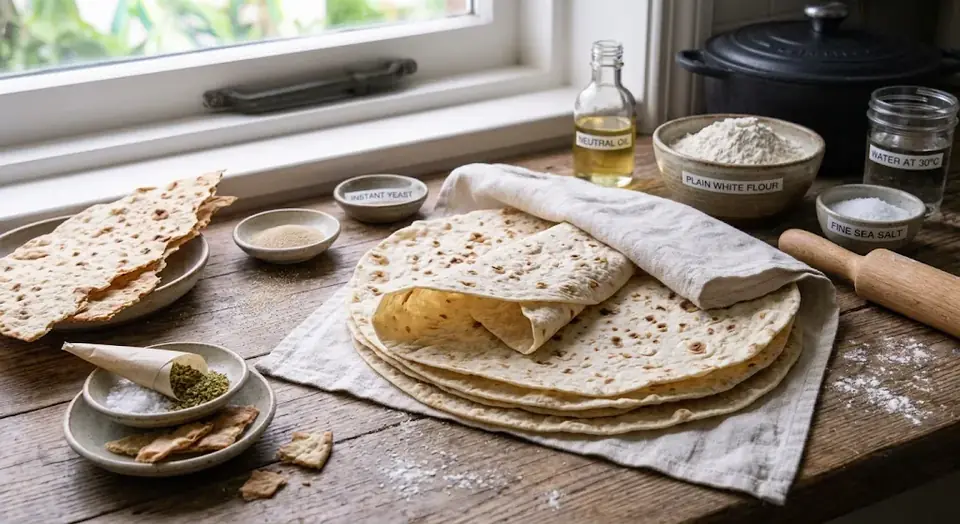
Armenia · The Tonir · 40.21° N, 45.01° E
Lavash
Paper-thin Armenian sheets, eaten soft or dried and revived.
At a glance.
Lavash comes from Armenia · The Tonir and appears in The Bread Atlas, in the chapter Flatbreads. It makes 4 sheets, is made by oven 260°c / 500°f, and uses 5 ingredients and 11 steps.
- Yield
- Makes 4 sheets
- Method
- Oven 260°C / 500°F, 2½ hours
Ingredients
Tap an ingredient to tick it off.
- The Dough
Method
-
Mix the flour, salt and yeast, add the water at 30°C and the oil, and work to a firm dough — noticeably stiffer than a loaf dough, because a slack one cannot be rolled thin without tearing. Knead 10 minutes to a smooth, tight ball at 26°C.
-
Cover and rest 90 minutes at 24°C. The small quantity of yeast is there for flavor and extensibility rather than lift; the dough will swell modestly and should not double.
-
Divide into 4 pieces of about 200 g, round them, oil the tops lightly, and rest a further 30 minutes covered. Rolling can only begin once the dough has stopped pulling back at all.
-
Set a baking steel or a large stone on the middle rack and heat the oven to 260°C for 45 minutes. An overturned heavy baking tray works if you have neither, though it needs an extra 15 minutes of preheating.
-
Roll one piece on a lightly floured surface, working from the middle outward and turning it often, until it is a sheet of roughly 45 × 30 cm. Then keep going. Lavash is finished when the sheet is under 1 mm and the pattern of the bench shows through it.
-
If the dough resists, stop and leave it two minutes rather than forcing it. A torn sheet cannot be patched; the tear opens further in the oven.
-
Drape the sheet over a floured rolling pin or a thin board and unroll it onto the hot steel in one movement. It will begin to blister immediately.
-
Bake 60–90 seconds only, until the sheet is dry to the touch, freckled with brown blisters and still flexible. Watch it — the difference between soft lavash and a cracker is about 20 seconds.
-
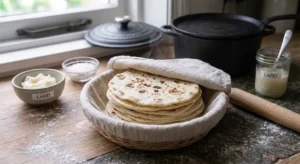
Stack the sheets straight from the oven under a heavy cloth. The steam they give off softens them into the pliable state used for wrapping. Fold them once cool enough to handle.
-
For the dried form, lay the baked sheets flat on a rack in a dry room, uncovered, for 3–4 hours until they are brittle and snap cleanly. Stacked and kept dry, they hold for months without spoiling.
-
To revive dried lavash, flick both sides with water from your fingers, stack the sheets between two damp cloths, and leave 10–15 minutes. They return to full softness and should then be used the same day.
Cook’s notes
- To serve and keep
- Wrapped around khorovats with onion, tomato and herbs; torn and used to lift cheese and greens; or layered wet into ghapama and stews. Dried sheets are also crumbled into soup as a thickener. Keep soft lavash sealed and eat within two days; keep dried sheets flat, stacked and out of the damp.

Where it comes from
In 2014 UNESCO inscribed lavash on its Representative List of the Intangible Cultural Heritage of Humanity under Armenia's nomination, describing the preparation, meaning and appearance of the bread as an expression of Armenian culture. The listing was contested by neighbors who bake the same thing, and in 2016 a second, multinational inscription followed covering flatbread making and sharing culture across Azerbaijan, Iran, Kazakhstan, Kyrgyzstan and Turkey. Both entries are worth knowing, because the honest position is that thin sheet bread belongs to a wide region and that its Armenian practice is nonetheless distinct and deeply documented. It is baked in a tonir, a clay well sunk into the ground and fired from below. Women work in groups: one rolls, one stretches the sheet over a padded oval cushion, one leans headfirst into the pit and slaps it against the wall, where it bakes in under a minute. Autumn baking sessions produce months of bread at once, stacked dry and hard. Lavash also carries ritual weight — it is laid over the shoulders of a bride and groom at the threshold as a wish for prosperity.
Lavash: quick answers
How many does this Lavash recipe make?
This recipe makes 4 sheets.
Where does Lavash come from?
In 2014 UNESCO inscribed lavash on its Representative List of the Intangible Cultural Heritage of Humanity under Armenia's nomination, describing the preparation, meaning and appearance of the bread as an expression of Armenian culture. The listing was contested by neighbors who bake the same thing, and in 2016 a second, multinational inscription followed covering flatbread making and sharing culture across Azerbaijan, Iran, Kazakhstan, Kyrgyzstan and Turkey. Both entries are worth knowing, because the honest position is that thin sheet bread belongs to a wide region and that its Armenian practice is nonetheless distinct and deeply documented. It is baked in a tonir, a clay well sunk into the ground and fired from below. Women work in groups: one rolls, one stretches the sheet over a padded oval cushion, one leans headfirst into the pit and slaps it against the wall, where it bakes in under a minute. Autumn baking sessions produce months of bread at once, stacked dry and hard. Lavash also carries ritual weight — it is laid over the shoulders of a bride and groom at the threshold as a wish for prosperity.
More from Armenia
More in Flatbreads
https://www.atlasserie.com/recipes/bread/lavash/