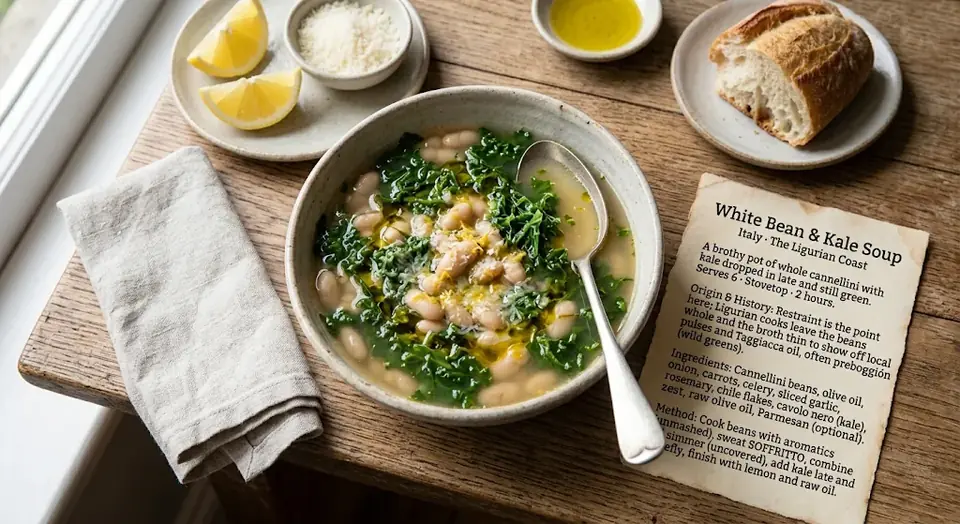
Italy · The Ligurian Coast · 43.43° N, 12.37° E
White Bean & Kale Soup
A brothy pot of whole cannellini with kale dropped in late and still green.
At a glance.
White Bean & Kale Soup comes from Italy · The Ligurian Coast and appears in The Soup Atlas, in the chapter Beans, Lentils & Grains. It serves 6, takes about 2 hours, and uses 19 ingredients and 10 steps.
- Yield
- Serves 6
- Method
- Stovetop
- Time
- 2 hours
Ingredients
Tap an ingredient to tick it off.
- For the beans
- For the soup
- For the greens and the finish
Method
-
Soak the beans overnight in cold water with the salt dissolved in it, then drain and rinse. Simmer them with the fresh water, the two whole garlic cloves, sage and bay for 55–70 minutes, until tender to the center but still holding a distinct shape. Cool them in their liquid.
-
Strip the kale leaves off their central stems by folding each leaf in half and pulling the stem away in one motion. The stems stay woody however long you cook them. Shred the leaves finely and set them aside, unwashed for now so they do not sit wet.
-
Warm the 60 ml of oil in a wide pot over medium-low heat. Add the onion, carrot and celery and cook for 12 minutes, stirring, until softened and glassy. Keep the heat low enough that nothing colors — this soup wants sweetness, not browning.
-
Add the sliced garlic, rosemary and chile flakes and cook for 90 seconds, until the garlic is fragrant and barely turning ivory at the edges. Any darker and it will taste bitter in a broth this clear, where there is nothing to hide behind.
-
Add the drained beans, the stock, 400 ml of the bean liquid and the Parmesan rind. Bring to a bare simmer and cook, uncovered, for 20 minutes. Do not blend any of it. The broth should stay thin enough to see the beans through.
-
Taste and season with the salt. In a soup with this little in it, seasoning is most of the flavor; go further than feels comfortable and then check again in a minute, once the salt has spread.
-
Wash and drain the kale now. Raise the heat until the pot is simmering properly, then stir in the shredded leaves. They will fill the pot and then subside within thirty seconds.
-
Cook the kale uncovered for 6–8 minutes, no more, and leave the lid off the whole time. Finely shredded cavolo nero is tender well before it turns olive-drab, and a closed lid holds in the vegetable's own acids, which is what dulls the color.
-
Pull out the rind and the rosemary stalk. Take the pot off the heat, stir in the lemon zest and a small squeeze of the juice, and check the salt one last time.
-
Ladle into wide bowls, making sure everyone gets both beans and greens, and finish each with a heavy pour of raw olive oil and a grinding of black pepper. Parmesan is optional here and many Ligurian cooks would leave it off.
Cook’s notes
- The technique
- Salt the soaking water, whatever you were told. The old rule that salt toughens beans is the reverse of what happens: sodium ions displace the calcium and magnesium that cross-link pectin in the seed coat, so the skin softens at roughly the same rate as the interior instead of lagging behind and bursting. Around 10 g of salt per liter of soaking water is enough, and it seasons the beans from the inside as a bonus. The visible result is exactly what this soup needs — whole beans with intact skins and creamy centers, rather than a pot of blown-out husks.
- Make ahead
- The bean base holds five days refrigerated and freezes for three months. The kale does not: it dulls and softens overnight, so cook only what you will eat and add fresh greens to each reheated batch. Reheat to a simmer, then stir the raw shredded leaves into the hot pot for their six minutes and finish with new oil and zest.
- Troubleshooting
- Beans burst and the broth cloudy — the pot boiled rather than simmered, or the soak went unsalted. Kale drab and slimy — overcooked, or cooked under a lid; shred finer and count the minutes. Watery and characterless — the stock was weak and the pot under-salted; reduce a little and season again. Greens tough and stringy — the central stems went in.
- Variations
- A genuinely Ligurian turn is a spoonful of pesto stirred into each bowl at the table, in place of cheese. Chard, escarole or young spinach can stand in for the kale, with the cooking time cut to a minute or two. Adding a little pasta or a handful of farro makes it a fuller meal, at the cost of the clarity that defines it. Borlotti work but give a darker, heavier broth.
- To serve and keep
- Wide shallow bowls, and toasted bread rubbed with a cut garlic clove and doused in oil on the side. It should look like a broth with things in it, not a purée. Drink a Ligurian white — Pigato or Vermentino — cold enough to bead the glass. Made in full within this recipe — Soaked and Simmered Cannellini, Garlic and Chile Oil Base. Also listed in the Component Index at the back.

Where it comes from
The rest of Italy calls the Tuscans mangiafagioli, bean eaters, and means it as a jab. This particular bowl belongs a little further west, on the Ligurian coast, where the soups run thinner and the olive oil is the point. Liguria is a narrow strip of terraced land between mountains and sea with almost no room for pasture, so its cooking leans on pulses, wild greens and vegetables: preboggión, the foraged mix of wild herbs and leaves gathered in spring, goes into everything from ravioli filling to soup. The region grows its own celebrated white beans in the Arroscia and Argentina valleys, at Pigna, Badalucco and Conio, small-seeded and thin-skinned, and it presses taggiasca olives into a mild, sweet oil that can be poured on with a heavy hand without dominating. Minestrone alla genovese, the region's best-known soup, is finished with a spoon of pesto rather than cheese. The habit that matters here is restraint: where a Tuscan cook thickens and mashes, a Ligurian one leaves the beans whole and lets you see through the broth.
White Bean & Kale Soup: quick answers
How long does White Bean & Kale Soup take?
About 2 hours.
How many does this White Bean & Kale Soup recipe make?
This recipe serves 6.
Where does White Bean & Kale Soup come from?
The rest of Italy calls the Tuscans mangiafagioli, bean eaters, and means it as a jab. This particular bowl belongs a little further west, on the Ligurian coast, where the soups run thinner and the olive oil is the point. Liguria is a narrow strip of terraced land between mountains and sea with almost no room for pasture, so its cooking leans on pulses, wild greens and vegetables: preboggión, the foraged mix of wild herbs and leaves gathered in spring, goes into everything from ravioli filling to soup. The region grows its own celebrated white beans in the Arroscia and Argentina valleys, at Pigna, Badalucco and Conio, small-seeded and thin-skinned, and it presses taggiasca olives into a mild, sweet oil that can be poured on with a heavy hand without dominating. Minestrone alla genovese, the region's best-known soup, is finished with a spoon of pesto rather than cheese. The habit that matters here is restraint: where a Tuscan cook thickens and mashes, a Ligurian one leaves the beans whole and lets you see through the broth.
More from Italy





More in Beans, Lentils & Grains


https://www.atlasserie.com/recipes/soup/white-bean-and-kale-soup/