Cuba & the Caribbean · Potaje de Frijoles Negros · 21.65° N, 78.93° W
Black Bean Soup
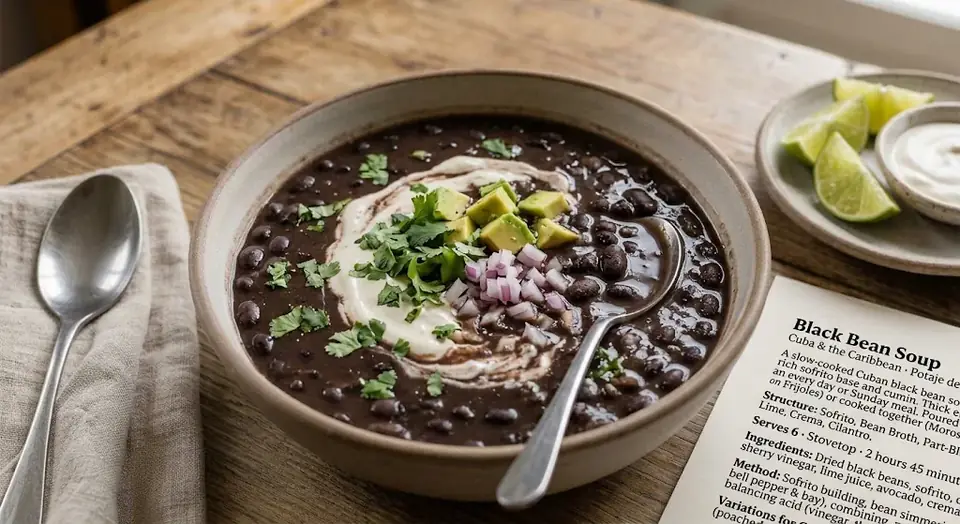
Black turtle beans under sofrito and cumin, cut with lime and crema.
At a glance.
Black Bean Soup comes from Cuba & the Caribbean · Potaje de Frijoles Negros and appears in The Soup Atlas, in the chapter Beans, Lentils & Grains. It serves 6, takes about 2 hr 45 min, and uses 22 ingredients and 10 steps.
- Yield
- Serves 6
- Method
- Stovetop
- Time
- 2 hr 45 min
Ingredients
Tap an ingredient to tick it off.
- For the beans
- For the sofrito
- To finish
Method
-
Drain the soaked beans and put them in a large pot with the water, bay leaves, the whole green pepper and the epazote sprig if you are using it. Nothing acidic goes in yet — no tomato, no lime, no vinegar, and no chipotle either.
-
Bring to a boil for two minutes, skimming the dark foam, then drop the heat until the surface moves lazily. Cook, partly covered, for 1½–2 hours. Top up with boiling water if the beans ever break the surface, since exposed beans cook unevenly and split.
-
Test at ninety minutes by crushing a bean against the roof of your mouth. It should give completely, with no chalky core and no resistance in the skin. Cook until that is true; how long it takes depends entirely on how old the beans are.
-
While the beans cook, make the sofrito. Warm the oil in a wide pan over medium-low heat and cook the diced onion and both peppers for 15 minutes, stirring, until they slump, sweeten and start to gild. This is a slow, quiet stage and it is where the flavor of the soup is built.
-
Add the garlic paste, cumin, oregano and smoked paprika. Cook for 90 seconds, stirring constantly, until the spices smell toasted and the pan is fragrant enough to notice from across the room. Do not let the garlic brown or the whole base turns acrid.
-
Fish out and discard the whole green pepper and the bay leaves from the bean pot. Scrape the sofrito in, along with the chopped chipotles, the adobo and the stock. Only now that the beans are fully tender does anything acidic join them.
-
Simmer, uncovered, for a further 30 minutes so the pot pulls together and reduces slightly. The liquid should darken from purple-black to a glossy near-black and lightly coat the back of a spoon.
-
Ladle out about a third of the soup and blend it smooth — jug no more than a third full, center cap removed, folded towel over the opening — then stir it back in. You want plenty of whole beans left standing in a thickened liquid, not a purée.
-
Season in this order: salt first, until the beans taste of themselves; then the sherry vinegar, which adds depth rather than brightness; then the lime juice, off the heat, tasting as you go. Two limes is a starting point, not a limit.
-
Serve in deep bowls with a spoonful of crema swirled in, diced avocado, cilantro and raw red onion. Lime wedges on the table. White rice alongside, or spooned straight into the bowl if you want it the Cuban way.
Cook’s notes
- The technique
- Acid genuinely does keep beans hard, and this is the recipe where it matters most. The cell walls are held together by pectin, and pectin dissolves readily in neutral or slightly alkaline water but resists strongly below about pH 5.5. Tomato, vinegar, citrus and the adobo clinging to a chipotle can all drop a bean pot into that range, and beans that would have softened in ninety minutes will still be resisting after four hours. It is not a myth and it is not a small effect. Cook the beans plain until they crush without chalk, then add every acidic thing at once.
- Make ahead
- This improves for two days as the sofrito settles into the beans, and keeps five days refrigerated. It freezes for four months, though the texture goes slightly softer. Reheat gently with a splash of stock, stirring from the base. Add the lime, crema and avocado only at the moment of serving; lime added the day before tastes stale and dull.
- Troubleshooting
- Beans still firm after three hours — either acid went in early or the beans are old; a scant ¼ teaspoon of baking soda per liter will push them along, but any more turns them slippery and soapy. Thin and grayish — not enough was blended; purée another ladleful. Muddy and flat — under-limed. Bitter — the garlic or spices caught in the sofrito pan.
- Variations
- Venezuelan caraotas negras go the other way, seasoned with a little sugar or papelón and served with white cheese and sweet fried plantain. Costa Rican sopa negra runs much thinner and takes a poached egg. On the epazote question: it is a Mexican bean-pot herb rather than a Caribbean one, and its reputation for reducing wind is traditional rather than clinically demonstrated — use a sprig of the fresh leaves if you like the resinous flavor, never the concentrated essential oil, which is toxic in small doses.
- To serve and keep
- Deep bowls with a mound of plain long-grain white rice, either alongside or dropped into the middle. Crema, avocado, cilantro, raw onion and lime, with tostones or fried plantain if you want a full plate. Drink cold lager, or a rum highball with plenty of lime. Made in full within this recipe — Cuban Sofrito, Black Bean Pot. Also listed in the Component Index at the back.

Where it comes from
Phaseolus vulgaris was domesticated twice in the Americas, once in Mesoamerica and once in the Andes, and the black turtle bean is one of the results. It traveled through the Caribbean with the people who grew it and became, in Cuba, potaje de frijoles negros — a pot cooked slowly with a sofrito of onion, garlic, cumin and ají, thinned to a soup or thickened to a stew depending on the household and the week. Poured over white rice it is arroz con frijoles; cooked together it becomes moros y cristianos, the name a blunt reference to the Reconquest. Every neighboring cuisine has its own reading. Venezuelan caraotas negras are sweetened, sometimes with papelón, and served with fried plantain. Costa Rican and Nicaraguan sopa negra is thinner and often arrives with a poached egg sitting in it. Cuban families in Miami kept the dish intact through exile, and it is one of the few things about which cooks from the island and cooks from Florida do not argue. It is Lenten food, Sunday food and everyday food at once.
Black Bean Soup: quick answers
How long does Black Bean Soup take?
About 2 hr 45 min.
How many does this Black Bean Soup recipe make?
This recipe serves 6.
Where does Black Bean Soup come from?
Phaseolus vulgaris was domesticated twice in the Americas, once in Mesoamerica and once in the Andes, and the black turtle bean is one of the results. It traveled through the Caribbean with the people who grew it and became, in Cuba, potaje de frijoles negros — a pot cooked slowly with a sofrito of onion, garlic, cumin and ají, thinned to a soup or thickened to a stew depending on the household and the week. Poured over white rice it is arroz con frijoles; cooked together it becomes moros y cristianos, the name a blunt reference to the Reconquest. Every neighboring cuisine has its own reading. Venezuelan caraotas negras are sweetened, sometimes with papelón, and served with fried plantain. Costa Rican and Nicaraguan sopa negra is thinner and often arrives with a poached egg sitting in it. Cuban families in Miami kept the dish intact through exile, and it is one of the few things about which cooks from the island and cooks from Florida do not argue. It is Lenten food, Sunday food and everyday food at once.
More from Cuba
More in Beans, Lentils & Grains




https://www.atlasserie.com/recipes/soup/black-bean-soup/