
Italy · Tuscany · 43.43° N, 12.37° E
Tomato and Bread Soup
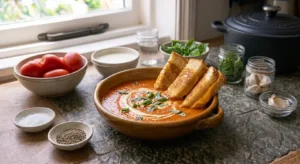
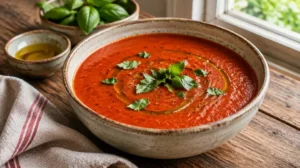
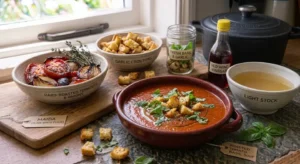
Pappa al pomodoro: stale unsalted bread collapsed into tomato and oil.
At a glance.
Tomato and Bread Soup comes from Italy · Tuscany and appears in The Soup Atlas, in the chapter Classic & Everyday Soups. It serves 4, takes about 1 hr, and uses 14 ingredients and 11 steps.
- Yield
- Serves 4
- Method
- Stovetop
- Time
- 1 hr
Ingredients
Tap an ingredient to tick it off.
- For the dried bread
- For the hand-crushed tomato base
- For the pot
- To finish
Method
-
Check the bread. It has to be genuinely dry and hard, so that it drinks liquid and swells rather than dissolving. If yours is only a day old, tear it into 4 cm pieces and dry it in a 150°C (300°F) oven for 20 minutes, until it rattles in the tray.
-
If you are using fresh tomatoes, score a cross in the base of each, drop them into boiling water for 30 seconds and into iced water, then slip the skins off. Crush the flesh in your hands over a bowl, keeping every drop of juice.
-
Warm the 120 ml of olive oil in a wide pot over low heat with the sliced garlic and chili flakes. This is a lot of oil and it is not a mistake — with no cream, no stock reduction and no meat anywhere in the dish, the oil is the entire fat of it.
-
Cook the garlic for 3–4 minutes until it turns pale gold and smells sweet. Take it no further. Browned garlic in this much oil turns acrid, and there is nothing in the rest of the pot loud enough to hide it.
-
Add the crushed tomatoes and their juice, the basil stalks and the teaspoon of salt, and simmer for 20 minutes, stirring occasionally, until the tomato has darkened and thickened and the oil has begun to separate out at the edges in orange pools.
-
Pull out the basil stalks. Pour in the hot stock, bring it back to a simmer, then tear in the dried bread piece by piece and push it under the surface with a spoon so every piece is wetted.
-
Take the pot off the heat, cover it, and leave it alone for 20 minutes. Nothing more is cooking now — the bread is only absorbing, and this is the step nobody has patience for and everybody needs.
-
Return it to low heat and beat it hard with a wooden spoon for a minute or two. The pieces break down and the whole thing turns into a thick, rough porridge; it is ready when the spoon leaves a track that closes slowly rather than instantly.
-
Judge the texture now. It should be thick enough that a spoon stands almost upright and stiff enough to hold a shape on the plate. If it is loose, keep beating over low heat; if it has gone past into stodge, let it down with a splash of hot stock.
-
Season with the remaining salt and the black pepper. Remember that the bread brought none — unsalted bread means this pot needs distinctly more salt than the same soup made with a salted loaf would.
-
Let it cool to warm rather than hot, which is how it is eaten and how the olive oil reads properly. Serve in shallow bowls, pour over far more raw oil than seems sensible, and scatter the torn basil.
Cook’s notes
- The technique
- The bread is not a garnish and it is not a thickener in the ordinary sense — it is the body of the dish, and the whole recipe is a lesson in how staling works. As bread ages its starch retrogrades: the gelatinized starch chains recrystallize and squeeze out water, which is why the loaf goes hard rather than merely dry. Those recrystallized granules can take liquid back up and swell without dissolving, which is exactly what you want. Fresh bread, whose starch is still hydrated and whose gluten is still elastic, has nothing to absorb with and turns to paste in seconds. Two days old is the minimum. Three is better.
- Make ahead
- Pappa al pomodoro keeps two days refrigerated and thickens into something close to a solid, which Tuscans consider a feature — reheat it slowly with a splash of water and beat it loose again. It does not freeze; the bread turns to grit on thawing. The tomato base alone freezes for three months, and the dried bread keeps in a paper bag for a week, which effectively makes this a twenty-minute soup.
- Troubleshooting
- Watery and thin — it is not finished; keep beating over low heat, or the bread was too fresh to absorb. Gluey and pasty — fresh bread was used and dissolved rather than swelling. Harsh and bitter — the garlic browned in the oil. Tastes flat — under-salted, which is almost always the case with a soup built on unsalted bread; add salt in stages and taste again warm, not hot.
- Variations
- Ribollita is the winter relative — the same principle applied to cannellini beans, cavolo nero and yesterday's minestrone, layered with bread and reboiled, which is what its name means. Panzanella takes the same stale loaf in the other direction, raw and cold with tomato and onion. Some Sienese versions add a beaten egg at the end for richness, which is a legitimate old practice and produces a denser bowl.
- To serve and keep
- Serve warm, never scalding, in shallow bowls, with a bottle of your best oil on the table so people can pour their own. Nothing else is needed and nothing else is traditional. Drink a young Chianti, served cool, or a glass of Vernaccia di San Gimignano. Made in full within this recipe — Oven-Dried Bread, Hand-Crushed Tomato Base. Also listed in the Component Index at the back.

Where it comes from
Tuscan bread is made without salt, and Tuscans call it pane sciocco — insipid bread, the same word they use for a dull person. The favorite explanation, that Pisa blockaded salt shipments to Florence in the twelfth century and Florentine bakers adapted, is repeated everywhere and rests on no contemporary evidence; the sober version involves the gabella del sale, the salt tax levied by successive governments and the Papal States, which made salt expensive enough to leave out of a daily loaf. Either way the effect is the same. Unsalted bread stales quickly, because salt holds moisture, and a region with a fast-staling loaf and a horror of waste will build dishes around the third day of it. Pappa al pomodoro is one of them, alongside ribollita and panzanella. It carried beyond Tuscany largely through popular culture: Vamba's children's novel Il giornalino di Gian Burrasca and, decisively, the 1964 television adaptation in which Rita Pavone sang Viva la pappa col pomodoro, after which every Italian child knew the name of a dish invented for people with nothing.
Tomato and Bread Soup: quick answers
How long does Tomato and Bread Soup take?
About 1 hr.
How many does this Tomato and Bread Soup recipe make?
This recipe serves 4.
Where does Tomato and Bread Soup come from?
Tuscan bread is made without salt, and Tuscans call it pane sciocco — insipid bread, the same word they use for a dull person. The favorite explanation, that Pisa blockaded salt shipments to Florence in the twelfth century and Florentine bakers adapted, is repeated everywhere and rests on no contemporary evidence; the sober version involves the gabella del sale, the salt tax levied by successive governments and the Papal States, which made salt expensive enough to leave out of a daily loaf. Either way the effect is the same. Unsalted bread stales quickly, because salt holds moisture, and a region with a fast-staling loaf and a horror of waste will build dishes around the third day of it. Pappa al pomodoro is one of them, alongside ribollita and panzanella. It carried beyond Tuscany largely through popular culture: Vamba's children's novel Il giornalino di Gian Burrasca and, decisively, the 1964 television adaptation in which Rita Pavone sang Viva la pappa col pomodoro, after which every Italian child knew the name of a dish invented for people with nothing.
More from Italy


More in Classic & Everyday Soups
https://www.atlasserie.com/recipes/soup/tomato-and-bread-soup/