United States · The Day After · 39.87° N, 98.73° W
Turkey Noodle Soup
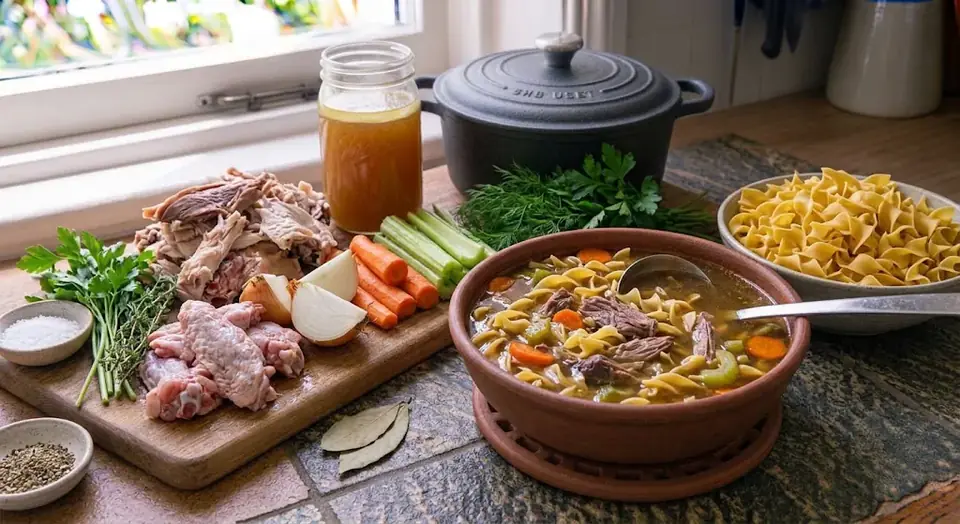
The stripped Thanksgiving carcass, simmered dark and rebuilt with noodles.
At a glance.
Turkey Noodle Soup comes from United States · The Day After and appears in The Soup Atlas, in the chapter Classic & Everyday Soups. It serves 6, takes about 4 hours, and uses 19 ingredients and 11 steps.
- Yield
- Serves 6
- Method
- Slow simmer
- Time
- 4 hours
Ingredients
Tap an ingredient to tick it off.
- For the roast turkey stock
- For the soup
- For the noodles
- To finish
Method
-
Break the carcass down with kitchen shears or your hands so it lies flat in the pot and the maximum bone surface meets the water. Include the wing tips, the back and any skin and jelly left in the roasting tin.
-
Add the raw wings or necks. A roasted frame has already surrendered some of its collagen and soluble protein to the oven and the tin, so a little raw poultry restores the gelatin and gives the stock the body it would otherwise lack.
-
Cover with the cold water and add the onions, carrot, celery, bay, thyme, parsley stalks and peppercorns. Cold water and a slow climb pull flavor out of bone gradually; starting hot seizes the surface proteins and locks some of it in.
-
Bring it to a bare simmer over 30 minutes and skim the foam that rises in the first twenty. After that, hold it with one bubble breaking every second or two and leave it for 3 hours, uncovered. Never let it boil.
-
Strain the stock through a fine sieve and discard the solids. Chill it if you have time — the fat sets into a solid disc that lifts off whole, and there is no simpler way to degrease a stock. Reserve two tablespoons of that fat.
-
You should have about 2 liters. If it tastes weak, boil it down hard, uncovered, until it does not; a roasted carcass stock can take reduction that a delicate chicken stock cannot, because the flavors in it are already big.
-
Melt the reserved turkey fat in a clean pot and cook the diced onion for 6 minutes over medium heat, until soft and edged with gold. This small amount of browning suits a roast-bone stock in a way it would not suit a pale one.
-
Add the strained stock and the carrot coins, simmer for 8 minutes, then add the celery and give it 5 more. Both should keep a slight resistance in the middle, because they will go on softening in the bowl.
-
Cook the noodles in a separate pan of well-salted water, drain them and rinse briefly under cold water to stop them cooking. They go into the bowls, never the pot — left in the broth they swell overnight and drink most of it.
-
Add the torn turkey meat and heat it through for 2 minutes only. It is already fully cooked, and dark meat holds up far better here than breast, which turns dry and cottony on a second heating.
-
Season with salt in stages, add the pepper and the lemon juice, and stir through the dill and parsley off the heat. Divide the noodles between warm bowls and ladle the soup over the top.
Cook’s notes
- The technique
- Roasting changes a stock more than any other single decision. An unroasted carcass gives a pale, clean, faintly sweet broth; a roasted one gives a stock that is amber to brown, meaty and slightly bitter at the edges, because Maillard browning has already generated melanoidins and hundreds of aromatic compounds in the oven that no amount of simmering will produce. The trade-off is body. Roasting denatures and dries surface collagen and leaves a good deal of it stuck to the tin, so a stock from a stripped roast frame alone tends to be thin. Adding raw wings is the fix, and it is why the best day-after stock is not made from leftovers exclusively.
- Make ahead
- Freeze the carcass whole if the day defeats you; it keeps six months and makes stock whenever you want it. The finished stock holds four days refrigerated and six months frozen. Cool it fast — decant into shallow containers rather than leaving a deep pot on the counter, since a large volume of stock stays in the bacterial danger zone for hours. Reheat until it steams throughout, and keep noodles and meat separate.
- Troubleshooting
- Thin and watery on the tongue — no raw bones went in; reduce hard, or dissolve a teaspoon of gelatin into the finished stock. Cloudy and greasy — the pot boiled and emulsified the fat. Bitter — the carcass was heavily charred, or vegetables scorched in the pot. Meat dry and stringy — breast was used and reheated too long; go for thigh and leg.
- Variations
- A southwestern turn adds a chopped chipotle, hominy and lime in place of the noodles. A Pennsylvania Dutch version drops rolled squares of noodle dough straight into the broth and accepts the cloudiness. Adding 100 g of wild rice with the stock and giving it 40 minutes makes the upper-midwestern version, which is arguably the better use of a turkey than the roast was.
- To serve and keep
- Serve in deep bowls with the noodles at the bottom, cracked pepper over the top, and leftover dinner rolls warmed in the oven. Cranberry sauce on the side is not traditional and is very good. Drink cold beer, or the tail of whatever was opened the day before. Made in full within this recipe — Roast Turkey Stock. Also listed in the Component Index at the back.

Where it comes from
The turkey is an American bird twice over — domesticated first in Mesoamerica and again, separately, by the Ancestral Puebloans of the Southwest — and it became the fixed center of Thanksgiving largely through the campaigning of Sarah Josepha Hale, the magazine editor who lobbied five presidents before Abraham Lincoln proclaimed a national day of thanksgiving in 1863. What followed the roast was never written down anywhere because it needed no instruction. A household that has spent money on a large bird does not throw away the frame, and the soup made from it on the Friday is one of the few genuinely universal American food traditions, cutting across region, income and religion. The stripped carcass is in real terms worth more than the leftover meat: the bones, joints and cartilage carry the collagen that becomes gelatin, and the roasting has already done half the flavor work. Whether it goes into the pot that evening or into the freezer for February is the only decision the tradition leaves open.
Turkey Noodle Soup: quick answers
How long does Turkey Noodle Soup take?
About 4 hours.
How many does this Turkey Noodle Soup recipe make?
This recipe serves 6.
Where does Turkey Noodle Soup come from?
The turkey is an American bird twice over — domesticated first in Mesoamerica and again, separately, by the Ancestral Puebloans of the Southwest — and it became the fixed center of Thanksgiving largely through the campaigning of Sarah Josepha Hale, the magazine editor who lobbied five presidents before Abraham Lincoln proclaimed a national day of thanksgiving in 1863. What followed the roast was never written down anywhere because it needed no instruction. A household that has spent money on a large bird does not throw away the frame, and the soup made from it on the Friday is one of the few genuinely universal American food traditions, cutting across region, income and religion. The stripped carcass is in real terms worth more than the leftover meat: the bones, joints and cartilage carry the collagen that becomes gelatin, and the roasting has already done half the flavor work. Whether it goes into the pot that evening or into the freezer for February is the only decision the tradition leaves open.
More from United States



More in Classic & Everyday Soups
https://www.atlasserie.com/recipes/soup/turkey-noodle-soup/