The Soup Atlas
Green Herb Soup
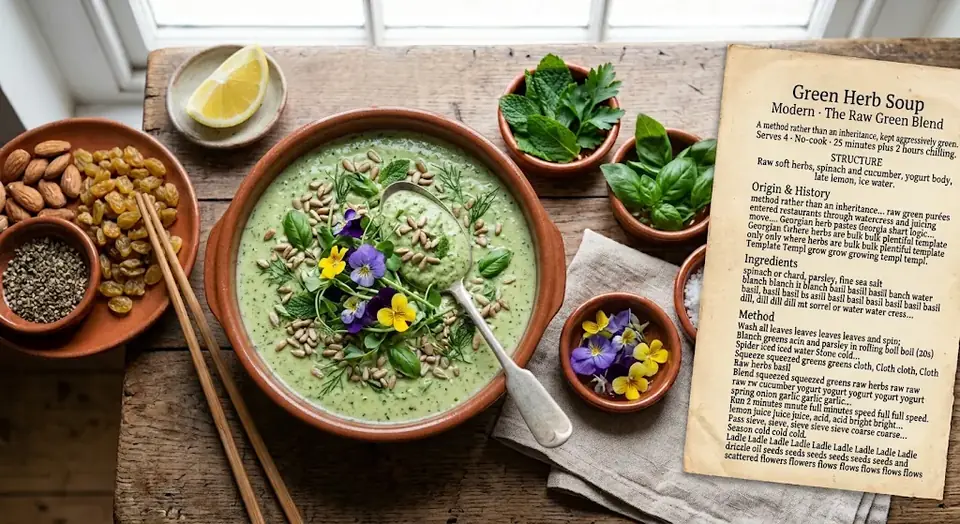
Soft herbs and leaves blended raw and cold, kept aggressively green.
At a glance.
Green Herb Soup is a recipe from The Soup Atlas, in the chapter Chilled & Light Soups. It serves 4, takes about 2 hr 25 min, and uses 19 ingredients and 10 steps.
- Yield
- Serves 4
- Method
- No-cook
- Time
- 2 hr 25 min
Ingredients
Tap an ingredient to tick it off.
- For the blanched greens
- For the raw blend
- To finish
Method
-
Wash all the leaves and herbs in several changes of cold water and spin them dry. Every element of this soup goes into the bowl either raw or barely cooked, so washing is the only cleaning step it receives, and grit in a smooth green soup is impossible to disguise.
-
Bring the 2 liters of water to a rolling boil with the 20 g of salt and set a large bowl of iced water beside the stove. Salt the blanching water heavily; it seasons the leaves in the seconds they are in it and helps hold their color.
-
Drop in the spinach and parsley and count 20 seconds, no more. Lift them straight into the iced water with a spider and swirl them until they are stone cold. Blanching softens the fibres and drives out the air trapped in the leaves, which is what makes the color read as vivid rather than dull.
-
Squeeze the blanched greens between your palms until no more water comes out, then squeeze again in a clean cloth. A handful that looks dry still holds two or three tablespoons of water, and every one of them thins the soup and dilutes its flavor.
-
Leave the basil, dill, mint and sorrel raw. Their aromatics are volatile and heat-sensitive, and boiling them even briefly costs you the top notes that make the soup taste like a garden rather than like green vegetables.
-
Blend the squeezed greens with all the raw herbs, the cucumber, yogurt, spring onion, garlic, oil, salt and 300 ml of the ice water. Run the machine for 2 minutes at full speed — herb stems and leaf veins need real time to break down into something the tongue reads as smooth.
-
Add ice water rather than tap water, and add it generously. A blender at full speed puts a surprising amount of energy into what it is blending, and a long run can lift a soup by several degrees, which is enough to start dulling the color.
-
Hold the lemon juice back until the last possible moment. Acid is what turns bright green to olive: hydrogen ions displace the magnesium atom at the centre of each chlorophyll molecule, converting it to pheophytin, and the change is visible within twenty minutes of the juice going in.
-
Pass the soup through a medium sieve if you want it entirely smooth, or leave it as it is for a coarser bowl. Chill for 2 hours, covered, with cling film pressed onto the surface to keep air off it.
-
Season it cold — another teaspoon of salt is usual — then stir in the lemon juice and serve within the half-hour. Ladle into chilled bowls, drizzle with oil, and scatter the seeds and any herb flowers over the top.
Cook’s notes
- The technique
- Green is a race against three things: heat, acid and time. Chlorophyll holds a magnesium ion at its core, and heat or acid knocks that ion out, converting the molecule to pheophytin, which is the olive-brown of overcooked broccoli. So this soup keeps everything cold, blanches only what needs softening, for twenty seconds, and adds the lemon at the table rather than in the jug. Alkali holds the color brilliantly — a pinch of baking soda is the old trick — but it also dissolves the cell walls and destroys vitamin C, leaving a slippery, flat soup. Avoid it.
- Make ahead
- This is a same-day soup, and preferably a same-hour one. Blanched and squeezed greens keep two days refrigerated in a sealed box, so the slow part can be done ahead. The blended base holds four hours before the color starts to slide, and the lemon goes in at the very end. It does not freeze; the yogurt splits and the herbs turn black.
- Troubleshooting
- Olive-brown within the hour — the lemon went in too early, or the blender ran hot. Stringy and fibrous — parsley stalks and old herb stems; blend longer or sieve. Thin and grassy — the blanched greens were not squeezed. Bitter — too much sorrel or over-blanched watercress. Separated in the bowl — the yogurt was low-fat, so use full-fat.
- Variations
- Sorrel-led versions veer sharp and want no lemon at all, since the leaf carries its own oxalic acid. A dairy-free version uses avocado or soaked cashews in place of yogurt. Adding 200 g of chilled cooked peas gives it body and sweetness. Frankfurter grüne Soße's classic seven herbs — borage, chervil, cress, parsley, burnet, sorrel and chives — make an excellent blend here.
- To serve and keep
- Serve very cold in shallow bowls, with a poached egg, a spoonful of ricotta or a piece of grilled bread rubbed with garlic. It works equally well poured into small glasses before a meal. Drink a cold Grüner Veltliner or a herbal iced tea. Made in full within this recipe — Blanched Green Base, Raw Herb Blend, Seed and Oil Finish. Also listed in the Component Index at the back.
Where it comes from
This soup is a method rather than an inheritance, and it is more honest to present it that way than to give it a false birthplace. Cold green purées entered restaurant cooking through two doors. One was French: potage cressonnière and its relatives, watercress and sorrel soups that had been served chilled in summer since the nineteenth century. The other was the raw-food and juicing movement of the 1970s onward, which brought high-powered blenders into domestic kitchens and made a genuinely raw soup possible for the first time. Green sauces are far older and far more widespread — Italian salsa verde, German Frankfurter grüne Soße with its seven herbs, Mexican salsa verde, Georgian herb pastes — and they share this dish's underlying logic, which is that soft herbs should not be cooked. What is new is the scale: using herbs by the bunch as a bulk ingredient rather than a seasoning only makes sense where herbs are cheap and plentiful. Treat the recipe as a template and build it from whatever is growing fastest.
Green Herb Soup: quick answers
How long does Green Herb Soup take?
About 2 hr 25 min.
How many does this Green Herb Soup recipe make?
This recipe serves 4.
Where does Green Herb Soup come from?
This soup is a method rather than an inheritance, and it is more honest to present it that way than to give it a false birthplace. Cold green purées entered restaurant cooking through two doors. One was French: potage cressonnière and its relatives, watercress and sorrel soups that had been served chilled in summer since the nineteenth century. The other was the raw-food and juicing movement of the 1970s onward, which brought high-powered blenders into domestic kitchens and made a genuinely raw soup possible for the first time. Green sauces are far older and far more widespread — Italian salsa verde, German Frankfurter grüne Soße with its seven herbs, Mexican salsa verde, Georgian herb pastes — and they share this dish's underlying logic, which is that soft herbs should not be cooked. What is new is the scale: using herbs by the bunch as a bulk ingredient rather than a seasoning only makes sense where herbs are cheap and plentiful. Treat the recipe as a template and build it from whatever is growing fastest.
More in Chilled & Light Soups
https://www.atlasserie.com/recipes/soup/green-herb-soup/